
Food Truck Franchise vs. Starting from Scratch in NZ (2026): A Complete Cost & Compliance Guide
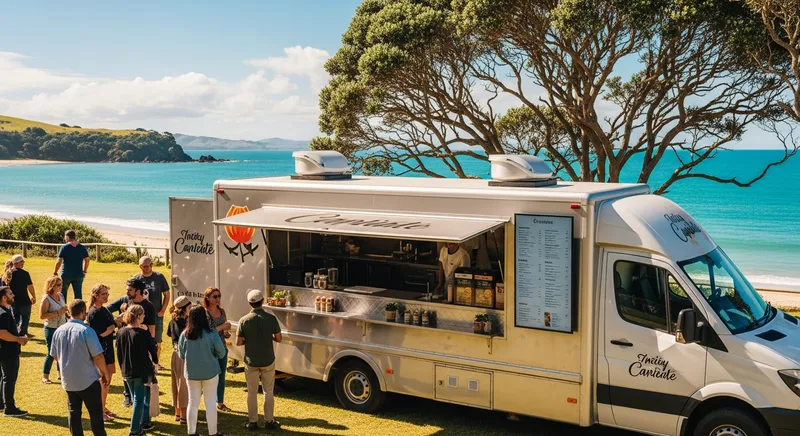
Launching Your NZ Food Truck Dream: The Definitive Guide
You're captivated by the dream of running your own food truck in New Zealand. The freedom of the open road, the joy of sharing your culinary creations, the appeal of being your own boss. But as you lie awake at 2am with a spreadsheet open, the dream can feel buried under a wave of confusion. The internet offers fragmented advice, outdated articles, and intimidating legal jargon.
This leaves you stuck at the first major hurdle, facing the question that paralyzes so many aspiring entrepreneurs: Should I buy into a 'safe' food truck franchise, or risk it all to build my own unique brand from scratch?
This guide is designed to be the single source of truth you've been searching for. We'll walk you through every step, from making that foundational decision to navigating the complex web of costs and compliance in New Zealand for 2026. Consider this your clear, integrated roadmap to turning that food truck dream into a profitable reality.
The Core Decision: Franchise vs. Starting from Scratch
This is the most important decision you'll make, as it dictates your entire business journey. Neither path is inherently better, but one will be better for you. Let's break down the pros and cons.
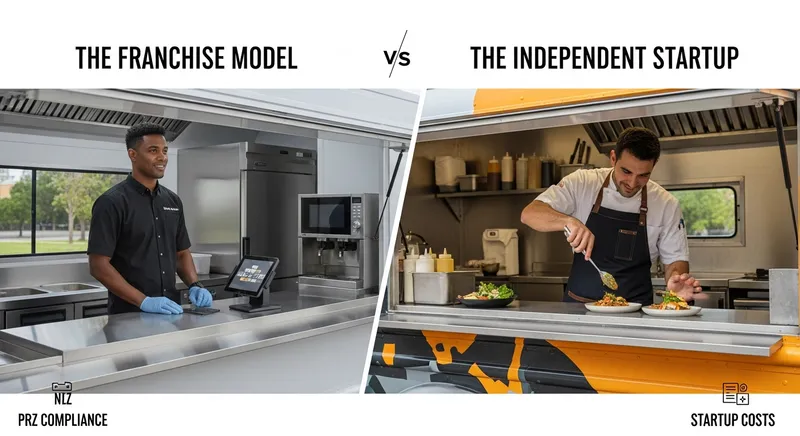
The Case for a Food Truck Franchise
Buying into a franchise means you're purchasing a business-in-a-box. You get a proven system, brand recognition, and ongoing support. New Zealand is, per capita, the most franchised nation in the world, with the sector contributing over $47 billion to the economy, according to research cited by the Franchise Association of New Zealand.
Pros:
- Proven Business Model: You're investing in a concept that already works, reducing the risk of market failure.
- Brand Recognition: Customers may already know and trust the brand, giving you an instant customer base.
- Comprehensive Training & Support: Franchisors provide extensive training on operations, marketing, and accounting.
- Easier Access to Financing: Banks are often more willing to lend to a franchisee with a proven track record than a brand-new independent startup.
- Group Buying Power: Benefit from negotiated prices on supplies, ingredients, and equipment.
Cons:
- High Initial & Ongoing Fees: Expect a significant franchise fee upfront, plus ongoing royalties (a percentage of your revenue) and marketing levies.
- Limited Creative Freedom: The menu, branding, truck design, and operational procedures are all dictated by the franchisor.
- Shared Reputation: Your business's success is tied to the reputation of the entire franchise. One poorly run location can damage the brand for everyone.
- Contractual Restrictions: You'll face strict rules on where you can operate and how you can sell the business.
The Case for Starting from Scratch
This is the path for the true visionary-the entrepreneur who has a unique concept and wants to build an empire on their own terms.
Pros:
- Total Creative Control: Your menu, your brand, your truck design-every decision is yours. You can adapt quickly to trends.
- Higher Profit Potential: You keep 100% of the profits. There are no royalty fees to pay out.
- Build Your Own Asset: You are creating a unique brand that has its own value, which you can grow and one day sell.
- Flexibility and Agility: Want to test a new dish or pivot your concept? You can do it overnight without needing approval.
Cons:
- Higher Risk: There's no safety net. You are responsible for every aspect of the business, from concept to execution.
- Steep Learning Curve: You must become an expert in everything: cooking, marketing, accounting, legal compliance, and logistics.
- Brand Building is Hard: It takes significant time, effort, and marketing spend to build brand awareness and trust from zero.
- Financing Can Be More Difficult: You will need a highly detailed and convincing business plan to secure loans.
The Verdict: A Quick Quiz to Help You Decide
- Do you value a proven system over creative freedom? (Yes = Franchise, No = Scratch)
- Are you more of an operator (executing a plan) than a visionary (creating the plan)? (Yes = Franchise, No = Scratch)
- Is your primary goal to minimize risk, even if it means lower potential returns? (Yes = Franchise, No = Scratch)
- Do you have a truly unique food concept that doesn't fit an existing franchise model? (Yes = Scratch, No = Franchise)
Understanding the Full Cost: A Realistic NZ Budget for 2026
Costs can vary dramatically, but here is a detailed breakdown of what to expect. While some reports suggest the NZ hospitality industry is growing, with Restaurant Association of New Zealand data showing sales of $15.99 billion, it's an industry facing significant cost pressures.
Startup Costs: What You'll Spend Before You Sell
- The Vehicle & Fit-Out (The Biggest Expense): $40,000 - $250,000+
- Second-hand, basic fit-out: $40,000 - $80,000
- New trailer with a professional fit-out: $85,000 - $150,000
- New, fully-equipped truck: $150,000 - $250,000+
- Critical Note: Any heavily modified vehicle must be certified under the Low-volume Vehicle (LVV) Code to be road-legal, as outlined by Waka Kotahi (NZTA). This is separate from your food safety compliance.
- Initial Stock and Packaging: $3,000 - $7,000
- Licensing, Registration & Certification Fees: $1,500 - $4,000
- This includes council registration, FCP verification, gas/electrical certificates, and vehicle registration.
- Point-of-Sale (POS) System: $500 - $2,500
- A modern, tablet-based system is ideal for food trucks. You can even use your own tablet or iPad as a POS system to save on initial hardware costs.
- Branding & Marketing (Website, Signage): $2,000 - $10,000
- Contingency Fund (Working Capital): $10,000 - $20,000 - DO NOT skip this.
Ongoing Operational Costs
- Cost of Goods Sold (COGS): Typically 25-35% of revenue. Master this by using a POS with strong inventory management, like Lazygrid's ingredient-level tracking, to monitor costs and minimize waste. For a deep dive, see our guide on calculating prime cost and surviving the squeeze.
- Staff Wages: The food services sector is a major employer, with Stats NZ Tatauranga Aotearoa noting an 8.9% annual increase in filled jobs in 2023.
- Fuel, Insurance, and Vehicle Maintenance: Budget 5-10% of revenue.
- Consumables & Supplies: Gas bottles, cleaning supplies, etc.
- Event Fees & Site Rentals: Can range from $100 to over $1,000 per day for major events.
- Payment Processing Fees: Usually 1-2.5% of credit/debit card sales.
The A-to-Z Compliance Guide: Getting Legal in NZ
Navigating bureaucracy is daunting. Here is your step-by-step checklist. The official Business.govt.nz portal provides a fantastic 5-step guide for getting the basics right.
Step 1: Your Business Structure
Before anything else, decide if you'll be a sole trader or a company. A company offers limited liability, protecting your personal assets, but has more reporting requirements. Consult an accountant for advice specific to your situation.
Step 2: The Food Control Plan (FCP)
This is non-negotiable. An FCP is your written plan for keeping food safe. The Ministry for Primary Industries (MPI) is the ultimate authority here.
- How to get it: Download the MPI template, customize it for your specific food truck operations, and get it checked by an approved verifier. You then register your FCP with your local council.
Step 3: Vehicle Compliance
Your truck needs to be safe, not just your food.
- Warrant of Fitness (WOF): Standard for any vehicle.
- Electrical Warrant of Fitness (EWOF): Mandatory if you have a 230/240-volt electrical system. As the Auckland Council website specifies, this is a key requirement.
- Gas Safety Certificate: Mandatory if you use LPG appliances. Both electrical and gas systems fall under the safety regulations managed by WorkSafe New Zealand.
Step 4: Local Council Permits (Mobile Trading Licence)
Once your food and vehicle are certified, you need permission to trade. This involves getting a mobile trading licence from your 'home' council (the one where you are based). This licence allows you to trade within that council's district at approved locations.
A Tale of Four Cities: Comparing Council Rules
While the Food Act is national, local bylaws for mobile trading vary. This is a common point of confusion.
- Auckland: Has specific zones and requires you to apply for a licence for a designated site or as a roaming trader.
- Wellington: Has designated food truck areas and a clear process. The Wellington City Council helpfully clarifies that once you are registered with any home council, you can operate anywhere in NZ, provided you have landowner permission (e.g., for a private event or market) and comply with local district plans.
- Christchurch & Queenstown: Have their own sets of rules for popular public spaces.
Actionable Tip: The golden rule is to always check the specific mobile trading page on the local council's website before you plan to trade there. A quick search can save you a hefty fine.
The Tech Stack That Drives Success
Once you've navigated the costs and compliance, the right technology becomes your competitive advantage. In the tight confines of a food truck, efficiency is profit. The right tech isn't a luxury; it's a core tool that slashes costs and boosts sales.
Your Point-of-Sale (POS) System
Your food truck POS needs to be fast, mobile, and reliable, especially when the internet isn't. Modern systems, like Lazygrid, run on an iPad or iPhone, giving you a powerful till in a tiny footprint. Look for a crucial 'offline mode' feature, which ensures you can keep taking orders and payments at a remote festival even if the cell signal drops.
Busting Queues with Smart Ordering
A long queue is a good problem, but it can also deter potential customers. Two tools can help:
- Online Ordering: A system that lets customers order and pay ahead on your own branded website means they just show up to collect. This gives you commission-free revenue, unlike most third-party apps.
- Self-Service Kiosks: A customer-facing tablet can act as a second cashier, taking orders and payments while your staff focus on food. This is a key strategy to slash wage costs without cutting staff.
Understanding Your Performance with Analytics
How do you know which menu item is most profitable? Or what your busiest hour is? Don't guess. A POS with powerful reporting and analytics is vital. It tells you what's selling, when it's selling, and what your true profit margins are, allowing you to make data-driven decisions instead of relying on gut feelings.
Looking Ahead: Trends for 2026 and Beyond
To stay competitive, keep an eye on emerging trends. Customer demand for sustainability is growing, leading to a rise in carbon-neutral and compostable packaging. Furthermore, the first wave of electric vehicle (EV) food trucks is appearing, offering lower running costs and a powerful green marketing angle. Factoring these trends into your long-term plan can give you a significant edge.
Frequently Asked Questions
How much does a full food truck fit-out cost in NZ?
A full fit-out is the largest variable cost. A budget of $40,000 to $150,000+ is realistic for the fit-out alone, not including the truck itself. A basic fit-out with second-hand equipment might be at the lower end, while a custom-built kitchen with brand-new, high-end appliances will be at the top end. Key costs include stainless steel surfaces, commercial-grade refrigeration, extraction hoods, plumbing, and all cooking equipment. Remember to budget for mandatory certifications for any gas and electrical work.
What's the difference between a Food Control Plan (FCP) and a National Programme?
This distinction from the Ministry for Primary Industries (MPI) relates to the risk level of the food you handle.
- Food Control Plan (FCP): For higher-risk food businesses. If you are preparing and cooking meals with raw meat, making fresh salads, or creating complex dishes, you will almost certainly need an FCP. This is a detailed, customized plan for managing food safety.
- National Programme (NP): For lower-risk businesses. This applies if you only sell pre-packaged food, heat pre-cooked food, or serve simple beverages like coffee. The rules are less intensive. The vast majority of food trucks fall under the FCP category.
Can I operate a food truck from my home kitchen in NZ?
Generally, no. Food sold to the public must be prepared in a registered commercial kitchen that has been verified to meet the standards of your Food Control Plan. A domestic home kitchen is very unlikely to meet these requirements. The solution for many startups is to rent time in a registered commissary kitchen for food prep before loading the truck for service.
What are the most popular food truck concepts in NZ right now?
While trends change, several concepts consistently perform well in New Zealand. These include:
- Gourmet Burgers & Loaded Fries
- Authentic Tacos & Mexican Street Food
- Wood-Fired Pizza
- Asian Fusion (Bao, Dumplings, Noodles)
- Plant-Based & Vegan Cuisine
- Specialty Coffee & Pastries The key to success is not just the concept, but a narrow focus on doing a few things exceptionally well.
What insurance is mandatory for a food truck in NZ?
While only a few types are legally mandatory, a comprehensive insurance package is essential for survival.
- Mandatory: Commercial Vehicle Insurance (to be legally on the road) and ACC cover (if you have employees).
- Essentially Mandatory: Public Liability Insurance. No event organizer or council will let you trade without it. It covers you if your operations cause injury to a member of the public or damage to property.
- Highly Recommended: Product Liability (covers food-related illness), Asset Insurance (protects your truck and fit-out), and Business Interruption Insurance (covers lost income during repairs).
Ready to Take the Next Step?
Whether you choose the franchise route or build from scratch, having the right systems in place is the foundation of success. A smart, efficient technology stack frees you from administrative headaches and lets you focus on what you love: creating amazing food.
If you're ready to see how the right technology can help your food truck succeed, explore how Lazygrid's all-in-one POS, online ordering, and kiosk system is built for mobile operators in New Zealand.