
Menu Engineering Masterclass: 15 Psychological Tactics to Increase AOV by 30%
As a business owner, you're constantly battling rising food and labour costs. Squeezing more profit from your existing operation isn't just a goal; it's a necessity. But what if your most powerful tool for increasing revenue wasn't a new marketing campaign, but the very menu your customers already use?
Welcome to menu engineering. It's not a dark art, but a data-driven science for understanding and influencing customer behaviour. Forget generic advice. This masterclass will give you 15 actionable psychological tactics you can implement today using a modern digital POS system. We'll move beyond theory to show you how to leverage specific features to increase your Average Order Value (AOV), boost profitability, and turn your menu into your most effective salesperson.
What is Digital Menu Engineering? (And Why It's Your New Secret Weapon)
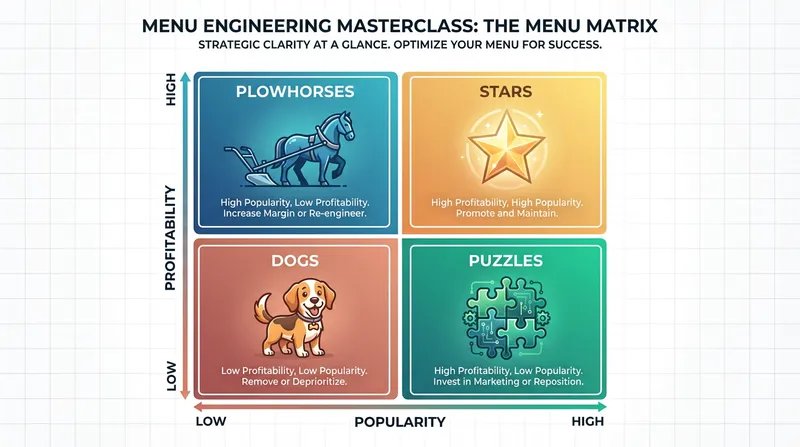
At its core, menu engineering is the practice of strategically designing a menu to guide customers toward more profitable choices. The classic foundation for this is the Menu Matrix, which categorises every item based on its popularity and profitability:
- Stars: High popularity, high profitability. (Promote these!)
- Plowhorses: High popularity, low profitability. (Can you increase the price or reduce the cost?)
- Puzzles: Low popularity, high profitability. (How can you sell more of these?)
- Dogs: Low popularity, low profitability. (Consider removing them.)
In the past, this analysis was a difficult, once-a-year task. The game-changer in the digital age is your ability to use real-time data from your POS system, self-service kiosk, and online ordering platform to make decisions instantly. Instead of relying on guesswork, you can A/B test menu items, roll out instant updates, and use dynamic visuals to capture attention. As the National Restaurant Association notes, technology is crucial for restaurants to adapt and thrive. A modern system with the right POS features is no longer a luxury, but a necessity.
Foundational Pricing Tactics: Anchoring Value and Reducing Friction
How you present your prices can be even more important than the prices themselves. Before we get into layout and descriptions, you must master the psychology of pricing. These core strategies reframe how customers perceive cost and value, making them feel more comfortable spending more. If you're wondering how this fits into your overall budget, it's worth reviewing a guide on POS system costs in NZ to see how an advanced system is an investment, not an expense.
Tactic 1: Remove Currency Signs
Currency signs (like '$' or '£') subconsciously trigger the negative feeling associated with spending money, known as the 'pain of paying'. Simply removing them can make customers feel like they're making a decision based on preference, not cost. A landmark study from the Cornell University School of Hotel Administration found that diners presented with a menu using numerals only (e.g., '15' instead of '$15.00') spent significantly more.
Tactic 2: Master 'Decoy Pricing'
The Decoy Effect is one of the most powerful pricing strategies. It involves introducing a third option that is strategically priced to make one of your other options seem like a much better deal. As explained in this Harvard Business Review video, this tactic nudges customers towards the choice you want them to make.
Example:
- Small Coffee (Profitable): 4
- Medium Coffee (The Decoy): 5.50
- Large Coffee (Most Profitable): 6
The Medium is priced so close to the Large that the Large seems like an incredible value, effectively boosting sales of your most profitable size.
Tactic 3: Use Price Anchoring
Price anchoring involves placing a deliberately expensive item at the top of a menu section. This 'anchor' item sets a high price point in the customer's mind, making every other item below it appear more reasonable by comparison. You may not sell many of the anchor item, but it will lift the sales of the high-margin items just below it.
Example: Place a '$45 Premium Eye Fillet' at the top of your mains. Suddenly, the '$28 Slow-Cooked Lamb Shank' (your high-profit 'Star' item) looks like a bargain.
The Art of Persuasion: Sell More with Seductive Descriptions
Words have the power to make customers taste the food before they even order it. Vague, simple descriptions lead to price-based decisions. Evocative, sensory descriptions create desire and justify a higher price point. This is one of the most effective low-cost marketing ideas you can implement.
Tactic 4: Use Nostalgic Language
Connect with your customers on an emotional level. Use words that evoke a sense of comfort, care, and quality. Instead of 'Chicken Soup', try 'Grandma's Hearty Chicken & Vegetable Soup'.
Tactic 5: Highlight Provenance
Instead of 'Beef Burger', try 'Hawke's Bay Angus Beef Burger'. Highlighting local suppliers like this, or mentioning 'fresh Marlborough mussels', builds community trust and suggests superior quality. This isn't just fluff; research highlighted by Cornell University found that descriptive labels increased sales by as much as 28%.
Tactic 6: A/B Test Your Descriptions
This is where a digital POS becomes invaluable. You no longer have to guess which description works best. Run a simple A/B test:
- For two weeks, name an item 'Fish of the Day'.
- For the next two weeks, rename it 'Pan-Seared Akaroa Salmon with Lemon Dill Sauce'.
- Use your POS reporting suite to compare the sales data for both periods. The numbers will tell you exactly which description sold more.
Digital Menu Layout: Guiding the Eye to Boost Profit
On a screen, you have seconds to capture attention. Unlike a paper menu, you can use motion, high-resolution imagery, and strategic placement to direct your customer's gaze exactly where you want it. This is crucial for both digital menu boards and optimizing your QR code menu.
Tactic 7: Guide the Eye to Prime Real Estate
On a digital screen, a customer's eyes typically go to the middle first. This is your prime real estate. Place your 'Star' items here, not tucked away in a corner.
Tactic 8: Use High-Quality Photos
A picture is worth a thousand words, and on a digital menu, a stunning photo of your signature dish can make it irresistible. Use vibrant, high-quality images for your most profitable items.
Tactic 9: Limit Choice
The 'paradox of choice' is real. Too many options lead to anxiety and indecision. According to research highlighted by menu psychology experts, the sweet spot is around six items for fast-food menus and seven to ten per category for full-service restaurants.
Tactic 10: Use Visual Cues
Your menu design software should allow you to easily draw attention to specific items. A simple box, a 'Bestseller!' tag, or a different background colour can make an item pop. Use this technique to highlight your 'Puzzles'—the high-profit items that need a sales boost. As noted by Restaurant Business, this data-driven approach is key to optimization.
The Automated Upsell Engine: Boosting AOV with Kiosks & Online Ordering
This is the most direct and powerful way to increase your AOV. While you can train staff to upsell, they can be busy, forget, or feel awkward. A Self-Service Kiosk or Online Ordering platform never forgets. It prompts every single customer, every single time. Research shows that customers often feel more comfortable and spend more when using self-service technologies.
Configure your digital ordering system to automatically make suggestions at the perfect moment:
Tactic 11: Automated Upselling
When a customer adds a regular coffee, prompt them: "Go large for just $1 more?"
Tactic 12: Automated Cross-selling
When a customer orders a burger, suggest: "Add a side of our famous curly fries?"
Tactic 13: Automated Bundling
When a customer adds a sandwich and a drink, offer: "Make it a combo with chips and save $2."
Tactic 14: Last-Minute Add-ons
On the final checkout screen, ask: "Forgot dessert? Add a chocolate brownie to your order!"
Field studies, like one from the University of Nevada, Las Vegas (UNLV), confirm the significant impact of kiosks on sales. By moving to a branded online ordering platform, you not only implement these tactics but also keep 100% of the profit.
Closing the Loop: Continuous Optimization
Tactic 15: Use POS Data to Continuously Optimize
Menu engineering is not a one-time task. It's a continuous loop of implementing, measuring, and optimizing. This is where your POS reporting and analytics suite becomes the central hub of your strategy.
Use your dashboard to track AOV, item sales velocity, and profit margins week by week. Did your new descriptive language for the chicken dish (a 'Puzzle') increase its sales? Did adding a 'Bestseller' tag to your steak ('Star') boost its popularity even further? The data will give you definitive answers. This data-driven feedback loop, which can even be linked to your KDS analytics, allows you to refine your menu scientifically, ensuring long-term profitability.
Conclusion: Turn Your Menu into Your #1 Salesperson
Your menu is more than just a list of items and prices; it's a powerful psychological tool. By combining the pillars of modern menu engineering—pricing psychology, descriptive language, strategic digital layout, and automated upselling—you can systematically increase your average order value and transform your profitability.
The engine that powers this entire process is a modern, data-driven POS system. It provides the tools to implement these tactics and, more importantly, the analytics to measure their success. By embracing these strategies, you're not just selling food; you're creating a more profitable, efficient, and successful business with a POS system designed for the unique NZ market.
Ready to transform your menu into your best salesperson? Explore Lazygrid's features to see how our digital menu tools, automated upselling, and real-time analytics make menu engineering effortless.
Still have questions about implementing these menu engineering tactics? Here are answers to the most common questions we hear from business owners.
Frequently Asked Questions
What is the fastest way to increase a restaurant's average order value (AOV)?
While all these tactics contribute, the most direct and consistent method is implementing automated upselling and cross-selling prompts on a self-service kiosk or online ordering platform. Its power lies in its consistency; it prompts every customer, every time, without fail. This automated process removes human friction and captures revenue that might otherwise be missed during a busy service.
How do I calculate a menu item's profitability?
At its simplest, you use the food cost percentage formula: (Total Cost of Ingredients / Item Sale Price) x 100. A lower percentage means higher profitability. The good news is that a modern POS system with inventory management can track ingredient costs and calculate these margins for you automatically, making menu matrix analysis much simpler and more accurate.
Does removing dollar signs from a menu actually work?
Yes, overwhelmingly so. Academic research, including famous studies from Cornell University, confirms that removing currency signs psychologically reduces the 'pain of payment.' This small but powerful shift makes customers focus more on what they want to eat rather than what it costs, frequently leading to higher overall spending and a better customer experience.
How many items should I have on my menu?
Less is often more. Referencing the 'paradox of choice' concept, studies suggest an optimal range to avoid overwhelming customers. For a fast-food restaurant or cafe, aim for around six items per category. For a full-service restaurant, seven to ten items per category is a good benchmark that helps customers decide faster and feel more confident in their choice.
Can menu psychology work for a service business like a salon or massage shop?
Absolutely. The principles are universal and can be easily adapted. For example, a salon can use 'decoy pricing' on service packages (e.g., a 'Basic Cut' vs. a 'Cut & Colour' vs. a slightly overpriced 'Cut & Treatment' decoy). 'Upselling' can be an automated prompt during online booking to add a premium product or hot stone treatment, while 'descriptive language' can be used to explain the unique benefits and sensory experience of a signature massage, justifying a higher price.