
Best EFTPOS NZ (2026): The Small Business Guide to Fees

Choosing an EFTPOS solution for your New Zealand small business can feel like navigating a minefield. You're bombarded with promises of low rates and free terminals, but you have a nagging fear of hidden fees, confusing jargon, and being locked into an expensive, multi-year contract you can't escape. This lack of transparency is the biggest headache for owners of cafes, restaurants, salons, and food trucks across the country.
This guide cuts through the noise. We will give you a clear, honest breakdown of the true costs, explain the technology in simple terms, and provide a step-by-step framework for choosing the right EFTPOS provider for your specific needs in 2026. Forget the sales pitches and opaque pricing. By the end of this article, you will have the confidence to select a payment solution that saves you money and helps your business grow.
The Real Cost of Payments: Why 'Cheap' EFTPOS is Rarely Cheap
The most common mistake business owners make is choosing a provider based on a single advertised rate. The "cheapest EFTPOS NZ" provider is rarely the one with the lowest headline fee. To understand the true cost, you need to look at the Total Cost of Ownership (TCO), which is a combination of four key elements.
- Hardware Costs (Terminal): This is the physical machine. You can either rent it for a monthly fee or buy it outright.
- Monthly Fees: These are fixed costs you pay regardless of how many transactions you process. This can include account fees, software fees (for POS integration), PCI compliance fees, and support charges.
- Transaction Fees: The fee you pay on every single transaction. This is where things get complicated, as the fee can vary wildly depending on the card type (debit, credit, contactless).
- Hidden Fees: These are the costs buried in the fine print, such as early termination fees, minimum transaction volume penalties, and fees for chargebacks or support calls.
To find the most cost-effective solution, you must add all these costs together. A low transaction rate can easily be offset by high monthly rental and hidden fees. A great first step in managing your business finances is understanding every cost associated with getting paid. For a complete breakdown, use a dedicated worksheet to calculate the POS System Cost NZ (2026): A Worksheet for True Price & Hidden Fees.
Decoding EFTPOS Transaction Fees in New Zealand
Transaction fees are the most confusing part of any EFTPOS plan. The entire system has been so complex that even industry bodies like Retail NZ have noted the payment system is not transparent and is too complicated for most people to understand. However, thanks to recent government regulation, it's becoming easier to understand.
The Retail Payment System Act 2022 was introduced to "promote competition and efficiency in the retail payment system for the long-term benefit of merchants and consumers." The biggest change was the capping of interchange fees, which are a major component of the cost you pay.
Here's what you need to know:
- Domestic Debit (Your Bank's EFTPOS Card): These are typically the cheapest transactions, often a fixed fee of a few cents.
- Credit & Contactless (Visa/Mastercard/Paywave): These are more expensive. The fee you pay is a Merchant Service Fee, which is a bundle of costs including:
- Interchange Fee: A fee paid to the cardholder's bank. This is now capped by the Commerce Commission New Zealand.
- Scheme Fee: A fee paid to the card network (Visa or Mastercard).
- Acquirer's Margin: The fee your EFTPOS provider adds on top for their service and profit.
Surcharging: Should You Pass the Fee to Customers?
Many businesses add a surcharge for credit or contactless payments to cover this extra cost. However, you must be careful. The Commerce Commission states that any surcharge must only cover the actual cost of that payment option. Following the fee caps, organisations like Consumer NZ now expect most surcharges to be around 1% or less, and they have received hundreds of complaints about businesses charging excessive fees.
The decision to surcharge can also impact customer behaviour. Research from Payments NZ in 2024 found that 28% of consumers will avoid using contactless payments if there is a surcharge, a figure that doubled from 2022.
To Rent or To Buy? The Great EFTPOS Terminal Debate
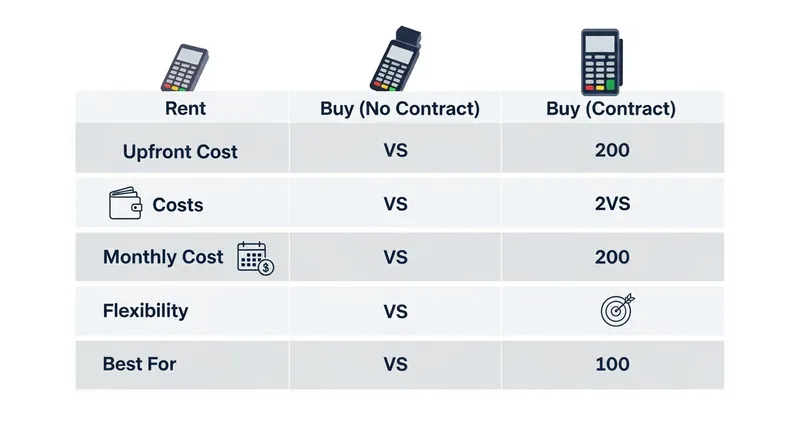
After fees, the next big decision is whether to rent your terminal from a provider (like a bank) or buy it outright. There are significant pros and cons to each approach.
| Feature | Renting an EFTPOS Machine | Buying an EFTPOS Machine |
|---|---|---|
| Upfront Cost | Low to none. You pay a monthly rental fee ($30 - $100+). | High. You own the hardware ($500 - $1500+). |
| Monthly Cost | Ongoing rental fees for the life of the contract. | No rental fees. You may have a software or support fee. |
| Flexibility | Low. Often tied to a 24-36 month contract with termination fees. | High. Especially with no-contract providers, you can switch anytime. |
| Support & Upgrades | Usually included. If the terminal breaks, they replace it. | Varies. May be included or an extra cost. You are responsible for upgrades. |
| Best For | Businesses that want predictable monthly costs and included support. | Businesses that want to lower long-term costs and avoid contract lock-in. |
Historically, renting was the only option. However, the rise of providers like Square and modern POS systems has made buying accessible and often more affordable in the long run, especially for businesses that want to avoid long-term contracts.
Choosing Your Weapon: A Guide to Modern EFTPOS Terminals
The right hardware depends entirely on your business type. A bustling restaurant has very different needs from a mobile beauty therapist.
Countertop EFTPOS Machines: These are the traditional workhorses you see in retail shops and cafes. They are wired, reliable, and designed for a fixed location. They are perfect for businesses where the customer always pays at the counter.
Portable EFTPOS Solutions: These wireless terminals are essential for restaurants offering pay-at-table service. They connect via Wi-Fi or Bluetooth, allowing staff to take payments anywhere on the premises, improving service speed and customer experience.
Mobile EFTPOS for Food Trucks & Markets: For businesses on the go, a truly mobile solution is critical. These often use 4G/5G connectivity and have long-lasting batteries. For a deep dive into this category, check out our guide on the Best Mobile EFTPOS for NZ Food Trucks & Markets.
Android EFTPOS Terminals: This is the next generation of payment hardware. These devices combine a modern EFTPOS terminal with a full-featured Android tablet. This means you can run your entire POS system, take orders, and accept payments on a single, sleek device, reducing clutter and cost. This is a core part of the trend toward integrated, all-in-one business management tools.
The Power of Integration: Why Your EFTPOS and POS Must Talk to Each Other
One of the biggest sources of errors and inefficiency in a small business is having a separate till and EFTPOS terminal. Your staff has to key the amount into the till, then key the exact same amount into the EFTPOS machine. This double-handling is slow and prone to costly mistakes.
An integrated system, where your Point of Sale (POS) software automatically sends the transaction amount to the EFTPOS terminal, solves this. For example, with a system like Lazygrid POS, when a customer orders a flat white, the $4.50 total is sent directly to the terminal with one tap. This delivers huge benefits:
- Speed and Accuracy: Transactions are faster, and costly keying errors are eliminated. This is critical for improving kitchen efficiency, a topic we explore further in our guide to KDS for NZ Restaurants.
- Unified Reporting: All your sales data, whether cash or card, is in one place. This makes it easy to track performance and understand your business without manually reconciling reports.
- Seamless Operations: Integration extends beyond payments. When your EFTPOS is part of a unified platform, it connects to your Online Ordering, Booking System, and Inventory Management. An online order is paid for and the stock is updated automatically, with no manual work required. This is a smarter choice than trying to piece together international systems not built for the local market, like Toast POS in NZ.
The Contract Trap: Finding No-Contract EFTPOS in NZ
Many traditional EFTPOS providers lock you into 24 or 36-month contracts. While this might come with a lower monthly fee, it removes all flexibility. If your business needs change, or you find a better deal, you are stuck. Getting out early can trigger termination fees costing hundreds or even thousands of dollars.
'No-contract EFTPOS' has become a popular search term for a reason. Pay-as-you-go providers offer a compelling alternative:
- Flexibility: You can stop using the service at any time without penalty. This is ideal for new businesses, seasonal operations like food trucks, or anyone who values agility.
- Simple Pricing: Often features a straightforward, blended transaction rate and a one-off cost for the hardware.
- Provider Accountability: The provider has to earn your business every single month, which often leads to better service and innovation.
How to Get an EFTPOS Machine for Your Small Business: A Step-by-Step Guide
Ready to choose a provider? Follow these steps to make a smart decision.
- Assess Your Needs: How many transactions do you expect? Do you need mobility (pay-at-table, on the road)? What integrations are important (POS, accounting, booking)?
- Compare Providers: Don't just go to your bank. Look at independent NZ providers and modern POS companies. Create a spreadsheet to compare their Total Cost of Ownership.
- Ask the Right Questions: Use this checklist when talking to a potential provider:
- What is the exact cost to buy vs. rent the terminal?
- What are all the monthly fees? (account, software, PCI, etc.)
- What are the transaction rates for EVERY card type? (EFTPOS debit, Visa/MC Debit, Visa/MC Credit, Contactless)
- What is the contract length? What is the early termination fee?
- Is there a minimum monthly transaction volume?
- What are the support hours and costs? Is 24/7 support available and is it free?
- Application and Setup: Once you've chosen, the provider will guide you through the application, which typically involves a credit check and providing business details. As the government's Business.govt.nz portal advises, offering flexible and modern payment methods is key to getting paid efficiently.
Your Next Step: Choosing a Transparent Payment Partner
As digital payments become the norm, with the Reserve Bank of New Zealand noting the decline in cash use, choosing the right EFTPOS system is more critical than ever. The best solution isn't just about accepting payments. It's about finding a transparent partner with a clear fee structure that integrates seamlessly into your operations.
An all-in-one system like Lazygrid eliminates the complexity of dealing with multiple vendors. By focusing on total value rather than a single advertised fee, you can make a choice that truly benefits your bottom line.
| Feature | Traditional EFTPOS Setup | Integrated Solution (Lazygrid) |
|---|---|---|
| Setup Complexity | High (multiple vendors) | Low (single provider) |
| Monthly Costs | Multiple bills, often with hidden fees | One clear, predictable bill |
| Contract Length | Often 24-36 month lock-in | No lock-in contracts |
| Integration Level | Low (manual double-entry) | High (POS, online, inventory sync) |
| Support | Multiple contacts, blame shifting | One expert team for everything |
Ready to see how Lazygrid combines transparent EFTPOS pricing with a complete POS solution? Book a demo to see how our integrated system eliminates hidden fees.
Frequently Asked Questions
What is the absolute cheapest way to accept card payments in NZ?
For a brand-new business or one with low transaction volume, the cheapest entry point is typically a pay-as-you-go provider where you buy the hardware upfront and have no monthly fees or contract. While the per-transaction rate might seem slightly higher than some contract plans, you avoid fixed monthly rental fees ($400 - $1200+ per year) and the risk of early termination penalties. Your total cost is directly proportional to your sales, which is ideal when you're starting out.
Can I really get an EFTPOS machine with no contract in NZ?
Yes. This is one of the biggest shifts in the payments industry. Modern providers like Square and integrated POS systems like Lazygrid offer models where you purchase the hardware outright and operate on a month-to-month basis. This gives you complete flexibility to change providers if your needs evolve, without the fear of being locked into a 24 or 36-month agreement with hefty cancellation fees. It puts the pressure on the provider to keep you happy with great service.
What's the real difference between EFTPOS, Paywave, and contactless fees?
- EFTPOS (Debit): This refers to using a domestic debit card by inserting it and entering a PIN. These are the cheapest transactions for a merchant, often costing just a few cents.
- Contactless (Paywave/Tap-and-Go): This refers to tapping any card (debit or credit). These transactions are routed through the more expensive Visa or Mastercard networks, not the domestic EFTPOS network. Therefore, they incur a higher percentage-based fee (e.g., 1.5% - 2.5%), similar to a credit card transaction. This is why many businesses choose to surcharge for contactless payments.
Do I need a separate business bank account for my EFTPOS machine?
While not always a strict requirement from the EFTPOS provider, it is highly recommended and a standard business best practice in New Zealand. Using a separate business account makes financial tracking, reconciliation, and tax preparation significantly easier. It allows you to clearly separate your business income and expenses from your personal finances, which is crucial for accurate bookkeeping and meeting your obligations with the IRD.
What is better for my cafe: Square or a traditional bank EFTPOS terminal?
It depends on your priorities and business volume. Here's a quick comparison:
- Square: Excellent for simplicity and flexibility. You get a single, easy-to-understand blended rate, no contract, and sleek hardware. It's a fantastic option for new businesses, market stalls, or anyone who values simplicity above all else.
- An Integrated POS System (like Lazygrid): This can be more cost-effective for established, higher-volume businesses. While setup is more involved than a simple reader, an integrated system offers powerful features like advanced inventory, staff management, and detailed reporting. The ability to have different rates for different card types can also result in lower overall costs if you process a high volume of domestic debit transactions.