
How to Master Your NZ Restaurant's Food Cost Percentage (Free Calculator & 6 Strategies)

How to Master Your NZ Restaurant's Food Cost Percentage (Free Calculator & 6 Strategies)
Introduction: Your Profit Margin is Shrinking - Here's the #1 Number to Fix It
As a restaurant or cafe owner in New Zealand, you feel it every day. The price of produce goes up, your meat supplier adds a fuel surcharge, and another wage increase is on the horizon. You're working harder than ever, but your profit margin seems to be getting thinner. You're not imagining it. Even as sales grow, the Restaurant Association of New Zealand's 2024 Hospitality Report highlights that rising operating costs are a major challenge for the industry.
In this environment, just hoping for the best isn't a strategy. To protect your business, you need to take control. The single most powerful number you can master is your food cost percentage. It's the key to understanding your profitability, making smart pricing decisions, and ensuring your business thrives. This guide will give you the formulas, a free calculator, and six practical strategies to take control of your food costs today.
What is Food Cost Percentage (and Why It's Critical for NZ Restaurants)
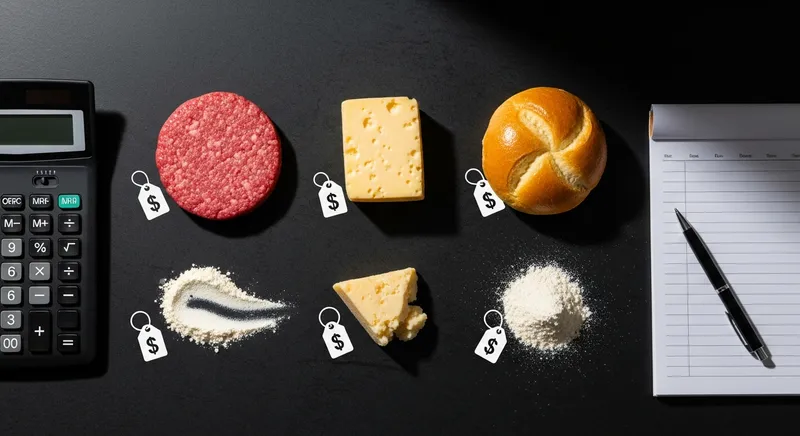
Simply put, your food cost percentage is the portion of your total revenue that you spend on food ingredients. It tells you exactly how much of every dollar earned is spent on the ingredients required to make that dollar.
The standard formula to calculate it over a period (like a month) is:
Food Cost % = (Beginning Inventory + Purchases - Ending Inventory) / Total Food Sales
For most restaurants, the ideal food cost percentage sits somewhere between 28% and 35%. However, this can vary. A steakhouse will have a higher cost than a pasta restaurant, for example. What matters most is knowing your number and working to improve it.
In New Zealand's current economic climate, tracking this isn't just good practice-it's essential for survival. With unpredictable supplier prices and shifting customer habits, knowing your food cost percentage is the only way to ensure your menu is actually making you money.
How to Calculate Your Food Costs: The Formulas for Profit
Getting a handle on your numbers can feel overwhelming, but it boils down to a few key formulas. This section breaks down the essential calculations you need to turn your menu into a profit engine.
Your Free Tool: To make this process easier, we've created a free, downloadable NZ Restaurant Food Cost Calculator. Use it to calculate your costs per dish and set profitable menu prices instantly.
How to Calculate Cost Per Dish
This is the foundation of a profitable menu. You need to know exactly what it costs to create every single item you sell. The process, known as 'plating' a recipe, is straightforward:
- List every ingredient in a single dish, including oils and spices.
- Determine the cost of that exact quantity of each ingredient.
- Sum the costs to get your total recipe cost.
Example: The Classic Kiwi Burger
- Beef Patty (150g): $2.50
- Brioche Bun: $0.80
- Cheese Slice: $0.40
- Lettuce & Tomato: $0.50
- Beetroot & Egg: $0.90
- Sauces & Spices: $0.20
Total Recipe Cost: $5.30
Pro Tip: Manual recipe costing takes hours. Modern POS systems like Lazygrid track ingredient costs automatically and calculate your food cost percentage in real-time as you sell, saving you from spreadsheet headaches.
How to Price a Menu Item
Once you have your recipe cost, you can set a menu price that guarantees profit. Use this formula:
Menu Price = Total Recipe Cost / Target Food Cost %
Using our burger example, if your target food cost is 30% (or 0.30):
Menu Price = $5.30 / 0.30 = $17.67
You would likely round this to a clean menu price of $18.00 or $18.50. In New Zealand, prices ending in .00 or .50 often perform better in hospitality than prices ending in .99, so test what works for your customers.
Beyond Food: Calculating Your Prime Cost
Smart operators know that food is only half the story. Your Prime Cost is the most important number for your restaurant's overall financial health. According to Investopedia, this is the sum of your direct materials (food and beverage) and direct labor costs.
Prime Cost = Cost of Goods Sold (COGS) + Total Labor Cost
For most NZ restaurants, you should aim for a Prime Cost between 60% and 65% of your total sales. If yours is above 70%, it signals an urgent need for action on either food costs, labor costs, or both.
Tracking this is non-negotiable in New Zealand, especially as labor costs rise. With the minimum wage set at $23.95 per hour as of April 2026, and a Hospitality New Zealand survey finding wage costs are a significant portion of outgoings, you must factor this in. Understanding your prime cost is crucial, as is having a solid strategy for retaining NZ hospitality & salon staff.
6 Proven Strategies to Reduce Your Food Costs (Without Sacrificing Quality)
Once you know your numbers, you can start improving them. Here are six actionable strategies you can implement in your restaurant, cafe, or food truck this week.
Strategy 1: Conduct a Waste Audit to Find Hidden Costs
You are likely throwing away more profit than you think. Research commissioned by WasteMINZ found that a staggering 61% of food waste in NZ cafes is avoidable. Further research from the University of Otago confirms that while businesses are motivated by economic gains, they often underestimate how much they waste.
Action Step: For one week, set up three separate, clearly labeled bins in your kitchen: one for spoilage (e.g., expired milk), one for preparation waste (e.g., vegetable peels), and one for plate waste (food returned uneaten). Weigh them daily. The results will shock you and show you exactly where to focus your reduction efforts.
Quick Win: This week, weigh your prep waste for just 3 days. Most NZ cafes discover they're throwing away $200-$500 per week in avoidable waste. That's a potential saving of $10,000-$26,000 annually.
Strategy 2: Master Menu Engineering to Maximise Profit
Your menu is not just a list of food; it's your single most important marketing tool. As explained by advisory firm Baker Tilly, menu engineering involves categorizing every item based on its popularity (sales volume) and profitability (profit margin).
- Stars: High Profit, High Popularity. (Promote these! Your best items.)
- Plow Horses: Low Profit, High Popularity. (Popular but not making much money. Can you increase the price slightly or reduce the cost?)
- Puzzles: High Profit, Low Popularity. (Great margins but not selling. Can you promote them, rewrite the description, or train staff to upsell them?)
- Dogs: Low Profit, Low Popularity. (Consider removing these from the menu.)
Action Step: Use your sales data to plot your menu items on this matrix. For a deeper dive, check out our NZ Menu Engineering Guide: Boost Restaurant & Salon Profits.
Strategy 3: Standardise Recipes and Portion Control
Does one chef add a little more cheese than another? Does the lunch shift use a bigger scoop for fries than the dinner shift? These small inconsistencies add up to thousands of dollars in lost profit over a year.
Action Step: Document every single recipe with precise measurements. Equip your kitchen with portioning tools like scales, measured ladles, and scoops. Train your team on why portion control is crucial for profitability. This also ensures a consistent, high-quality experience for your customers every time.
Strategy 4: Implement a 'First-In, First-Out' (FIFO) Inventory System
FIFO is a simple principle: the first items you purchase should be the first items you use. This is the single most effective way to reduce spoilage waste.
Action Step: When new stock arrives, move all the old stock to the front of the shelf and place the new stock behind it. Label items with their delivery date. This ensures older products are used before they expire, turning inventory into revenue instead of waste.
Strategy 5: Smart Supplier & Price Management
Don't just accept supplier price increases as a given. Stay proactive. Review prices from your key suppliers like Bidfood, Service Foods, or Gilmours, and don't be afraid to compare.
Action Step: Create a simple spreadsheet to track the prices of your top 20 most-purchased ingredients across your suppliers. Review it weekly. When you see a price creep up, call your supplier to ask why. Get quotes from competitors to ensure you're getting a fair market rate.
Strategy 6: Analyse Your Sales Data Weekly
Your POS system is a goldmine of data. It's time to create a ritual to use it effectively.
Action Step: Set aside 30 minutes every Monday morning. Open your POS, filter last week's sales by item, and export your top 10 and bottom 10 sellers. Ask yourself: Does this data align with what we're ordering? If you're buying ingredients for a dish that isn't selling (a 'Dog'), it's time to remove it. If a popular item has a low margin (a 'Plow Horse'), it's time to re-cost it.
The Ultimate Solution: How POS Inventory Software Automates Cost Control
Running these calculations and tracking everything manually is time-consuming and prone to error. This is where technology becomes your most valuable employee. A modern POS system with integrated inventory management automates the entire process, giving you complete control with minimal effort.
Imagine this: every time you sell a burger, the system automatically deducts one patty, one bun, 15g of cheese, and 10ml of ketchup from your live inventory count. It knows the cost of each component and calculates your real-time food cost and profit margin on that single sale.
An integrated system can:
- Track stock levels in real-time and send you low-stock alerts automatically.
- Manage recipes to track ingredient-level consumption.
- Generate instant food cost and COGS reports, saving you hours of spreadsheet work.
- Link sales data directly to inventory, showing you exactly what to order and when.
This transforms your decision-making from guesswork to data-driven strategy. You can instantly see which menu items are most profitable and which are losing you money. If you're looking for a system to provide this level of control, explore some of The Best Cloud POS Systems for NZ Restaurants.
Conclusion: Take Control of Your Profitability Today
In the challenging New Zealand hospitality market, controlling your costs is the difference between surviving and thriving. It starts with understanding and actively managing your food cost percentage. By moving from reactive frustration to proactive management, you put the power back in your hands.
Start by calculating your costs per dish, implement the six strategies to reduce waste and optimize your menu, and leverage technology to automate the process for ultimate accuracy and efficiency. Mastering this single metric will give you the clarity and confidence to build a more resilient and profitable business.
Ready to automate your food cost tracking? Lazygrid's inventory management calculates your costs per dish, tracks waste in real-time, and shows you exactly which menu items are profitable. See how it works with a free demo.
Frequently Asked Questions
What is a good food cost percentage for a cafe in NZ?
A good benchmark for a New Zealand cafe is typically between 25% and 30%. This is often slightly lower than a full-service restaurant's target of 28-35%. The reason is that high-margin items like coffee and other beverages can help balance out the cost of food. However, the ideal number depends entirely on your specific menu and business model. The most important thing is to calculate your own percentage accurately and track it consistently over time to spot trends and make improvements.
How do I account for free staff meals in my food cost?
This is a common point of confusion that can easily distort your numbers. Staff meals are a legitimate cost of doing business and should be included in your Cost of Goods Sold (COGS), but they must be tracked separately to avoid skewing your sales data. The best practice is to have a 'Staff Meal' button in your POS system. When an employee has a meal, ring it up through the POS at a $0.00 price. This correctly removes the ingredients from your inventory without artificially inflating your sales revenue, giving you a true food cost percentage.
My food cost is over 40%, what's the first thing I should do?
A food cost percentage over 40% signals a critical issue that requires immediate attention. The very first action you should take is a waste audit. Uncontrolled waste is the fastest way to destroy your profit margin. Check these three areas immediately:
- Spoilage: Are you over-ordering and letting food expire? Is your stock rotation (FIFO) failing?
- Portioning: Are your chefs using incorrect scoop sizes or adding extra ingredients 'by eye'?
- Yield: Are you accounting for butchering or prep loss? A 'yield test' on key proteins will show you how much usable product you get from what you buy. Start by physically tracking everything you throw away for three days. The source of the problem will quickly become obvious.
How often should I calculate my food cost percentage?
For a comprehensive and accurate picture, you should perform a full food cost percentage calculation, which includes a complete physical inventory count, at least once per month. This gives you a firm understanding of your overall profitability. However, you should be engaging with your costs much more frequently. Best practice is to spot-check individual recipe costs weekly, especially for items with volatile ingredient prices. This allows you to make agile pricing decisions instead of waiting until the end of the month to discover a problem.
What's the difference between food cost and cost of goods sold (COGS)?
In a restaurant or cafe context, these terms are very closely related and often used interchangeably. Cost of Goods Sold (COGS) is the accounting term for the total direct cost of all the ingredients used to produce the items you sold during a specific period. Food Cost is the same figure, often expressed as a percentage of your revenue (Food Cost Percentage). Essentially, COGS is the dollar amount ($), while Food Cost Percentage is that dollar amount shown as a proportion of your sales (%).