
NZ Menu Engineering Guide: Boost Restaurant & Salon Profits
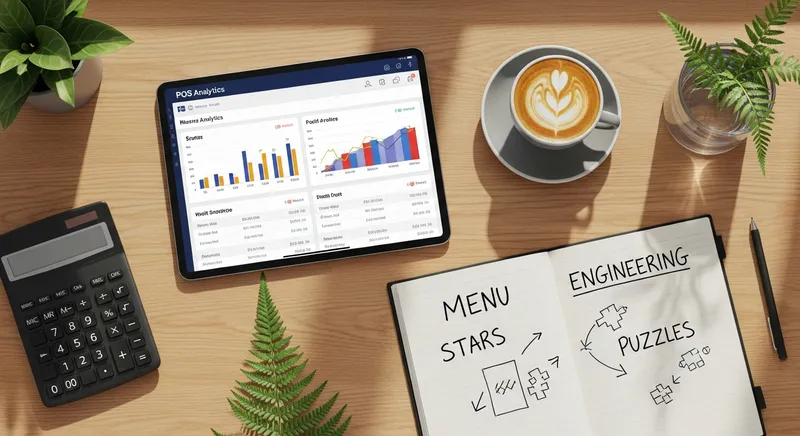
As a New Zealand business owner, you're constantly told to innovate and optimize. You read advice from US-based experts about complex strategies, but it feels disconnected from your reality. Generic advice on menu engineering is often impractical and overwhelming, failing to account for the unique challenges you face: calculating margins with GST, managing rising local food costs, and dealing with some of the highest hospitality labour costs in recent memory. You have a powerful tool sitting on your counter-your POS system-but you may not know how to use its data to make confident, profitable decisions about your menu or service list.
This is not another generic guide. This is a practical playbook specifically for Kiwi owners of restaurants, cafes, food trucks, beauty salons, and massage studios. We'll break down menu engineering into simple, actionable steps, using NZ-specific context to help you turn your menu into your most powerful profit-generating asset. Forget the confusing jargon; it's time to get practical and unlock the hidden profit in your business.
What is Menu Engineering? (And Why It's Crucial for Kiwi Businesses)
Menu engineering is the process of using your sales and cost data to design a menu that maximizes profitability. It's a methodical way to see which items make you the most money and which are most popular with your customers. Think of it as a financial health check-up for your offerings.
For New Zealand businesses, this isn't just a 'nice-to-have'. It's a critical survival tool. The Restaurant & Café Association of New Zealand's Hospitality Report highlights that labour costs can reach as high as 40% of turnover, and food cost inflation continues to be a significant pressure. In this environment, you can't afford to have underperforming items on your menu. By analyzing your menu, you can make small changes that lead to significant increases in your bottom line, helping you combat these rising costs without simply raising all your prices.
And it's not just for restaurants. The same principles apply whether you're selling flat whites, food truck burgers, or 60-minute massages. If you have a list of products or services with different prices and costs, you can-and should-engineer it for profit.
The Foundation: Calculating True NZ Food & Service Costs
Before you can analyze your menu, you need to know the true cost of every item you sell. This is your Cost of Goods Sold (COGS). Generic advice often misses a crucial step for New Zealand businesses: correctly handling GST.
To calculate your true margin, you must use GST-exclusive figures for both your sale price and your costs. Your POS system should show you the sale price without GST, and you should calculate your ingredient costs without the GST you claim back.
Here's the correct formula for an individual item's cost percentage:
Total Cost of All Ingredients / Sale Price (excluding GST) = Food Cost Percentage
Let's take a Kiwi classic: a gourmet lamb burger.
- Lamb patty: $3.50
- Brioche bun: $1.00
- Lettuce, tomato, onion: $0.75
- Special sauce & cheese: $0.90
- Total Ingredient Cost (COGS): $6.15
If you sell the burger for $25.00 including GST, the GST-exclusive price is $21.74 ($25 / 1.15). For a detailed breakdown of GST rules, refer to our NZ Hospitality Compliance Guide.
Your food cost percentage is: $6.15 / $21.74 = 28.3%
This is a healthy food cost. The average for NZ restaurants can range from 28% to 35%. Knowing this number for every single item is the first step to mastering your menu.
A modern POS with Inventory Management makes this process much easier by tracking ingredient costs automatically. Unlike systems that require manual spreadsheets, Lazygrid's integrated inventory tracks your costs in real-time, giving you an accurate COGS for every item you sell.
The Two Pillars of Menu Engineering: Popularity and Profitability
Menu engineering rests on two simple data points for each item:
Profitability (Contribution Margin): How much actual cash does this item contribute to your bank account after costs? It's not a percentage. The formula is: Contribution Margin = Sale Price (ex. GST) - Cost of Item (COGS)
Using our burger example: $21.74 - $6.15 = $15.59 Contribution Margin. This $15.59 is what's left to pay for labour, rent, and other overheads, with the remainder being your profit.
Popularity (Menu Mix): How many of each item do you sell over a specific period (e.g., a month)? This data should be easy to pull from your POS system's Reporting & Analytics. A simple rule of thumb for determining if an item is 'popular' is the 70% rule. Calculate the average number of items sold, then any item that sells more than 70% of that average can be considered popular.
Once you have these two pieces of data for every item, you can plot them on the menu matrix. This is where you get the clarity to make strategic decisions. For an in-depth comparison of systems that provide this data, see our review of the best cloud POS systems for NZ restaurants.
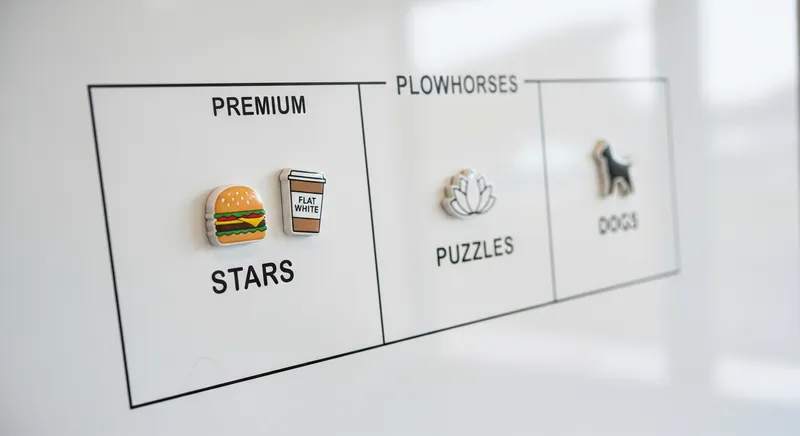
The Menu Matrix: Stars, Plowhorses, Puzzles, and Dogs
This matrix is the heart of menu engineering. It divides your menu items into four categories, each with a clear action plan.
Stars: High Profitability, High Popularity
These are your superstars. Customers love them, and they make you great money. That gourmet lamb burger with its $15.59 margin and high sales volume is a classic Star.
- What to do: Feature them prominently on your menu. Maintain strict quality control. Train staff to recommend them. Never run out of ingredients for your Stars. Consider a small price increase if the market will bear it.
Plowhorses (or Workhorses): Low Profitability, High Popularity
These are customer favourites that don't make you much money per sale. Think of a classic eggs benedict or a simple side of fries. They are popular and keep people coming back, but their margins are slim.
- What to do: Your goal is to increase profitability without reducing popularity. Try slightly reducing the portion size if it's generous. Test a small price increase. Can you reduce the cost by changing a supplier? Most effectively, train staff to upsell a high-margin add-on, like a craft beer with the fries. This is key to increasing your restaurant's Average Order Value (AOV).
Puzzles: High Profitability, Low Popularity
These are the items that could be making you a lot of money, but for some reason, they aren't selling. Perhaps it's a complex-sounding seafood chowder or an expensive steak option.
- What to do: Figure out why they aren't selling. Reposition the item on the menu. Give it a more appealing name and description. Use photos. Make it a daily special to encourage trial. Offer a staff incentive for every one they sell. If after all this they still don't sell, consider if it's worth the effort.
Dogs: Low Profitability, Low Popularity
These items are not popular and don't make you money. They take up valuable menu space and inventory.
- What to do: In most cases, remove them from your menu. The only exception is if a Dog serves a strategic purpose, like a simple kids' meal that enables a family (who will order high-margin Stars) to dine with you. Otherwise, simplify your menu and focus on your winners. With Lazygrid's Menu Management, you can instantly hide or remove a Dog from your POS and online ordering platforms with a single click.
Pro Tip: Want to see your menu data visualized this way? Lazygrid's analytics dashboard makes menu engineering effortless, automatically categorizing your items into Stars, Plowhorses, Puzzles, and Dogs at a glance.
Beyond Restaurants: Engineering for Cafes, Salons & Service Businesses
This is where most guides fall short. The menu matrix is an incredibly powerful tool for any NZ service business.
For Cafes and Food Trucks:
Your menu is smaller, and volume is everything. Engineering is even more critical. Analyze your coffee and cabinet food combos. Is your 'Muffin and Coffee' deal a high-volume Plowhorse? Maybe you can pair that coffee with a higher-margin slice instead. For food trucks, where speed is essential, a well-engineered menu with fewer, more profitable items can drastically improve service times and profit per event. A dedicated POS for food trucks can provide the specific data you need.
For Salons, Spas, and Massage Studios:
Your 'menu' is your list of services. You can apply the exact same logic:
- Service Profitability: Calculate the contribution margin for each service. The formula is
Service Price - (Cost of Consumables + Technician's Time-Based Wage). A 60-minute massage might have low consumable costs but high labour cost. A 30-minute facial might have higher product costs but less labour. - Service Popularity: Your Booking/Reservation System data will tell you which services are booked most often.
Plotting this reveals powerful insights:
- Star: A 'Deluxe Manicure' that's popular and uses mid-cost but high-price products.
- Plowhorse: A 'Basic Eyebrow Shape'. Hugely popular, quick to do, but low margin. Can you bundle it into a package with a high-margin lash tint?
- Puzzle: A 'Specialized Anti-Ageing Facial'. High price and high margin, but rarely booked. It needs better marketing, client education, or a promotional offer.
- Dog: An obscure body wrap treatment that is never booked and requires expensive, perishable products. It's time to retire it.
Lazygrid's integrated booking system feeds directly into your analytics, showing you which treatments are your Stars in real-time, a key strategy for retaining valuable salon staff by maximizing their earning potential.
Putting It Into Action: Menu Psychology & Design
How you present your menu can be just as important as what's on it. Groundbreaking research from institutions like Cornell University's School of Hotel Administration shows that strategic design can significantly influence customer choice and increase sales.
- Remove Currency Signs: Studies have shown that removing the '$' symbol can lead to customers spending more. Simply listing a price as '25' instead of '$25.00' makes it feel less like a transaction.
- Use Descriptive Language: Don't just list 'Chicken Burger'. Call it a 'Free-Range Chicken Burger with Avocado, Bacon & Chipotle Aioli'. Research in the International Journal of Hospitality Management confirms that evocative descriptions increase a dish's appeal and perceived value.
- Guide Their Eyes: Readers' eyes typically go to the top right corner first, then the top left, then the middle. This is the 'Golden Triangle'. Place your Stars in these prime locations.
- Use Boxes and Visuals: A simple box around an item or a subtle icon can draw attention. Use this to highlight your Stars or Puzzles you want to promote.
These psychological tweaks are powerful, low-cost marketing tactics. For more ideas, check out these low-cost marketing ideas for NZ restaurants.
Your Data-Driven Advantage: The Lazygrid POS
In the past, menu engineering was a painstaking manual process. Today, your POS system is a data goldmine that does the heavy lifting. Making decisions based on 'gut feel' is a recipe for failure when detailed data is at your fingertips.
This is where an all-in-one system like Lazygrid becomes essential. Unlike systems that charge extra for core features, Lazygrid includes comprehensive analytics in every plan. Our Reporting & Analytics feature is the engine for your menu engineering project.
With a few clicks, you can generate a 'Sales by Item' report for any period. This gives you the 'Popularity' data instantly. When combined with the Inventory Management feature, which tracks your ingredient costs, you have both pillars of the matrix-popularity and profitability-ready for analysis. This data-driven approach is what separates thriving businesses from those that stagnate. It allows you to be agile, responding to changing tastes and cost pressures with precision.
For a direct comparison, see our Lightspeed vs Square vs Lazygrid review.
Take Control of Your Profitability
Understanding the theory is the first step; putting it into action is what drives growth. Lazygrid is designed to make menu engineering simple and accessible for busy NZ business owners.
- Automated Insights: Our reporting automatically tracks sales popularity and, when paired with inventory, calculates profitability for every item. No more manual spreadsheets.
- Actionable Strategies: Use our integrated promotions engine to feature your 'Puzzles' or create loyalty rewards around your 'Stars'.
- Effortless Updates: Instantly remove 'Dogs' or adjust prices across your POS and commission-free online ordering from one central dashboard.
Ready to turn data into profit? See how Lazygrid can transform your business.
Book a Free Demo with Our Wellington-Based Team
Frequently Asked Questions
What is a good food cost percentage for an NZ restaurant?
A healthy food cost percentage for a typical New Zealand restaurant or cafe is between 28% and 35%. However, this is not a one-size-fits-all number. Fine dining establishments might have higher food costs (35-40%) due to premium ingredients, while a pizza place with lower-cost ingredients could aim for 20-25%. The key is to know your target and track it accurately for each item, always calculating using GST-exclusive prices.
How can I apply menu engineering to my beauty salon's services?
Treat your service list exactly like a food menu. Calculate the contribution margin for each service by subtracting direct costs (consumable products, and critically, the technician's wage for that specific block of time) from the service price. Use your booking system data to determine popularity. You'll likely find a 'Basic Manicure' is a popular but low-margin 'Plowhorse', while a 'Deluxe Anti-Ageing Facial' is a high-margin but low-popularity 'Puzzle'. This analysis will show you which services to promote, package, or re-price.
What's the difference between a Plowhorse and a Puzzle?
It's all about popularity vs. profit. A Plowhorse is popular but has a low profit margin (e.g., a side of fries). Lots of people buy it, but you don't make much on each one. The goal is to make it more profitable. A Puzzle is the opposite: it has a high profit margin but isn't popular (e.g., a complex, expensive duck dish). You make great money when it sells, but it rarely does. The goal is to figure out how to sell more of it.
How do I calculate profitability correctly with NZ GST?
This is a critical point many get wrong. To calculate your true operational profit margin, you must remove GST from the equation. Use the GST-exclusive sale price and the GST-exclusive cost of your ingredients. Your POS system should provide the ex-GST sale price, and you claim back GST on your business purchases. The formula for contribution margin is: Sale Price (ex. GST) - Ingredient Cost (ex. GST) = True Contribution Margin.
How often should I analyze my menu?
A full, deep-dive menu engineering analysis should be conducted at least twice a year to align with seasonal changes (e.g., summer vs. winter menu). However, you should be reviewing your key numbers and top-selling items on a monthly basis using your POS system's reporting. This allows you to spot trends, catch rising ingredient costs early, and make minor adjustments before they become major problems.