
Slash Wage Costs, Not Staff: A NZ Cafe's Guide to Lean Operations with QR Ordering & Kiosks
As a New Zealand cafe or restaurant owner, you are likely feeling the pressure from both ends. Operating costs are climbing, with the Restaurant Association of New Zealand noting that labour costs have hit a record high, and the hunt for skilled, reliable staff feels never-ending. It's a stressful position that can feel like it forces a difficult choice: cut staff to save your business, or watch your profit margins disappear.
But what if there was a third option? What if you could significantly reduce your operating costs, not by cutting your valuable team, but by making your operations smarter, faster, and more efficient?
This guide provides a practical roadmap for implementing lean management principles in your NZ hospitality business. We will show you how to use accessible technology like QR code ordering and self-service kiosks to slash wage-related costs, empower your existing staff to achieve more, and build a more resilient and profitable business without letting a single team member go.
The Squeeze: Understanding the Real Costs in NZ Hospitality
The financial pressure on New Zealand's hospitality sector is not just a feeling, it's a statistical reality. The industry is dynamic, with Stats NZ data showing significant movement in employment, reflecting a constant struggle to find and retain staff. This challenge is compounded by rising costs across the board.
The 40% Problem: Labour Costs Hit Record Highs
The Restaurant Association's 2025 Remuneration Survey paints a stark picture, revealing that labour costs now consume an average of 40 percent of revenue for hospitality businesses-the highest on record. This is a key concern also highlighted in submissions to the Ministry of Business, Innovation & Employment (MBIE), where reducing operational costs is seen as critical for the sector's health.
This environment creates a perfect storm where your biggest asset, your staff, also becomes your biggest expense. The traditional response might be to reduce hours or staff numbers, but this often leads to a decline in service quality, increased stress on remaining employees, and ultimately, a negative impact on your brand and revenue. The solution isn't fewer people, it's a more efficient process.
| Traditional Model | Lean Model with Technology |
|---|---|
| Staff are tied to one task (e.g., till operator). | Staff are flexible and redeployed to high-value roles. |
| Labour costs scale directly with customer volume. | Technology absorbs repetitive tasks, increasing capacity. |
| Service speed is limited by staff count. | Customers order and pay on demand, reducing wait times. |
| Prone to errors from manual order taking. | Digital orders are sent directly to the kitchen, improving accuracy. |

What is Lean Management for Restaurants? (And Why It's Not About Cutting Staff)
Lean management is a philosophy focused on maximizing customer value while minimizing waste. In a restaurant context, 'waste' isn't just about food scraps. It's also wasted time, wasted movement, and wasted potential. Academic research published in the journal Sustainability has validated that lean management methods are highly effective in food service for decreasing operational costs and reducing waste.
Instead of focusing on staff reduction, a lean approach asks: How can we eliminate inefficient tasks so our team can focus on what truly matters-great food and fantastic customer service?
This is where technology becomes a powerful ally. By automating repetitive, low-value tasks, you empower your team to be more productive and engaged. You don't replace your staff, you redeploy them to higher-value roles.
Actionable Tip: Start by mapping your current workflow. Watch how an order moves from the customer to the counter, to the kitchen, and back to the customer. Identify every step that involves waiting, walking, or manual data entry. These are your opportunities for lean improvements.
How Technology Can Improve Restaurant Efficiency: Your Lean Operations Toolkit
While the hospitality sector has seen productivity gains, as noted in a report by Hospitality New Zealand, there is still immense potential for improvement. Global leaders like Deloitte emphasize that digital transformation is no longer optional for cost optimization and better guest service. Here are the key tools for your NZ business.
QR Code Ordering: The Front-of-House Game Changer
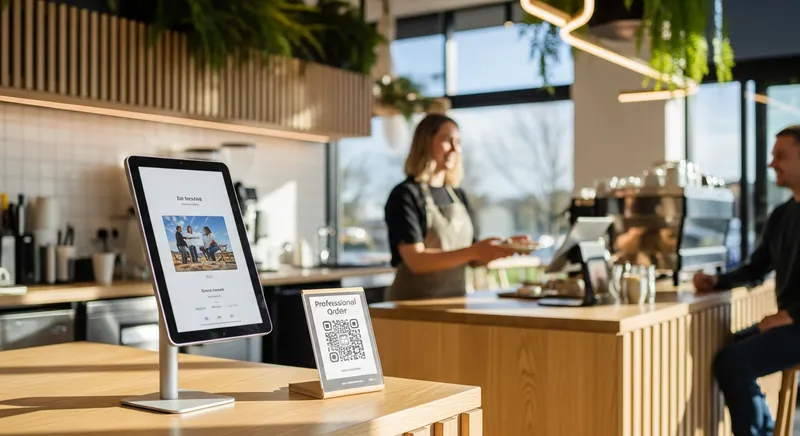
QR code ordering allows customers to view your menu, place their order, and pay directly from their own smartphone. Research published by SciTePress confirms that these systems increase operational efficiency and offer a faster ordering process. Instead of one staff member being tied up at a till, your entire floor becomes a point of sale.
- How it Reduces Wage Costs: A single staff member can manage a larger section because they are no longer running back and forth to take orders and process payments. They are freed up to deliver food, check on tables, and enhance the customer experience.
- Staff Redeployment: The team member who used to be stuck behind the till can now become a 'Customer Experience Host', welcoming guests, explaining specials, and ensuring everyone is happy. This is a more engaging and valuable role.
- Actionable Tip: Implement table-specific QR codes that are linked to your Table Management system. This ensures orders are sent to the kitchen with the correct table number, eliminating confusion. This is a core part of the Lazygrid Premium plan.
For businesses looking to own their customer journey, exploring the best commission-free online ordering systems for NZ is a crucial step.
Self-Service Kiosks: Slashing Queues and Boosting Order Value
For high-volume cafes and quick-service restaurants, the counter is often the biggest bottleneck. A self-service kiosk, which can be run from a simple tablet, provides an additional ordering point without needing an additional staff member.
- How it Reduces Wage Costs: A kiosk can handle a significant percentage of your orders during peak times, allowing you to serve more customers with the same number of staff. Data shows kiosks can increase average order value by 20-30% as customers feel more relaxed to browse and add items.
- ROI on Kiosk Cost: While there is an initial hardware cost, the return on investment is rapid. If a kiosk helps you serve an extra 20 customers during a two-hour lunch rush, the increased revenue and labour efficiency pay for the hardware in a matter of months. You can even use your own tablet or iPad as a POS system to keep costs down.
- Actionable Tip: Place your self-service kiosk in a high-visibility area near the entrance. Use clear signage to encourage its use, especially for takeaway orders, to split the queue and reduce congestion at the main counter.
Kitchen Display Systems (KDS): The Heart of a Lean Kitchen
A lean front-of-house is only effective if the kitchen can keep up. Paper dockets are a source of chaos: they get lost, are hard to read, and make it difficult to track order times. A Kitchen Display System (KDS) digitizes this entire flow.
- How it Reduces Waste: A KDS eliminates errors from misread handwriting and ensures modifications are clearly displayed. This reduces incorrect orders and food waste, directly impacting your bottom line.
- Improved Efficiency: Orders appear instantly and are colour-coded by time. Your kitchen staff can see the entire order queue at a glance, allowing them to better plan and coordinate. This reduces stress and improves ticket times.
- Actionable Tip: Use a KDS designed for small NZ restaurants to route items to different stations. For example, drinks orders can go to the barista's screen while food orders go to the chef's screen, streamlining preparation.
The Central Hub: An All-in-One POS System
These tools deliver maximum value when they work together. An All-in-One POS NZ system acts as the central nervous system for your lean operation. It connects your QR orders, kiosk sales, and KDS, feeding all the data into a single place.
- Real-time Analytics: Modern POS systems provide powerful Reporting & Analytics. You can see your peak hours, best-selling items, and staff performance in real-time, allowing you to make data-driven decisions instead of guessing.
- Integrated Inventory: The system automatically deducts ingredients as items are sold, giving you a real-time view of stock levels. This prevents running out of popular items and reduces over-ordering and waste, directly improving your NZ cafe profit margins.
- Actionable Tip: Schedule a 30-minute review each week to look at your POS sales data. Identify one low-performing item to remove from the menu and one trend to capitalize on (e.g., a spike in oat milk lattes) to optimize your offering.
The "Slash Wages, Not Staff" Blueprint: A NZ Cafe Case Study
Let's imagine "Welly Brews," a 40-seat cafe in Wellington. Before implementing lean principles, their wage costs were 41% of revenue. They had three front-of-house staff during the lunch rush: one on the till, and two running food and clearing tables. They were constantly stressed, and queues were long.
The Transformation:
- Implementation: They introduced Lazygrid's Premium plan. They placed QR code pucks on every table and set up one iPad as a self-service kiosk for takeaway orders.
- Workflow Change: The staff member previously on the till was retrained as a 'Floor Host'. Their job was now to greet customers, help anyone using the kiosk, and focus on service quality.
- The Results (After 3 Months):
- Reduced Congestion: 60% of dine-in customers and 80% of takeaway customers used the new systems, eliminating the queue.
- Increased Revenue: Average order value increased by 18% as customers added more sides and drinks via the kiosk and QR ordering.
- Wage Cost Reduction: Even with the same number of staff on the same pay, the increased revenue and efficiency meant wage costs dropped from 41% to 34% of total revenue.
- Improved Staff Retention: Staff reported higher job satisfaction. The Floor Host role was more engaging, and the runners felt less frantic. They kept their entire team, who were now happier and more productive.
This case study shows that the goal isn't to reduce payroll, but to increase the revenue generated per labour dollar spent.
Ready to Build a More Resilient Cafe?
The tools and strategies discussed here are not about replacing the human element of hospitality; they are about enhancing it. By embracing lean principles and smart technology, you can create a more efficient, profitable, and enjoyable environment for both your customers and your team.
Ready to see how lean operations could transform your cafe? Explore the Lazygrid Premium plan or chat with our NZ-based team today to start your journey towards a smarter, more resilient business.
To help you get started, here are some common questions we hear from NZ cafe owners.
Frequently Asked Questions
How can technology help with the hospitality staff shortage in NZ?
Technology helps you do more with the team you already have. By automating repetitive tasks like order-taking and payment processing with tools like QR ordering and self-service kiosks, you free up your valuable staff. They can then focus on higher-value activities such as improving the customer experience, managing the floor, and ensuring food quality. This increases their productivity and job satisfaction, which is key to retaining staff in a competitive market.
What is the best way to improve the efficiency of restaurant staff?
The best way is to provide them with better tools and processes. A fully integrated POS system is central to this. A Kitchen Display System (KDS) eliminates confusion and streamlines kitchen workflow. A POS with a visual table management layout helps servers turn tables faster. QR code ordering removes the bottleneck of taking orders manually. Efficiency isn't about making staff work harder; it's about removing the obstacles that slow them down.
Is QR code ordering worth it for a small cafe?
Yes, absolutely. The beauty of QR code ordering is its scalability. For a small cafe, it can empower a single staff member to manage the entire floor during quieter periods, as customers can order and pay without needing direct attention. It reduces order errors, speeds up table turnover, and provides a modern, convenient experience that customers appreciate. It's a low-cost, high-impact tool for any size of business.
How can I reduce food waste in my cafe?
Data is your best tool against food waste. An integrated POS system that includes Inventory Management is crucial. It tracks what you sell in real-time, deducting ingredients automatically. This gives you a precise understanding of what you're using. You can identify slow-moving menu items that lead to spoilage and make data-driven decisions to adjust your menu or purchasing. Low-stock alerts also prevent panic-buying and over-ordering, further cutting down on waste.
What are the real benefits of a Kitchen Display System (KDS)?
Beyond simply replacing paper tickets, a KDS brings calm and order to the kitchen. The primary benefits are speed, accuracy, and data. Orders are clearer and impossible to lose, which dramatically reduces costly errors. It tracks how long each order takes, allowing you to identify and fix bottlenecks in your kitchen process. This leads to faster service, happier customers, and a less stressful environment for your kitchen team, which is invaluable for staff retention.