
NZ Cafe Profit Margins 2026: A Guide to Calculating Prime Cost & Surviving the Squeeze

NZ Cafe Profit Margins 2026: A Guide to Calculating Prime Cost & Surviving the Squeeze
Does it feel like you're working harder than ever just to stand still? You're not imagining it. For cafe and restaurant owners across New Zealand, the daily grind is getting tougher. You're managing staff, delighting customers, and perfecting your flat whites, but at the end of the month, the profit margin just isn't what it should be.
The Restaurant Association of New Zealand reports that despite sales growth, the hospitality sector is under immense strain. The problem is clear: escalating food and wage costs are relentlessly squeezing your profitability. But you are not powerless. This guide provides a practical framework to calculate, understand, and control the single most important number in your business: your Prime Cost.
Key Takeaways for Busy Owners
- The Master Metric: Prime Cost = Cost of Goods Sold (COGS) + Total Labour Cost.
- The Gold Standard: Aim for a Prime Cost of 60% or less of your total sales.
- The Path to Profit: Control costs by engineering your menu, managing inventory, optimizing labour, and using integrated systems.
The Big Squeeze: Why Your Cafe Profits Are Under Pressure
As we look toward the 2026 business landscape, the pressure on profit margins is set to intensify. It's not just one thing, but a combination of factors that makes running a profitable food business in New Zealand more challenging than ever.
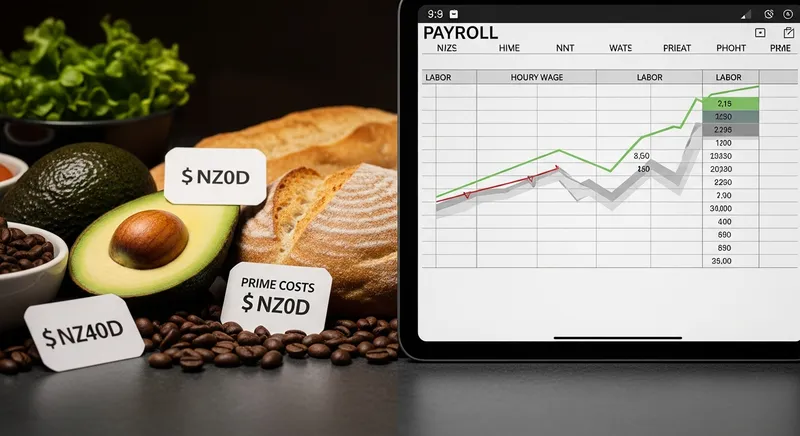
First, the cost of ingredients continues to climb. According to the latest data from Stats NZ, food prices have seen significant annual increases. These aren't small changes; they are systemic increases that directly inflate your Cost of Goods Sold (COGS).
Second, wage pressures are intensifying. The Restaurant Association's 2025 Remuneration Survey found that labour costs have hit a record high. Further data from Employment New Zealand (MBIE) highlights ongoing staffing challenges and upward pressure on pay rates.
Finally, other overheads aren't giving you a break either. Commercial real estate leaders like CBRE New Zealand forecast that positive rental momentum will continue through 2026. When you combine these forces, it's clear that relying on old assumptions about profit is a recipe for disaster.
Stop Guessing, Start Calculating: Your Guide to Prime Cost
To regain control, you must focus on the most critical metric for any hospitality business: Prime Cost. This is the master number that represents the majority of your controllable expenses.
In simple terms, the formula is:
Prime Cost = Cost of Goods Sold (COGS) + Total Labour Cost
This single figure tells you how much it costs to put a product on the plate and have someone serve it. Forget vague feelings about your finances; this is the number that matters. Let's break down how to calculate it accurately.
Step 1: Calculate Your Cost of Goods Sold (COGS)
Your COGS is the total cost of the ingredients you sold over a specific period. It's not just what you bought, but what you actually used.
The standard formula is:
COGS = Beginning Inventory + Purchased Inventory - Ending Inventory
- Beginning Inventory: The value of all stock at the start of the period.
- Purchased Inventory: The value of all stock bought during the period.
- Ending Inventory: The value of stock left at the end of the period.
To get these numbers, you need to do regular, accurate stocktakes. This process is the foundation of good inventory management for small business in NZ. Once you have your COGS, you can calculate your Food Cost Percentage (COGS ÷ Total Sales). A healthy food cost percentage in New Zealand is typically 28-35%.
Step 2: Calculate Your Total Labour Cost
Your labour cost is more than just hourly wages. To get a true picture, you must include all associated costs.
Your Total Labour Cost includes:
- Gross wages for all staff (including your own salary)
- Payroll taxes (PAYE)
- ACC levies
- KiwiSaver contributions
- Any other employee benefits (e.g., staff meals)
Given the wage pressures highlighted by sources like Employment New Zealand (MBIE), tracking this is non-negotiable. Modern POS systems with built-in staff management can automate total labour cost calculations, including on-costs, eliminating hours of manual spreadsheet work.
The 60% Rule: Your Target for a Profitable Cafe
Now that you have your COGS and Total Labour Cost, you can calculate your Prime Cost. So, what number should you be aiming for?
According to industry experts, the gold standard for a healthy hospitality business is a prime cost of around 60% of total revenue.
This means for every dollar that comes in, no more than 60 cents should be spent on your product and the labour to serve it. The remaining 40 cents is what's left for rent, utilities, marketing, other overheads, and-most importantly-your profit. If your prime cost is well above 60%, don't panic. The next section is for you.
4 Practical Strategies to Control Your Prime Cost and Boost Profit
Knowing your prime cost number is the diagnosis. Now it's time for the treatment. Here are four actionable strategies to lower your prime cost percentage.
1. Engineer Your Menu for Profit
Your menu is your single most powerful profitability tool. Menu engineering involves analysing the popularity and profitability of every item you sell.
- Actionable Tip: Identify your 'Stars' (high profit, high popularity) and feature them prominently. Make them stand out with photos or callout boxes.
- Actionable Tip: Don't be afraid to slightly increase the price of high-volume items. A 20-cent increase on coffee can have a huge impact. Using digital menus instead of print makes these updates instant and cost-free.
2. Attack Waste with Smart Inventory Management
Every time you throw out spoiled milk or wasted food, you are throwing away profit. Poor inventory tracking directly inflates your COGS.
- Actionable Tip: Strictly implement a 'first-in, first-out' (FIFO) system for all stock. Label items with delivery dates and ensure older stock is used first.
- Actionable Tip: Use sales data from your POS to forecast purchasing needs accurately. For example, by using sales data to forecast demand, a Wellington cafe reduced its weekly bread waste from 15 loaves to just 2, saving over $50 a week on that single item alone. An all-in-one POS system is invaluable here, connecting sales directly to inventory.
3. Improve Kitchen and Staff Efficiency
Wasted time is wasted money, directly impacting your labour cost percentage. An inefficient workflow burns through wages without generating more revenue.
- Actionable Tip: Implement a Kitchen Display System (KDS). A KDS eliminates lost paper dockets, reduces errors, and helps track order times, pushing your team to be faster and more accurate.
- Actionable Tip: Dive into your POS sales reports to find your true peak and quiet periods. Use this data to build smarter staff schedules that prevent you from being over-staffed during slow times.
4. Boost Revenue Without Adding Costs
Sometimes the best way to improve your prime cost percentage is to increase your total sales. More revenue over the same fixed costs will naturally improve your margins.
- Actionable Tip: Add a commission-free online ordering system to your website. This captures more orders during peak times without your staff having to answer the phone.
- Actionable Tip: Use an integrated booking system to manage tables more effectively, take deposits, and send automated reminders to reduce costly no-shows.
The Solution: Fight Fragmentation with an All-in-One System
Why is controlling prime cost so hard? Often, it's because the data you need is fragmented. Your sales are in the till, your inventory is on a spreadsheet, and your staff hours are in a separate app. It's impossible to get a clear, real-time picture.
This is where an All-in-One POS for NZ like Lazygrid changes the game. It solves the core problem by connecting your sales, inventory, and labour data in one single, unified platform.
Imagine seeing your food cost percentage update in real-time as sales happen. Picture your POS automatically deducting ingredients from your inventory. This isn't a future dream; it's the power of an integrated system. It turns the complex task of calculating prime cost into an automated, daily insight.
Conclusion: Take Control of Your Cafe's Profitability
Remember these three key steps:
- Understand and Calculate: Commit to regularly calculating your true Prime Cost.
- Aim for the Benchmark: Use the 60% rule as your target for a healthy business.
- Use Integrated Tools: Leverage technology to automate calculations and get the real-time data you need to control costs.
By embracing your numbers and using the right systems, you can do more than just survive the squeeze. You can build a more resilient, efficient, and profitable business that will thrive for years to come.
Ready to take control? See how Lazygrid automates Prime Cost tracking and gives you the real-time insights to boost your cafe's profitability.
Frequently Asked Questions
What is a good net profit margin for a cafe in New Zealand?
A good net profit margin for a well-run cafe in New Zealand is typically between 3% and 9%. Prime cost covers your two largest expenses (food and labour), while net profit is what's left after all expenses are paid. Mastering your prime cost is the most effective way to grow your net profit.
How do I calculate the food cost for a single menu item?
Use this formula: Total Cost of All Ingredients ÷ Menu Price. For example, if the ingredients for a flat white cost you $1.10 and you sell it for $5.50, your food cost is 20% ($1.10 ÷ $5.50). A modern POS with recipe management can automate this for your entire menu.
Is it better to lower costs or increase sales to improve profit?
Both are vital, but they should be tackled in order. First, get your costs under control by managing your prime cost. Once your operation is efficient, focus on strategically increasing sales. This ensures new revenue comes into a financially healthy business, maximizing profitability.
How often should I calculate my cafe's prime cost?
For maximum control, you should calculate your prime cost weekly. This frequency allows you to react to issues before they do significant damage. Manual methods are too slow; an integrated POS system can provide this data automatically and on-demand.
My prime cost is over 65%. What's the first thing I should do?
If your prime cost is high, take immediate action with this checklist:
- Audit Your Inventory: Conduct a full stocktake to identify sources of waste, spoilage, or potential theft. This checks your COGS.
- Review Your Menu Prices: Analyse your top-selling items. Are they still profitable based on your current ingredient costs? A small price increase might be necessary.
- Analyse Your Labour Schedule: Use your POS reports to compare your staff schedule against hourly sales. Are you consistently over-staffed during quiet periods? Adjust your roster to match demand.