
The short answer
Ask every customer, soon after the visit, without buying or filtering the response.
The best way to get more genuine Google reviews is consistency. Give every eligible customer the same brief, mobile-friendly invitation after their order is complete. Link directly to the correct Google profile, make private feedback easy too, and never offer a reward or ask only the customers you expect to rate you highly.
Local discovery
Why Google reviews matter for a business
The business reason is simple: Google reviews can help turn local searches into new customers. They help your business get discovered, give people evidence that it is worth choosing, and make them more likely to view your website, call, book, request directions, or walk through the door.
A person searching for “coffee near me,” a nearby restaurant, or a local salon is choosing between businesses they may never have visited. Your Google Business Profile is often the first version of your business they see: the location, opening hours, photos, rating, recent comments, and how you respond.
Google says local results are mainly based on relevance, distance, and prominence, and that more reviews and positive ratings can help local ranking. That does not make reviews a magic ranking switch, but it does make a healthy review profile useful for both visibility and customer confidence.
Read Google’s own guidance on improving local ranking on Google.
The problem with “just ask in person”
Staff remember to ask when the business is quiet and forget during busy periods. Customers can feel put on the spot, and verbal requests disappear as soon as they walk out the door. The result is an uneven trickle of reviews that depends more on timing and confidence than the quality of the experience.
A better approach is a small operating system: a clear trigger, a consistent message, a simple destination, and a routine for learning from the answers.
A repeatable playbook
A four-step system for earning more genuine reviews
Ask consistently
Use the same rule for every eligible customer. A repeatable process is more reliable—and more trustworthy—than staff deciding who looks happy enough to ask.
Wait until the visit is complete
Send the invitation after the order is finished, not while the customer is eating or standing at the till. Keep the delay short enough that the visit is still easy to remember.
Make feedback effortless
Use a mobile-friendly page, a small number of useful questions, and a direct route to the correct Google Business Profile. Every extra step loses responses.
Respond and improve
Treat feedback as operating data. Reply to public reviews professionally, look for repeated themes, and fix the service issues customers mention most often.
Keep the request human
You do not need a long campaign. A good invitation explains why the feedback matters, identifies the visit clearly, and gives the customer control. Something as simple as this works:
Thanks for visiting Harbour Bakery. We’d love to hear how your experience went—it only takes a minute.
The message asks for an honest account, not a five-star rating. That distinction matters for trust and for policy compliance.
Protect your reputation
Three shortcuts to avoid
Do not buy reviews
Do not offer a free coffee, discount, loyalty credit, or prize in exchange for posting a review.
Do not review-gate
Do not send happy customers to Google while hiding the public option from everyone else.
Do not script praise
Ask for an honest review. Do not prescribe a star rating or tell people which words to include.
Google’s Maps policy treats incentivised reviews and selectively soliciting positive reviews as fake engagement. Enforcement can include review removal and restrictions on a Business Profile. A slower stream of authentic feedback is worth far more than a short-lived spike that customers—or Google—cannot trust.
Check the current Google Maps fake engagement policy before running any review campaign.
A practical example
Where automation actually helps
Automation should remove missed opportunities, not remove the customer’s choice. Lazygrid can use a completed order as the trigger, wait for the delay set by the business, and send a feedback invitation to the customer. The response page is designed for a phone and keeps the public Google option visible rather than deciding who is allowed to see it.
This gives the business two useful outcomes: structured private feedback that can improve the operation, and a straightforward route for customers who independently choose to share their experience on Google.
Make useful feedback easy
Ask a few focused questions and leave room for the detail that a star score alone cannot explain.
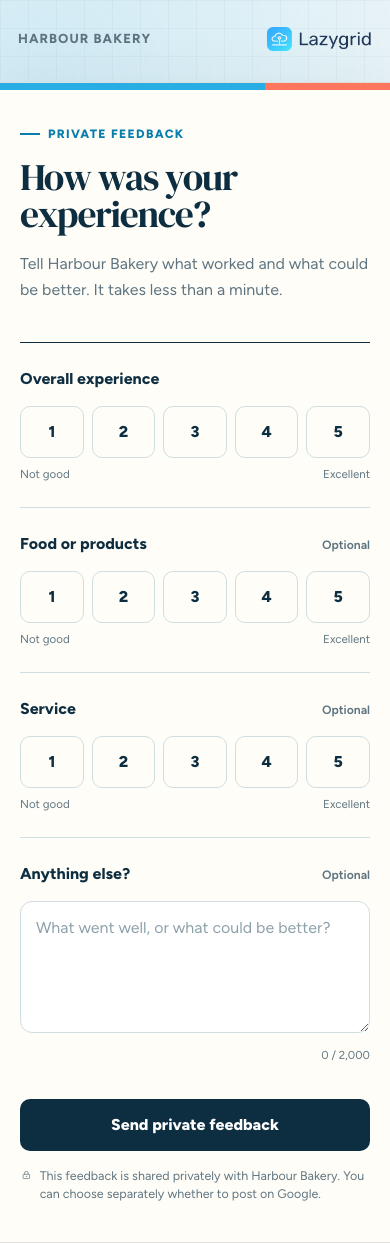
Leave the public choice to the customer
After submitting feedback, the customer can choose whether to continue to the business’s Google Business Profile.
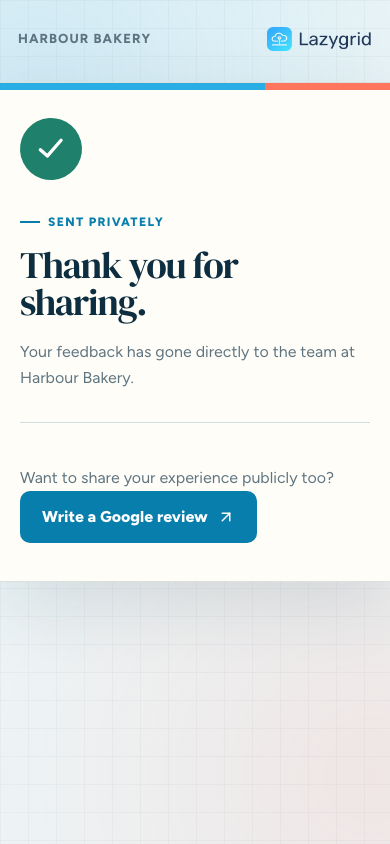
Start with a small test
Pick one location, set a sensible delay, and run the workflow long enough to see a normal mix of busy and quiet days. Track invitation delivery, feedback completion, repeated service themes, and public review activity. Then adjust the message or timing—without changing who receives the invitation.
Frequently asked
Google review questions from business owners
Why are Google reviews important for a business?
Google reviews can help more nearby customers discover a business in local search and give them confidence to choose it. A strong review profile can support visibility and turn searches into website visits, calls, direction requests, bookings, and foot traffic.
How should a business ask customers for Google reviews?
Ask every eligible customer consistently, keep the message short, and link directly to the business’s Google review form. Make the request after the visit while the experience is still fresh, without offering a reward or suggesting what rating to leave.
Can a business offer a free item or discount for a Google review?
No. Google’s fake engagement policy prohibits reviews posted because a business offered an incentive such as payment, a discount, a free product, or a service.
Is it okay to ask only happy customers for a Google review?
No. Selectively asking for positive reviews, or discouraging negative reviews, is review gating. Use the same invitation process for every eligible customer and let each person decide whether to post publicly.
When is the best time to ask a customer for a review?
Usually soon after the order is completed, while the visit is easy to remember. Avoid interrupting the meal or asking at the payment terminal. A short delay also gives the customer time to finish the experience before responding.
Do Google reviews improve local search rankings?
Google says local results are mainly based on relevance, distance, and prominence, and that more reviews and positive ratings can help a business’s local ranking. Reviews are one part of a complete and accurate Google Business Profile, not a guaranteed shortcut to the top position.
Build the habit into every day
Turn completed orders into better customer conversations.
See how Lazygrid connects ordering, customer feedback, and Google reviews in one practical workflow for hospitality businesses.
Google and Google Business Profile are trademarks of Google LLC. Lazygrid is not affiliated with or endorsed by Google. Policy links and guidance were checked on 4 September 2026.