
Square POS vs EFTPOS for NZ Food Trucks: Are Flat-Rate Fees Killing Your Margins?
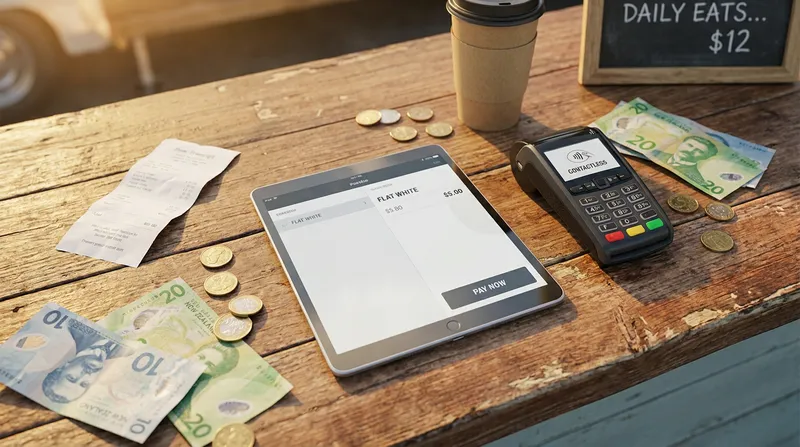
You are flipping burgers, pouring flat whites, or serving dumplings out of a window the size of a letterbox, and every dollar matters. Yet somewhere between the card tap and your bank account, a percentage of every single sale quietly disappears. For many New Zealand food truck operators, that leak is Square's flat-rate transaction fee of 1.6% on every card payment. On a $12 meal, that is 19 cents. On a $1,200 Saturday at a market, that is nearly $20 gone before you have paid for a single ingredient.
The question this article answers is simple: does Square's convenience justify its cost, or is a traditional EFTPOS integration a smarter long-term choice for your food truck, cafe, restaurant, or mobile hospitality business? We will break down the real numbers, expose the hidden trade-offs competitors rarely discuss, and show you a third path that combines the best of both worlds.
What Square POS Actually Costs NZ Food Trucks
Square markets itself on simplicity, and it delivers on that promise. Download the app, plug in a card reader, and you are accepting payments within minutes. For a brand-new food truck operator testing the market, that frictionless start is genuinely valuable.
But the pricing model deserves a closer look.
Square charges 1.6% per contactless or chip transaction in New Zealand. There are no monthly fees on the free plan, which sounds attractive. However, once you start processing real volume, the maths shifts dramatically.
| Monthly Turnover | Square Fee (1.6%) | Typical EFTPOS NZ Fee (blended ~0.8-1.0%) | Annual Difference |
|---|---|---|---|
| $10,000 | $160 | $80-100 | $720-960 |
| $20,000 | $320 | $160-200 | $1,440-1,920 |
| $40,000 | $640 | $320-400 | $2,880-3,840 |
Note: The blended EFTPOS NZ rate of 0.8% to 1.0% is based on published NZ bank merchant rate schedules as of 2025.
At $10,000 per month in card sales, Square costs $160. By comparison, negotiated EFTPOS fees might run $80 to $100, plus a $24 monthly POS plan. At this threshold, the integrated route is already comparable in price and includes features Square charges extra for.
At $40,000 per month in card sales (realistic for a busy food truck at multiple markets), you could be paying nearly $4,000 more per year with Square than with a properly negotiated EFTPOS NZ merchant facility. That is a commercial kitchen upgrade, a new fryer, or six months of ingredient costs.
According to Statistics New Zealand, the hospitality sector operates on notoriously thin margins, often between 3% and 9% net profit. A 1.6% transaction fee on every sale is not a rounding error. It is a structural drag on your business.
How Traditional EFTPOS Works in New Zealand
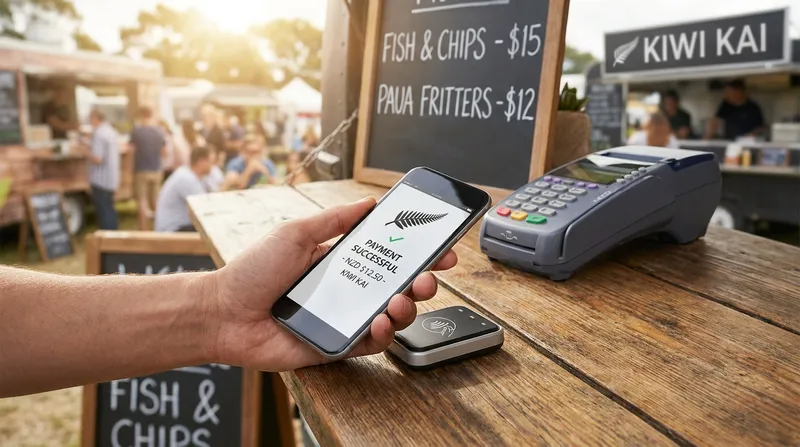
EFTPOS NZ is the dominant payment network for brick-and-mortar and mobile businesses across the country. According to EFTPOS NZ, more than 50,000 New Zealand merchants use their certified terminals, processing billions of dollars in transactions annually.
With a traditional EFTPOS setup, your merchant service fees are typically negotiated directly with your bank or a payment facilitator. These fees are usually structured as:
- A fixed monthly terminal rental (often $15-$40/month)
- A blended merchant service fee (often 0.5%-1.2% depending on card type and volume)
- No per-transaction markup beyond the agreed rate
It is worth noting that negotiating these merchant rates requires a business bank account and some trading history, which can be a barrier for brand-new operators. For high-volume operators, however, this structure is almost always cheaper than a flat-rate aggregator like Square.
The catch is that traditional EFTPOS terminals are standalone devices. They do not talk to your POS software unless you have a proper two-way EFTPOS integration.
Without integration, your staff manually enters the sale amount into the EFTPOS terminal after ringing it up on the POS. This creates two problems: human error (wrong amounts entered) and reconciliation headaches at end of day. If you want to understand how integrated EFTPOS reconciliation saves time and reduces till errors, the POS Reconciliation NZ: Stop Till Errors with 2-Way EFTPOS guide covers this in detail.
The Offline Mode Problem: Why Food Trucks Cannot Rely on Cloud-Only Systems
This is the gap that almost every competitor article ignores, and it is the one that matters most for food trucks.
Markets, festivals, sports grounds, and pop-up locations frequently have poor or no mobile data coverage. If your POS system requires a live internet connection to process payments, you are one dropped signal away from turning customers away.
Square does offer a limited offline mode, but with critical caveats:
- Offline payments are only accepted at Square's own risk
- Transactions are queued and processed when connectivity returns
- If a card is declined when the queue processes, you bear the loss
- Contactless payments are disabled in offline mode on some configurations
For a food truck operator at a remote market, this is not a theoretical risk. It is a real operational vulnerability.
A POS system with genuine offline mode continues processing sales locally, stores data on the device, and syncs when connectivity is restored, without the financial risk of unverified card approvals. According to Payments NZ, the payments infrastructure body overseeing New Zealand's retail payment systems, connectivity reliability remains a key consideration for mobile merchants.
When evaluating any cloud-based POS for your food truck, ask specifically: what happens to card payments when I lose internet? The answer will tell you everything.
Square POS vs EFTPOS Integration: A Side-by-Side Comparison
Here is an honest comparison across the dimensions that matter most to NZ food truck and cafe operators:
| Feature | Square POS (Free Plan) | Traditional EFTPOS + Integrated POS |
|---|---|---|
| Setup complexity | Very low | Moderate |
| Monthly fee | $0 (free plan) | $15-40 terminal rental + POS fee |
| Transaction fee | 1.6% all cards | 0.5%-1.2% negotiated rate |
| Offline mode | Limited, risky | Full local processing |
| EFTPOS NZ certified | No | Yes |
| Two-way integration | No | Yes (with compatible POS) |
| Inventory management | Basic | Advanced (with right POS) |
| Reporting | Basic | Comprehensive |
| Online ordering | Add-on cost | Included in some POS plans |
| NZ local support | Limited | Available with NZ-based providers |
The conclusion is not that Square is bad. It is that Square is optimised for simplicity at low volume. Once your food truck or cafe crosses roughly $8,000 to $10,000 per month in card sales, the economics of a proper EFTPOS integration start to outweigh the convenience premium.
The Hidden Costs of Square That Nobody Talks About
Beyond the 1.6% transaction fee, there are several less-discussed costs that affect food truck operators specifically.
Hardware dependency. Square's ecosystem is designed around its own hardware. If you want a receipt printer, a cash drawer, or a kitchen display, you are largely locked into Square-compatible peripherals, which carry a significant price premium over standard hospitality hardware.
No EFTPOS NZ certification. Square processes payments through its own payment gateway, not through the EFTPOS NZ network. This means you cannot use a standard bank-issued EFTPOS terminal alongside Square without manual reconciliation. New Zealand banks and many corporate clients specifically look for EFTPOS NZ certified terminals when reviewing merchant facilities.
Surcharging complexity. Many NZ food trucks pass card surcharges to customers to protect margins. Square's surcharging tools exist but require careful configuration, and the rules around surcharging under the Commerce Commission New Zealand guidelines require that surcharges not exceed the actual cost of processing. Flat-rate systems make this harder to calculate accurately.
Missing loyalty and gift card tools. Building a repeat customer base at regular markets is a significant revenue lever. Square's free plan lacks advanced loyalty programmes and native gift card capabilities. Regular market-goers love buying gift cards for friends, and these recipients often become loyal new customers.
What a Modern Integrated POS Looks Like for NZ Food Trucks
Imagine arriving at a busy Saturday market knowing your pre-orders are already paid for, your inventory is perfectly synced, and your EFTPOS terminal is running at your negotiated bank rate. This is what a modern cloud-based POS looks like for a New Zealand food truck.
The best setup is not Square OR EFTPOS. It is a system like Lazygrid POS, which combines full EFTPOS NZ integration, offline capability, and essential growth tools. Here is how that works in practice:
Payment processing: Integration with EFTPOS NZ certified terminals means you benefit from your negotiated merchant rates rather than a flat 1.6% markup. Over a year of trading, this difference funds real business growth.
Offline mode: The system continues processing sales locally during internet outages and syncs automatically when connectivity returns. No lost sales, no financial risk from unverified approvals.
Online pre-ordering: Customers can place and pay for orders before they arrive at your truck. No third-party commissions. Your brand, your customer data, your relationship. This is particularly powerful for food trucks with a regular market schedule, where regulars can order ahead and skip the queue.
Self-service kiosks and loyalty: For trucks with limited counter space, a self-service kiosk iPad speeds up ordering. Built-in loyalty programmes and gift card options turn casual walk-ups into returning regulars.
Inventory tracking: Know exactly what you have before service starts. Low-stock alerts mean you never run out of your best-seller mid-lunch rush. For a deeper look at how recipe-level costing works, Restaurant Inventory Management NZ: Stop Guessing Recipe Costs and Cut Food Waste is worth reading.
Plans start at $24/month for the Lite plan, while the $59/month Standard plan includes online ordering and booking, making it highly accessible for growing food truck operators. The Starter Package at $999 (GST exclusive) includes an iPad, wireless printer, and cash drawer, with leasing available from $79/month.
When Square Still Makes Sense
Fairness requires acknowledging that Square is the right tool in some situations:
- Brand-new operators processing under $5,000/month in card sales, where the simplicity outweighs the fee premium
- Occasional traders who operate one or two events per year and do not want a monthly commitment
- Businesses testing a concept before investing in a full POS infrastructure
- Operators in markets with reliable internet who do not need robust offline capability
If you are in any of these categories, Square is a reasonable starting point. The key is knowing when you have outgrown it.
Making the Switch: What to Consider
If you are currently on Square and considering a move to an integrated EFTPOS setup, here is a practical checklist:
- Calculate your actual transaction fee spend. Pull your last three months of Square statements and total the processing fees. This is your baseline.
- Get a merchant facility quote from your bank. Ask for blended rates based on your volume. Most NZ banks will negotiate, especially if you can show consistent turnover.
- Assess your internet reliability. Visit your regular trading locations and test mobile data. If you regularly drop signal, offline mode is non-negotiable.
- Evaluate your growth needs. Do you want online ordering? Loyalty programmes? Gift cards? These features should be included in your POS plan, not added as expensive extras.
- Consider the licence requirements. If you are still setting up your food truck operation, the How to Get a Food Truck Licence in NZ (2026 Guide) covers the regulatory side so your technology choices fit within your broader compliance framework.
For operators also running a fixed venue alongside a food truck, integrating your POS with accounting software is essential. The POS to Xero Integration: Automating Financial Reporting for NZ Hospitality Venues guide explains how to eliminate manual data entry entirely.
The Verdict: Flat-Rate Fees Are Costing You More Than You Think
Square's 1.6% flat rate is not inherently unfair. It is a transparent, predictable cost for a genuinely useful product. But for a food truck or cafe processing serious volume in New Zealand, it is almost certainly more expensive than a properly integrated EFTPOS solution.
The operators who thrive in NZ's competitive hospitality market are not the ones who chose the easiest setup on day one. They are the ones who built systems that scale, protect their margins, and give them real data to make decisions.
See how Lazygrid's EFTPOS NZ integration and offline mode could work for your food truck, with plans starting from $24/month.
For operators comparing broader POS alternatives in the NZ market, Best Toast POS Alternative NZ: Local Cloud Systems (2026) provides additional context on what local cloud-based systems offer over international platforms.
Frequently Asked Questions
What is Square's transaction fee in New Zealand and is it negotiable?
Square charges a flat 1.6% on all contactless, chip, and online card transactions in New Zealand. This rate is not negotiable regardless of your transaction volume.
By contrast, EFTPOS NZ merchant facilities negotiated through your bank typically offer blended rates between 0.5% and 1.2%. These rates can improve as your volume grows, potentially saving high-turnover food trucks thousands of dollars annually.
Can Square POS work offline at a market or festival in New Zealand?
Square does have a limited offline mode, but it queues card transactions and processes them when connectivity is restored. Square cannot verify whether a card has sufficient funds during offline processing.
If a transaction is later declined, you bear the financial loss. A POS system with genuine offline capability processes and stores transactions locally on the device, syncing when internet is available without the risk of unverified approvals.
What is the difference between Square POS and an EFTPOS NZ integrated POS system?
Square is a payment aggregator that bundles its own payment gateway with POS software. It does not connect to the EFTPOS NZ network used by most NZ banks.
An EFTPOS NZ integrated POS system connects your POS software directly to a certified EFTPOS NZ terminal. While you can technically use Square and EFTPOS NZ side-by-side, it creates operational complexity and requires manual end-of-day reconciliation.
Is Square POS suitable for a New Zealand food truck just starting out?
For a brand-new food truck processing under $5,000 to $8,000 per month in card sales, Square is a reasonable starting point. The zero monthly fee and instant setup reduce financial risk.
However, you should treat it as a stepping stone. As your volume grows, the 1.6% fee becomes increasingly costly compared to a negotiated EFTPOS merchant rate.
How do I calculate whether switching from Square to an EFTPOS integrated POS will save money?
First, find your total card processing fees on your Square statements for the last three months and annualise that figure. Then get a merchant facility quote from your bank based on your monthly card volume.
Add the monthly cost of your POS plan and EFTPOS terminal rental to the bank quote, and compare the two annual totals. For most NZ food trucks processing more than $10,000 per month, the integrated EFTPOS route is cheaper within the first year.