Why NZ Takeaways Are Ditching Uber Eats for Direct Ordering
The Friday Night Chaos: Why NZ Takeaways Are Ditching Uber Eats for Commission-Free Online Ordering
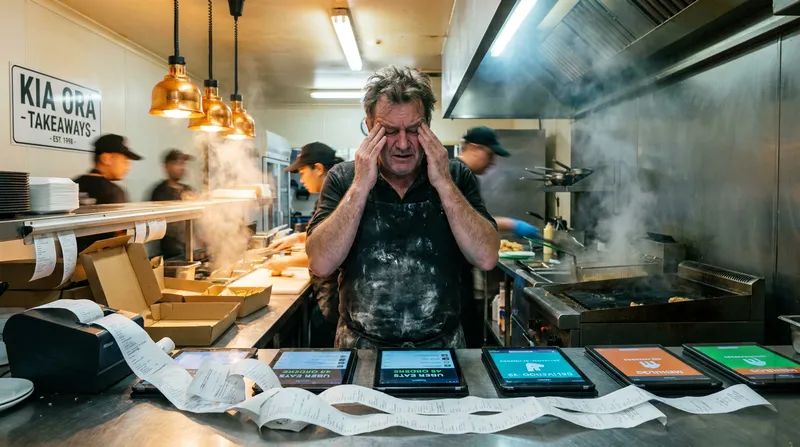
It is 6:30 PM on a Friday. Your kitchen is firing on all cylinders. The docket printer is spitting out orders faster than your chefs can read them. To your left, the Uber Eats tablet is pinging relentlessly. To your right, the Delivereasy tablet is flashing. Your front-of-house staff are frantically bagging orders while trying to serve the customers standing right in front of them.
From the outside, your business looks incredibly successful. You are moving a massive volume of food. But as an owner, you know the dark reality of the Friday night rush. When you sit down on Monday morning to review your margins, the truth hurts. You are working exhausting shifts and dealing with chaotic tablet management, only to realise you are making almost zero profit because third-party delivery apps are taking up to 35 percent commission on every single order.
If this sounds familiar, you are not alone. Across the country, hospitality owners are realising that the third-party delivery model is broken. This is exactly why a massive wave of local businesses are actively seeking Uber Eats alternatives NZ operators can rely on. They are taking back control of their margins by switching to direct online food ordering NZ platforms.
In this comprehensive guide, we will break down the true cost of delivery apps, show you how to transition your customers to your own platform without losing sales, and explain how a modern takeaway POS system NZ can automate the entire process.
Key Takeaways
- Margin Compression: Third-party delivery apps take up to 35 percent commission, leaving owners with minimal profit.
- The Hybrid Approach: Smart operators use delivery apps for customer acquisition while driving repeat business to their own direct ordering platforms.
- Customer Conversion: Tactics like strategic bag drops, exclusive menu items, and loyalty programmes effectively transition customers away from third-party apps.
- Operational Efficiency: Integrated POS systems eliminate tablet clutter and streamline kitchen operations.
- Labour Savings: QR code table ordering helps offset rising wage costs by improving front-of-house efficiency.
The Hidden Math: What Third-Party Apps Are Really Taking From You
Let us look at the actual math behind a typical third-party delivery order. According to data from the Restaurant Association of New Zealand, commission rates for major delivery platforms typically hover between 30 percent and 35 percent.
Imagine a customer places a $100 order for burgers and fries on a Friday night.
Here is how that $100 is distributed:
- Food and packaging costs: $32
- Staff wages and overheads: $30
- Uber Eats commission (30 percent): $30
- Your actual profit: $8
You did all the hard work. You bought the ingredients, paid the staff, cooked the food, and managed the chaotic kitchen. The delivery app simply routed a driver to your door, yet they walked away with almost four times your profit margin.
Furthermore, macro-level data from Stats NZ shows that the hospitality sector is facing intense margin compression due to rising operational and supply chain costs. You cannot afford to give away a third of your revenue just for the privilege of reaching your local customers.
This is why commission-free online ordering NZ is no longer just a nice feature to have. It is an absolute survival requirement for modern takeaways, cafes, and restaurants.
Uber Eats vs. Direct Online Ordering
| Feature | Uber Eats / Third-Party Apps | Direct Online Ordering (e.g., Lazygrid) |
|---|---|---|
| Commission Cost | 30% to 35% per order | 0% (Flat monthly subscription) |
| Customer Data | Owned by the app | 100% Owned by you |
| Menu Control | Limited, often delayed updates | Instant, real-time POS syncing |
| Brand Visibility | Listed next to direct competitors | Exclusive, fully branded experience |
What is a Direct Online Ordering System?
Before we discuss strategy, we need to define the technology. A restaurant online ordering system NZ is a digital platform that allows your customers to view your menu, place orders, and pay directly through your own branded website or web app, completely bypassing third-party marketplaces.
When you use an integrated solution like a direct online ordering system, the process is seamless:
- The customer visits your website (or scans a QR code) and places an order.
- The customer pays securely online via Stripe or another integrated payment gateway.
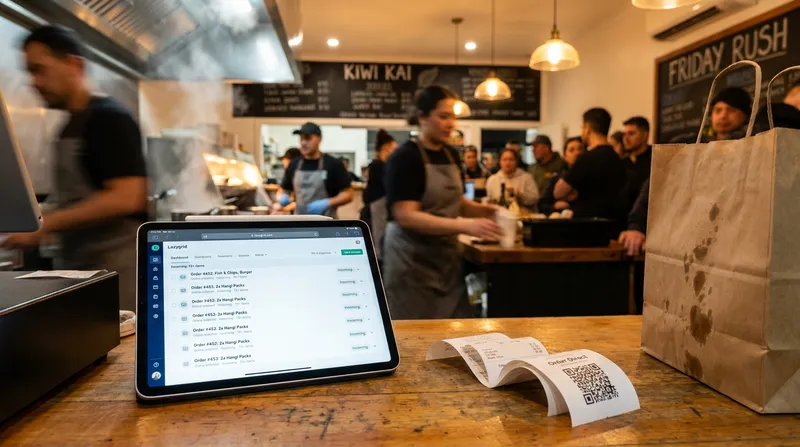
- The order flows directly into your Lazygrid POS system.
- A docket prints automatically in the kitchen.
- You keep 100 percent of the profit, paying only standard credit card processing fees.
There are no monthly commissions, no competing restaurants listed next to your menu, and no loss of customer data.
The Hybrid Approach: Using Delivery Apps as a Marketing Tool
One of the biggest fears business owners have is that if they turn off Uber Eats, they will instantly lose half their revenue. This fear is valid. Third-party apps have massive marketing budgets and huge user bases.
However, the smartest operators in New Zealand do not quit delivery apps cold turkey. Instead, they use the "Hybrid Approach."
In the Hybrid Approach, you treat third-party delivery apps purely as a customer acquisition channel, essentially a paid marketing tool. You accept that you will make very little profit on the first order a customer places through the app. Your entire goal is to ensure that their second, third, and fourth orders happen directly on your commission-free online ordering NZ platform.
Think of the 30 percent commission not as a tax on your food, but as a marketing fee to acquire a new local customer. Once you have them, it is your job to convert them.
How to Steal Your Customers Back (And Keep 100 Percent of the Profit)
Converting a customer from a third-party app to your direct online food ordering NZ system requires a deliberate strategy. You must give the customer a compelling reason to change their ordering habits.
Here are four actionable tactics you can implement this weekend:
1. The Strategic Bag Drop
Every time an Uber Eats or DoorDash driver picks up an order, you have a direct physical line of communication to the customer. Print high-quality, glossy flyers and drop one into every single delivery bag.
The flyer should have a clear, bold message: "Love our food? Order direct next time and get 15 percent off your entire meal! Scan this QR code to order now."
Even with a 15 percent discount, you are still making significantly more profit than you would by paying a 30 percent app commission.
2. Exclusive Menu Items
Customers love exclusivity. Create special menu items, family bundles, or secret dishes that are only available through your direct online ordering system. When customers browse your menu on a third-party app, add a note in your bio: "Want to try our famous Loaded Brisket Fries? Available exclusively when you order direct at our website."
3. Price Differentiation
Many operators are afraid to charge more on delivery apps, but it is a standard industry practice. Mark up your prices on third-party apps by 10 to 15 percent to partially offset the commission. Keep your direct online ordering prices lower. Customers will quickly realise that ordering directly from you is the cheaper option.
4. Implement a Digital Loyalty Programme
Third-party apps own the customer data. When a customer orders through them, you do not get their email address or phone number. By moving customers to your own platform, you capture this vital data. You can then use a built-in CRM to run a digital loyalty programme. Offer points for every dollar spent directly, which they can redeem for free items.
Integrating Online Orders with Your Takeaway POS System NZ
A major reason some owners hesitate to launch their own ordering platform is the fear of adding yet another tablet to the counter. The Friday night chaos is already bad enough without having to manually punch online orders into the till.
This is where a modern takeaway POS system NZ becomes invaluable.
When you upgrade to a unified system, your online ordering platform and your in-store point of sale are exactly the same software. If you sell out of a specific burger bun in the store, you simply tap a button on your POS, and it instantly updates your online menu, preventing angry customers from ordering out-of-stock items.
All orders, whether they come from a walk-in customer, a phone call, or your website, filter into the exact same kitchen display screen or docket printer. This eliminates double-entry, reduces human error, and completely streamlines your kitchen operations.
If you are worried about the cost of new hardware, modern solutions offer BYO hardware POS NZ flexibility. You can run the entire system on iPads or iPhones you already own.
Offset Rising Hospitality Wage Costs with QR Code Table Ordering
Takeaways are not the only businesses feeling the squeeze. Dine-in cafes and restaurants are facing unprecedented labour challenges. According to Hospitality New Zealand, rising wage costs are one of the most critical issues facing the sector today.
If you run a busy cafe, you know the bottleneck happens at the counter. During the morning coffee rush or the peak lunch hour, a long line forms. Customers get impatient, and your staff are trapped behind the till taking orders instead of making coffee or serving food.
Implementing QR code table ordering NZ is the ultimate shield against rising minimum wage costs. By placing a unique QR code on every table, customers can sit down, scan the code with their smartphone, browse a beautiful digital menu, and pay instantly.
This technology does not replace your staff, it supercharges them. Instead of paying someone to stand at a register punching in orders, that staff member can focus on running food, clearing tables, and providing excellent hospitality.
According to internal Lazygrid data, customers who order via QR codes or self-service ordering kiosks actually spend 20 to 30 percent more per order. They have time to browse the menu without feeling rushed, and the system automatically prompts them with upselling options like adding an extra shot of coffee or a side of fries.
For more insights on managing your labour effectively, check out our guide on optimising staff schedules.
Conclusion: Take Back Control of Your Business
The hospitality industry in New Zealand is tough enough without giving away your hard-earned profits to Silicon Valley tech giants. The Friday night rush should be a time of celebration, watching your revenue climb as your team executes a flawless service. It should not be a stressful, chaotic mess of pinging tablets that results in zero net profit.
By implementing a commission-free online ordering NZ platform, utilising QR code table ordering, and upgrading to a modern, integrated Takeaway POS System NZ, you can take back control of your customer relationships and your profit margins.
Stop working for the delivery apps, and start making them work for you. Use them for marketing, drop flyers in your bags, offer exclusive digital menus, and watch your direct revenue soar.
Ready to see how much you could save? Explore Lazygrid's plans starting from $24/month and try it free for 14 days. Plus, our Wellington-based support team is always here to help you succeed.
Frequently Asked Questions
Will I lose my regular customers if I leave Uber Eats?
Not if you transition them strategically. By using the "Hybrid Approach", you can keep third-party apps active for customer acquisition while offering incentives (like a 15 percent discount) for direct orders. Bag drops and exclusive menu items are proven ways to convert regular buyers to your direct online ordering system without losing their business.
How much does a commission-free online ordering system cost in NZ?
Unlike third-party apps that take up to 35 percent per order, modern POS systems typically charge a flat monthly subscription. For example, Lazygrid POS offers plans starting from $24 to $149 per month, which includes the POS software and online ordering capabilities. You only pay standard credit card processing fees, allowing you to keep 100 percent of your food profit.
How do I integrate direct online ordering with my existing takeaway POS system?
The most efficient way is to use an all-in-one cloud POS system. When your online ordering platform and in-store POS are the same software, orders from your website flow directly to your kitchen display screen or docket printer automatically. This eliminates the need for double-entry and clears the clutter of multiple delivery tablets from your front counter.
How can QR code table ordering help reduce my hospitality wage costs?
QR code ordering allows customers to browse the menu, order, and pay directly from their smartphones. This significantly reduces the time your front-of-house staff spend standing at a till punching in orders. Instead, your team can focus on running food and providing better service, allowing you to handle higher volumes of customers without needing to roster additional staff during peak hours.