
Best Cafe POS NZ: Track Beans & Milk Down to the Gram
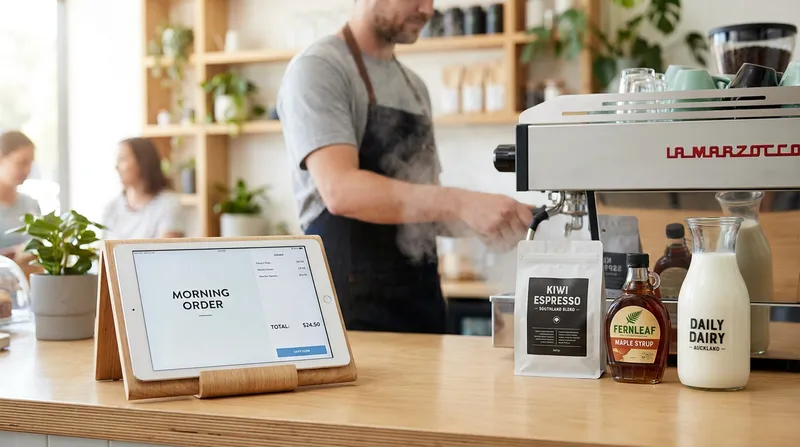
Many New Zealand cafe owners find themselves working exhausting hours only to see thin profit margins at the end of the month. The root cause is often a basic point of sale system that cannot track the true cost of liquid ingredients like milk and syrups or weighed goods like coffee beans. This invisible profit leak leads to inaccurate Cost of Goods Sold calculations, unexpected stockouts during the morning rush, and real uncertainty about whether your business is actually profitable. If your software only counts the number of cups you sell, you are missing the complete financial picture of your business.
The Morning Rush: Are You Actually Making Money on That Flat White?
The morning rush in a New Zealand cafe is a beautiful, chaotic symphony. The espresso machine hisses, the grinder hums, and the line of uncaffeinated customers stretches out the door. You are processing dozens of orders every hour. From the outside, your business looks incredibly successful. However, high sales volume does not always equal high profit if your inventory is not tracked correctly.
Many hospitality business owners mistakenly believe that selling a high volume of coffee guarantees a healthy bottom line. The reality is much more complicated. Standard retail systems treat a coffee order as a single, static unit. They count one flat white sold and deduct one flat white from a theoretical inventory. This basic unit tracking completely ignores the complex reality of a modern coffee order.
When a customer requests a half-strength, oat milk latte with a single pump of caramel, a basic system simply records a sale. It does not account for the premium alternative milk, the specific weight of the coffee beans used, or the exact volume of the syrup. Without this granular data, you are flying blind.
Actionable Tip: Take five minutes today to audit your current sales reports. Can you identify exactly how many litres of alternative milk your team used yesterday compared to the number of alternative milk surcharges processed? If the numbers do not match, you have a profit leak.
The Invisible Profit Leak: Why Standard POS Systems Fail Cafes
Generic retail POS systems are built to sell whole items like t-shirts or pre-packaged sandwiches. They fail spectacularly when applied to the dynamic environment of a specialty coffee shop. When your software treats a customized beverage as a single unit, it creates massive blind spots in your financial reporting.
These blind spots quickly turn into invisible profit leaks. Consider the daily realities of your cafe. A barista might forget to charge for an oat milk upgrade during a rush. Another staff member might use a heavy hand with the vanilla syrup. A new trainee might waste several espresso shots while dialing in the grinder. According to Fresh Cup Magazine, manual counting and data entry can lead to costly mistakes in busy cafes, making accurate ingredient-level tracking systems essential for maintaining profit margins.
Furthermore, relying on manual stocktakes to catch these discrepancies is a losing battle. Forcing your team to manually count syrup bottles and weigh open bags of coffee beans at the end of a long shift leads to errors and wasted wages. You need a system that tracks these variables automatically as every transaction occurs.
Actionable Tip: Implement a strict policy for dialing in the espresso grinder every morning. Create a specific "waste" button on your till so staff can log the exact amount of coffee beans used during this necessary calibration process.
What is Ingredient-Level Inventory Tracking?
Ingredient-level inventory tracking is the process of measuring your stock down to the gram for solids and the millilitre for liquids. Instead of tracking a generic "cup of coffee," this technology breaks down every menu item into its core components.
Modern cafe POS systems achieve this through the use of sub-recipes. When a customer orders a large latte, the cashier presses a single button. However, behind the scenes, the software automatically deducts 18 grams of coffee beans, 250 millilitres of milk, and one takeaway cup from your digital inventory. If the customer requests soy milk, the system swaps the standard dairy deduction for the exact volume of soy milk used.
Basic POS vs. Ingredient-Level POS
| Feature | Basic POS System | Ingredient-Level POS |
|---|---|---|
| Inventory Unit | Whole cups | Grams and millilitres |
| Modifiers | Text only | Deducts exact ingredients |
| COGS Accuracy | Estimated | Exact |
| Stock Alerts | Manual | Automated |
This level of detail is crucial for calculating your exact Cost of Goods Sold. Understanding your true costs answers the core question of whether a business is actually making money, as noted in a guide by the Business Development Bank of Canada. When you know exactly what every drink costs to produce, you can set prices that guarantee profitability.
Actionable Tip: Weigh your standard double espresso shot and measure your standard milk pour into your most popular cup sizes. Use these exact measurements to create accurate baseline recipes for your software.
Case Study: Calculating the Exact COGS of a Flat White
To understand the financial impact of micro-inventory tracking, let us break down the exact cost of a standard New Zealand flat white.
Assume you purchase your house blend coffee beans for $33 per kilogram. A standard double shot uses 18 grams of coffee, costing you exactly $0.59. You buy standard blue top milk for $3.50 per two-litre bottle. A flat white requires roughly 150 millilitres of milk, costing $0.26. Finally, your branded compostable takeaway cup and lid cost $0.25 combined.
Your total ingredient cost for this flat white is $1.10. If you sell this drink for $5.50, you have a healthy gross profit margin. However, because COGS is deducted directly from revenue to find gross profit, every untracked cost comes straight off your margin, as explained by the Corporate Finance Institute.
If a customer requests a premium single-origin bean or an expensive macadamia milk and your staff forgets to apply the surcharge, your cost jumps significantly while your revenue stays flat. Multiply that single error by fifty drinks a day, and you are losing thousands of dollars a year.
Actionable Tip: Calculate the exact cost of your most expensive alternative milk per millilitre. Ensure your POS surcharge completely covers this increased cost plus a reasonable profit margin.
Key Features to Look for in a Coffee Shop POS
When evaluating a new system for your cafe, you must look beyond basic transaction processing. Systems like Lazygrid offer a specific set of features tailored to the hospitality industry.
- Cloud-Based Architecture: Cloud systems allow you to check your sales data, update menus, and monitor inventory from your smartphone while you are away from the shop. Furthermore, opting for an iPad-based setup is highly recommended for small spaces. To understand how these devices maximize counter space, read our comprehensive guide on iPad POS NZ: Manage Bookings, Sales & Stock (2026).
- Seamless Accounting Integration: Integrating a perpetual inventory system with accounting software allows businesses to track stock levels and profit margins in real time, which is a major focus for local platforms like Xero. This integration completely eliminates the need for manual data entry at the end of the week.
- Loyalty and Self-Service: Loyalty programs keep your regulars returning, protecting revenue without increasing acquisition costs. Self-service kiosks reduce queue times and free up staff during peak hours.
- Transparent Pricing: Budgeting is critical for cafes. Ingredient-level inventory tracking is available on Lazygrid's Standard plan from $59/month, helping you self-qualify without hidden fees.
- Automated Low-Stock Alerts: Running out of your most popular oat milk or your signature espresso blend mid-morning is a disaster for customer loyalty. A smart system sends automated notifications to your phone the moment inventory drops below a predefined threshold.
Actionable Tip: Map out your ideal counter layout on a piece of paper. Ensure your chosen hardware fits the ergonomic flow of your baristas so they do not have to cross paths to process a payment.
Speed and Flow: Keeping the Barista Station Moving
In the coffee business, speed is a form of customer service. Even the best coffee in town will not save you if customers have to wait twenty minutes to get it. Your technology should actively speed up your workflow.
Integrated EFTPOS is the first step toward a faster counter. Lazygrid integrates seamlessly with EFTPOS NZ certified terminals, a standard trusted by 50,000+ NZ merchants. When your point of sale talks directly to your payment terminal, your staff never have to manually type the total amount into the card reader. This simple integration saves five to ten seconds per transaction and completely eliminates manual keying errors.
Behind the counter, you can replace messy paper dockets with a Kitchen Display System designed specifically for baristas. Paper tickets easily get lost, ruined by spilled water, or misread due to bad handwriting. A digital screen organizes orders clearly and highlights customized modifiers in bright colors. For a deeper dive into setting up digital screens, check out our KDS Configuration Guide: Optimise Your NZ Kitchen Flow.
Actionable Tip: Time your current average transaction speed during a busy period. Calculate how much more revenue you could generate per hour if you shaved just fifteen seconds off every single order.
Scaling Up: From Single Cafe to Multi-Location or Food Truck
As your business grows, your operational challenges multiply. Opening a second location or launching a mobile food truck requires a technology platform that can scale effortlessly alongside you.
Modern point of sale systems go beyond processing sales transactions to actively manage inventory and detailed sales reports from a single platform, an operational necessity recognized by business publications like Forbes. A multi-site operator needs centralized reporting to compare performance across different branches instantly. You also need the ability to manage a central prep kitchen that distributes baked goods and roasted beans to your various retail locations.
For mobile operators, offline mode capabilities are absolutely vital. If you take your food truck to a weekend festival in a remote New Zealand location, you cannot rely on a steady internet connection. Your software must continue to process cash sales and store data locally until you reconnect to the cloud. If you are planning to expand, our resources on Multi-Location POS Systems: The NZ Scaling Guide provide a roadmap for success.
Actionable Tip: Choose a software platform that allows you to add new registers or locations with a simple software license upgrade rather than requiring you to purchase expensive, proprietary legacy hardware.
How Lazygrid Helps NZ Cafes Stop the Leaks
Lazygrid's ingredient-level inventory tracking is built specifically to help Kiwi hospitality businesses maximize their margins. By automatically deducting every gram of coffee and millilitre of milk, Lazygrid ensures your financial reports reflect reality. It connects your front-of-house speed with back-of-house accuracy, allowing you to focus on brewing great coffee instead of stressing over missing inventory.
Conclusion: Stop Guessing, Start Tracking
Granular inventory tracking is the ultimate key to cafe profitability. When you track your coffee beans, milk, and syrups down to the exact gram and millilitre, you eliminate invisible profit leaks and gain total control over your business finances.
The right technology easily pays for itself by preventing uncharged extras, minimizing wasted ingredients, and saving hours of manual stocktaking labor. Explore how Lazygrid can give your cafe complete ingredient-level visibility from day one by visiting our product page.
Stop guessing about your profit margins. Implement a system that gives you the exact data you need to thrive in the competitive New Zealand hospitality market.
Frequently Asked Questions
What is the best POS system for a small cafe in NZ?
The ideal cafe POS system in NZ is cloud-based, runs on an iPad for maximum space efficiency, and offers ingredient-level inventory tracking. This setup allows you to accurately measure milk, syrups, and coffee beans instead of just counting cups.
How do I track coffee bean inventory accurately?
Instead of tracking by the cup, use a modern POS that supports sub-recipes. You can program the system to automatically deduct a specific weight (for example, 18 grams) of coffee beans from your bulk inventory every time a barista rings up a shot.
Can a cafe POS integrate directly with Xero?
Yes, top-tier hospitality systems in New Zealand offer direct Xero integration. This connection automatically syncs your daily sales, Cost of Goods Sold, and inventory data, which completely eliminates manual data entry for your accounting.
Do I need a KDS (Kitchen Display System) for a coffee shop?
While not strictly mandatory, a barista-facing KDS significantly improves speed and accuracy during the morning rush. It replaces easily lost paper dockets with clear digital order screens, ensuring customized drinks are made perfectly every time.
How does a POS system handle milk alternatives and extra shots?
Advanced software uses recipe modifiers. When a customer orders oat milk or an extra shot, the system automatically adds the appropriate surcharge to the bill and deducts the exact millilitre or gram amount from your digital inventory, protecting your profit margins.