
EFTPOS in New Zealand 2026: What It Actually Costs, and How to Check You're Not Overpaying
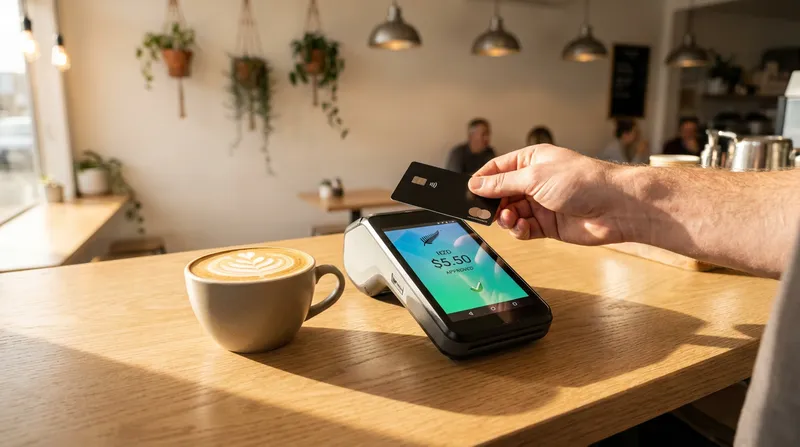
If you run a café, restaurant, or takeaway in New Zealand, here is the short version.
- Traditional EFTPOS — card inserted or swiped, customer selects Cheque or Savings — costs you nothing per transaction. No interchange, no merchant service fee. This is unique to New Zealand.
- The same card, tapped, does cost you money. Contactless debit carries a 0.20% interchange fee plus your bank's margin.
- Domestic credit card interchange was cut from around 0.80% to 0.30% on 1 December 2025. If your merchant statement didn't get cheaper in early 2026, that is a question worth asking your provider.
- The average merchant service fee in New Zealand is now around 0.91%. That figure comes from ANZ's own submission to the Commerce Commission. If you're paying substantially more, you have room to negotiate.
- Your total cost has three separate parts, usually from three separate companies: the terminal, the network, and the merchant service fee. Knowing which is which is most of the battle.
The rest of this guide shows you where each of those numbers comes from, what the three providers we integrate with are each best at, and the questions to ask before you sign anything.
A note on where we sit: Lazygrid doesn't sell EFTPOS terminals and doesn't earn a cut of your card fees. Our POS connects to whichever terminal you choose. That means we have no reason to talk you into an expensive setup — and it's why this guide is written as a measuring stick rather than a sales pitch.
The number most small operators don't know

Merchant service fees used to be published. Here is ANZ's Merchant Service Fee Schedule as it stood in August 2020 — card-present transactions, with the rate set by two things: your monthly credit card turnover, and your average transaction size.
| Monthly credit card sales | Avg $1,000+ | $100–499 | $50–74 | $30–49 | $0–29 |
|---|---|---|---|---|---|
| $50,000 + | 1.96% | 2.45% | 2.85% | 3.25% | 4.00% |
| $15,000–49,999 | 2.17% | 2.66% | 3.06% | 3.46% | 4.21% |
| $5,000–14,999 | 2.38% | 2.87% | 3.27% | 3.67% | 4.42% |
| $2,000–3,499 | 2.80% | 3.29% | 3.69% | 4.09% | 4.84% |
| $0–499 | n/a | 3.71% | 4.11% | 4.51% | 5.26% |
Look at the shape of that table. The lower your average sale, the more you pay. A business selling $1,000 items paid 1.96%. A business selling $8 flat whites paid up to 5.26%.
Now put a typical New Zealand café in it: average transaction around $25, monthly card turnover somewhere between $5,000 and $15,000. That's the 4.42% cell.
Against a current market average of 0.91%, that is nearly five times the going rate.
Two things to say about this, honestly. First, that schedule is from 2020 — it predates both the 2022 interchange caps and the December 2025 cut, so nobody should be on those rates today for a newly negotiated facility. Second, ANZ no longer publishes a merchant service fee schedule at all. The PDF is gone from their site. What ANZ publishes now is the interchange component — the part set by regulation — while its own margin is quoted per business. Its Merchant Operating Guide says only: "Fixed rates may be provided on request. Generally, a minimum monthly fee applies."
So the rack card has disappeared from public view, and the rates moved. But contracts don't renegotiate themselves. If you signed a fixed-rate merchant facility years ago and nobody has been back to you since, the old pricing logic — small average sale, small turnover, high rate — may well still be sitting on your statement.
That is the single most valuable thing in this guide: go and look at your merchant statement, find the percentage, and compare it to 0.91%.
Where the money actually goes
Your cost of accepting a card splits into two layers, and only one of them is negotiable.
Layer one: interchange. This goes to the bank that issued your customer's card. It is regulated by the Commerce Commission under the Retail Payment System Act 2022, it is published, and it is capped. These are the caps set out in the Commission's Final Decision and Reasons Paper of 17 July 2025:
| Card and method | In person | Online |
|---|---|---|
| Domestic debit — inserted or swiped, Cheque/Savings | 0.00% | 0.60% |
| Domestic debit — contactless tap | 0.20% | 0.60% |
| Domestic personal credit | 0.30% | 0.70% |
| Foreign-issued debit | 0.60% | 1.40% |
| Foreign-issued personal credit | 0.70% | 1.50% |
| Commercial credit (domestic and foreign) | Uncapped | Uncapped |
| Domestic prepaid | Uncapped | Uncapped |
Two changes worth knowing: domestic personal credit interchange dropped from 0.80% to 0.30% for in-person transactions on 1 December 2025, and foreign-issued cards were capped for the first time on 1 May 2026. Domestic debit caps did not change.
One line in that table deserves more attention than it usually gets: commercial credit cards are not capped. When a customer pays with a company card rather than a personal one, the interchange your provider passes through is unregulated — previously in the range of 0.45%–2.20% domestically. If you serve a lot of business customers, corporate accounts, or work lunches, that is a real and invisible cost difference. The Commission has this category under review.
Layer two: your acquirer's margin. This is your bank's or provider's own charge on top. ASB describes its pricing as "Interchange Plus" and says plainly that the Plus component is "tailored to a business". ANZ lists its equivalent as scheme fees, a network transaction fee, float costs, and the "ANZ acquirer margin".
Nobody publishes layer two, because by design it is a per-merchant negotiated number. That is not a gap in this guide — it is how the market works. Which is exactly why the 0.91% average matters: it is the only public benchmark you have.
The tap-versus-insert gap
This is the part that catches most operators, and it comes straight from ASB's own website:
If domestic Visa or Mastercard debit cards are accepted via contactless they will incur a 0.20% interchange fee and a Merchant Service Fee. If the same card is swiped or inserted, and CHQ or SAV is selected, then the transaction will be processed as an EFTPOS transaction and no fees will be incurred.
Same card. Same customer. Same amount. Tap and you pay; insert and you don't.
Across New Zealand, this is not a rounding error. In its 2024 submission to the Commerce Commission, ANZ put interchange-free EFTPOS at approximately 30% of transaction volumes, and noted it isn't limited to EFTPOS cards — scheme cards swiped or inserted at the point of sale are free too.
You can't dictate how customers pay, and we wouldn't suggest trying. But knowing this changes two decisions: how you think about surcharging, and — more importantly — which pricing model actually suits your business. More on that below.
The three things you're actually paying for
Most confusion about EFTPOS pricing comes from bundling three separate charges, often from three separate companies, into one mental number.
1. The terminal. A monthly rental or an outright purchase. Shift4's published comparison puts standard terminal rental at $30–$60 + GST per month. EFTPOS NZ doesn't publish terminal pricing — its site says the monthly fee depends on the device and contract term.
2. The network. New Zealand has two main payment networks, and this fee is published:
- Verifone network: $15.00 + GST per terminal, per month
- Worldline network: $18.90 + GST per terminal, per month
We're stating these as fact because three competing sources agree: Worldline's own standard merchant agreement lists an EFTPOS Administration Fee of $18.90 + GST per terminal per month regardless of transaction volume; EFTPOS NZ publishes both figures; and Shift4's pricing page quotes the same $15–$18.90 range for its competitors.
Worth knowing, from EFTPOS NZ directly: "Your acquiring bank and merchant facility are separate from your network connection. You can change networks and keep your existing bank." Terminal, network, and acquirer are three things you can change independently. You are not obliged to move all three at once.
3. The merchant service fee. Interchange plus your acquirer's margin, as above. This is the big one, and the one to benchmark against 0.91%.
There are smaller line items that rarely appear in a sales conversation. Worldline's standard agreement also lists a $30 + GST standby fee per terminal per six months — genuinely useful if you close seasonally and want to keep the terminal registered without paying full freight — along with telecommunications access fees of $6.95–$9.95 + GST per month, and, for leased-line connections, a charge that decreases as your volume rises: $200/month under 3,000 transactions, dropping to nothing above 8,000.
What each provider is best at
We connect to Windcave, EFTPOS NZ (Verifone), and Shift4. Each is genuinely the right answer for a different kind of business, so rather than crown a single winner, here's what each does best.
Most consistently recommended by the operators we work with — EFTPOS NZ (Verifone)
When we ask our customers which setup has given them the least trouble day-to-day, the Verifone Android terminals running the vcloud protocol come up most often. The current range covers most venue types: V400c and T650c on the counter, T650p as a hybrid counter/mobile unit, and M440 for self-service and kiosk setups.
One practical tip that falls out of this: ask which integration protocol your terminal will run, not just the model number. The same hardware can behave quite differently with your POS depending on the protocol, and it's rarely mentioned unless you raise it.
Simplest to get started — Shift4 (formerly Smartpay)
Shift4 is the only one of the three publishing a complete price list. Its Low Cost Tap & Pay plan is $0 terminal rental, $0 network fee, $0 connectivity, and a single blended merchant service fee of around 1% covering every card type. For an operator who wants one number and one bill, nothing else in this market is that simple.
Two things to know. If you knew this business as Smartpay, that's the same company — Shift4 announced the acquisition in June 2025 and completed it late that year. And per Shift4's own merchant terms, its devices connect via the Worldline network and you will still need a merchant account with a New Zealand bank. No provider in this market removes the bank from the picture entirely.
Most flexible billing structure — Windcave
Windcave is the only one of the three offering Interchange+ billing in New Zealand alongside blended pricing. On Interchange+, your invoice separates the regulated interchange fee from the provider's own margin, as two distinct line items.
That distinction matters more than it sounds. On a blended rate you get one percentage and no way to tell how much of it is pass-through cost and how much is margin — which makes it very hard to know whether a quote is competitive. If you want to see what you are actually paying for, ask whether Interchange+ is available to you.
Which pricing model fits your business
This is the decision that actually moves money, and it has nothing to do with brand.
A blended rate — one percentage for every card type — suits you if most of your revenue arrives on credit cards or contactless. You're paying a flat rate on transactions that would otherwise carry the higher interchange, and the simplicity is worth something.
Interchange-plus suits you if a large share of your transactions are inserted or swiped debit. Remember that roughly 30% of New Zealand card volume carries zero interchange. On interchange-plus, that pass-through cost is genuinely zero and you pay only the margin. On a blended rate, you pay the same ~1% on transactions that cost your provider nothing.
A café with a $9 average sale and a lot of local debit customers is in a very different position from a restaurant with a $180 average bill and a high proportion of credit and international cards. The same provider can be the cheaper choice for one and the more expensive choice for the other.
So the question to take to a sales conversation is not "what's your rate?" It's "what's your rate on inserted debit, on contactless debit, on domestic credit, and on international cards?" Four numbers. If you only get one, you're on a blended rate — which may still be the right answer, but you should know that's what you've agreed to.
The contract terms worth reading
Payment contracts have a reputation for locking businesses in for years. Worldline's standard tripartite merchant agreement — the one published by EFTPOS NZ and reproduced in Shift4's own terms — is more flexible than that reputation suggests.
- You can exit for convenience with 60 days' written notice. The provider needs 90 days to exit on you.
- The agreement auto-renews in successive 12-month terms once the initial term ends. Worth diarising.
- A price rise opens a window. If fees are varied, the change takes effect no earlier than a month after notice — and you may terminate within 30 business days of receiving it. A fee increase notice is a renegotiation opportunity, not just bad news.
- Provider liability is capped at the fees you paid them over the preceding six months.
Please check the current version against your own paperwork — the published standard text we're describing is dated 1 July 2022, and your Letter of Offer sets your actual fees and term.
Before you sign: five questions
- What is my rate on each of the four card types — inserted debit, contactless debit, domestic credit, international? If you only get one number, ask whether Interchange+ is available.
- Is there a minimum monthly merchant service fee? ANZ's Merchant Operating Guide notes that a minimum generally applies. On a low-turnover site, a minimum can quietly become your real rate.
- What happens when the network goes down? Can the terminal still take payment offline, and up to what value? Worldline's standard agreement sets an offline guarantee limit of $300 for debit cards without an international scheme mark.
- Who do I call? With a terminal provider, a network, and an acquiring bank in the mix, find out before there's a problem whether you have one contact or three.
- Can I test it in my own venue, at my own busy time, with an international credit card? Inserted domestic debit is close to instant for everyone. International credit authorisation travels the full cross-border chain — issuer, scheme, acquirer, gateway — and that is the transaction that will hold up your queue. It's also the one a showroom demo is least likely to put in front of you.
How we put this guide together
Lazygrid works with around 270 hospitality and retail businesses across New Zealand. Over the past year we've spoken with them directly, by phone and in person, about how their payment setup performs day to day. Not every operator had a view on every question, and this was ongoing customer conversation rather than a formal written survey — so we've reported what came up consistently rather than putting percentages on it.
Everything else here is sourced from public documents, and we've checked each against the original rather than a summary:
- Interchange caps: Commerce Commission, Interchange Fee Regulation for Mastercard and Visa Networks — Final Decision and Reasons Paper, 17 July 2025 (Table X1).
- Market averages and surcharging figures: ANZ's submissions to the Commerce Commission, 2 September 2024 and 20 July 2026.
- Merchant service fee structure and the tap/insert difference: ASB's published merchant service fee page.
- Terminal, network, and contract terms: Worldline's standard tripartite merchant agreement (1 July 2022 text, published by EFTPOS NZ and reproduced in Shift4's merchant terms), plus current published pricing from EFTPOS NZ and Shift4.
- The 2020 fee table: ANZ's Merchant Service Fee Schedule, document reference A0468 08/20. ANZ no longer publishes a merchant service fee schedule, so this document is not currently available online. We've included it because the pricing logic it shows — small average sale, higher rate — is still sitting on older merchant agreements.
We don't sell terminals. If this guide helps you take your existing statement back to your provider and ask a better question, it has done its job.
Frequently asked questions
How much does an EFTPOS machine cost in NZ? Terminal rental is commonly $30–$60 + GST per month, plus a network connection fee of $15.00 + GST (Verifone) or $18.90 + GST (Worldline) per terminal per month. Shift4's Low Cost Tap & Pay bundles terminal, network, and connectivity at $0 and charges a single blended rate of around 1% instead. On top of whichever you choose sits the merchant service fee on credit and contactless transactions.
What is the cheapest way to accept card payments in New Zealand? Traditional EFTPOS — the customer inserts or swipes and selects Cheque or Savings — carries no interchange and no merchant service fee. It is the cheapest card acceptance method in the country, and it's a quirk of the New Zealand payments network that doesn't exist in most markets.
What's a normal merchant service fee in New Zealand? ANZ told the Commerce Commission in July 2026 that the average merchant service fee across its merchant base is 0.91%, down from 1.35% in its 2024 submission. That is the best public benchmark available. Your own rate depends on your card mix, average transaction value, and turnover.
Why is contactless more expensive than inserting the card? A tapped debit card is routed through the Visa or Mastercard network and attracts 0.20% interchange plus your acquirer's margin. The same card inserted, with Cheque or Savings selected, runs on the domestic EFTPOS network, where interchange is zero.
Do I need a separate merchant account with my bank? In most setups, yes. An EFTPOS terminal accepts New Zealand debit cards by default; accepting Visa, Mastercard, or UnionPay credit and contactless requires a merchant facility from your bank, which sets your merchant service fee. Even Shift4, which acts as acquirer for its own plan, requires a New Zealand bank merchant account under its published terms.
Can I change my EFTPOS provider without changing banks? Yes. As EFTPOS NZ puts it, your acquiring bank and merchant facility are separate from your network connection — you can change networks and keep your existing bank.
Am I locked into a long contract? Under Worldline's published standard agreement, a merchant may terminate for convenience on 60 days' written notice, and the agreement auto-renews in 12-month terms. A variation to fees also gives you 30 business days to terminate. Check your own Letter of Offer, which governs your actual term and fees.
Did my fees go down after the December 2025 interchange cut? They should have. Domestic in-person credit interchange fell from around 0.80% to 0.30% on 1 December 2025, and that reduction was expected to flow through to merchant service fees. The change should have been visible on early-2026 statements. If yours didn't move, that is a reasonable thing to raise with your provider.