
How Self-Ordering Systems Boost NZ Restaurant Revenue 30%
Introduction: The Squeeze on NZ Hospitality Profits
New Zealand hospitality owners are exhausted. If you run a local cafe, restaurant, or food truck, you already know the daily struggle. Constant staff turnover and rising wage costs are squeezing your profit margins tighter than ever. You are paying more for ingredients, more for rent, and significantly more for labor, yet there is a limit to how much you can raise your menu prices before customers stop coming through the door.
At the same time, you might be terrified that introducing automated ordering screens will destroy the authentic, personal customer service that makes your independent venue special. You built your brand on connection, and the idea of replacing that with a cold corporate kiosk feels wrong.
However, hospitality technology in NZ has evolved. Implementing an automated ordering system is no longer a corporate takeover. It is a vital survival tool for independent venues. In this guide, you will learn exactly how a self-ordering system tackles the dual problems of staff shortages and low profit margins. More importantly, we will show you how to boost your average order size by up to 30 percent without losing your unique brand identity.
The Real Cost of Staff Shortages in Local Cafes and Restaurants
Finding and keeping reliable front-of-house staff is a systemic issue across the country. The reality is that the local talent pool is shrinking, and the cost of training new hires only to have them leave a few months later is crippling independent businesses.
According to research from Auckland University of Technology, the New Zealand hospitality workforce is young and highly transient. This makes staff shortages and high turnover a constant, systemic problem for local employers. When you are understaffed, the impact is immediate and severe. Queues build up out the door, wait times skyrocket, and your remaining staff become stressed and burned out.
This operational bottleneck directly leads to lost revenue. Customers who see a massive line during their short lunch break will simply walk away. A survey highlighted by Ringa Hora revealed that up to 62 percent of business respondents had to temporarily close due to ongoing staffing shortages. You cannot afford to shut your doors just because a staff member called in sick.
By integrating self-service technology, you can reduce restaurant wait times and keep the orders flowing even when you are a person down. The goal is to build a resilient business model that does not collapse when your roster changes.
Actionable Tip: Audit your busiest hours this week. Track exactly when your queues exceed five people. By identifying these specific staff bottlenecks, you can learn how to optimise staff schedules and deploy self-service technology precisely when it is needed most.
How a Restaurant Table Ordering System Increases Average Order Value
There is a direct, proven correlation between self-service technology and larger ticket sizes. Case study data shows self-ordering stations can increase average order size by up to 30 percent. When you implement a restaurant table ordering system, you fundamentally change the psychology of how your customers buy food.
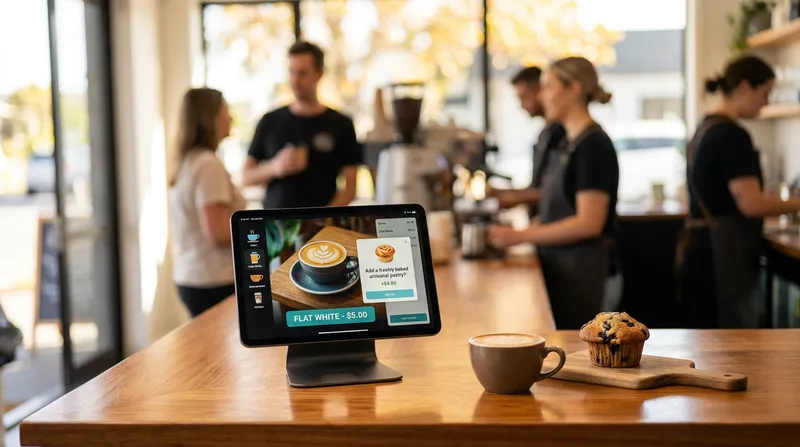
Think about the traditional ordering experience at a busy counter. A customer walks up, looks at the menu board, and feels the immediate pressure of the queue standing behind them. The cashier is rushing to get through the line. In this high-pressure environment, the customer usually panics, orders their basic main item, and steps away. They rarely take the time to browse the extras, sides, or premium drink upgrades.
When you remove that social pressure, everything changes. A customer sitting comfortably at their table with a digital menu can take their time. They can explore the menu at their own pace. They do not feel guilty taking an extra two minutes to decide if they want a slice of cake or an extra shot of espresso.
Data provided by Abacus from an Appetize case study shows that self-ordering stations accommodated more orders and resulted in a 30 percent increase in average order size. This translates to at least $8 more per transaction. Multiply that by 100 orders a day, and the revenue impact is massive.
The Psychology of Visual Upselling and Loyalty
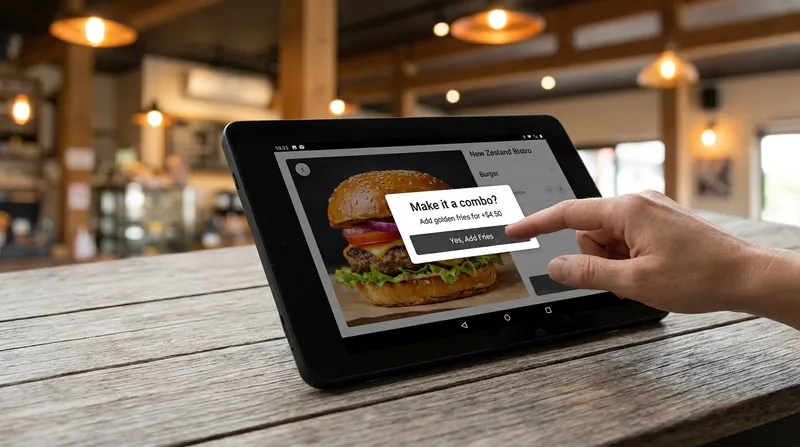
Humans eat with their eyes. A text-only paper menu relies entirely on the customer's imagination, which is a terrible sales strategy. An automated ordering system changes this dynamic by putting high-definition, mouth-watering images directly in front of the buyer. When a customer sees a glossy, perfectly lit photo of a loaded brownie sundae right before they pay, it triggers an impulse purchase that a simple text description never could.
A real-world example highlighted by the US Chamber of Commerce demonstrates this perfectly: restaurants increased their average order by 25 percent and drove a 100 percent increase in kitchen throughput during busy times simply by using self-ordering kiosks. The screens never forget to ask if a customer would like fries with their meal, and they always present the food in the best possible light.
Beyond visual upselling, you can also maximize revenue with built-in loyalty features. By integrating the Lazygrid Loyalty Programme directly into the checkout flow, you can turn first-time visitors into regulars. Customers can easily track their points on the screen, encouraging them to return and spend more.
Actionable Tip: Invest in professional photography for your top 5 highest-margin items. Do not use stock photos. Upload these authentic, high-quality images to your digital menu ordering system to maximize your upselling impact.
Balancing Technology with Hospitality: Keeping Your Brand Authentic
The biggest fear independent owners have is that self-service kiosk hospitality will make their venue feel like a sterile corporate fast-food chain. You pride yourself on knowing your regulars by name and remembering their usual coffee order. You do not want to lose that magic.
The secret is adopting a hybrid service model. Technology should not replace your hospitality; it should enhance it.
When you use a restaurant POS integration to handle the purely transactional parts of the business (taking the order and processing the payment), you free your staff from being human calculators. Instead of staring down at a screen punching in numbers, your staff can look up, make eye contact, and actually engage with your guests.
They can spend their time delivering food to the table, asking how the meal tastes, and clearing plates efficiently. This hybrid approach is especially effective for bar-restaurant hybrids, where staff need to balance quick drink service with longer dining experiences.
Actionable Tip: Train your staff to repurpose the time they save on taking orders. Implement a rule where staff must do a table touch-point (checking in on the guests and clearing empty glasses) every time they walk through the dining room.
Self-Ordering Kiosk Cost vs. NZ Minimum Wage
When evaluating any new technology, you need a transparent, localized ROI breakdown. Many owners hesitate because they assume the self-ordering kiosk cost will be astronomical. However, when you compare it to the current New Zealand minimum wage, the math becomes undeniable.
Currently, a full-time front-of-house employee on the NZ adult minimum wage of $23.95 per hour (effective 1 April 2026) costs a business nearly $1,000 a week before factoring in holiday pay, sick leave, and ACC levies. In contrast, modern cloud-based kiosk systems offer incredible value. Lazygrid offers transparent pricing tiers at $24, $59, and $149 per month.
Let us look at the Standard plan at $59 per month. That costs you less than $2 a day. If your digital menu increases your average order value by just $5 through automated upselling, the system pays for itself after the first few transactions of the month. Every extra dollar generated after that is pure profit.
Furthermore, Lazygrid is EFTPOS NZ certified. This means your self-ordering setup accepts every payment method your customers prefer, from contactless cards to Apple Pay, with complete reliability. You are securing a reliable system that never calls in sick, never forgets to upsell, and costs a fraction of a human wage.
Actionable Tip: Calculate your current front-of-house labor percentage. Set a realistic goal to reduce it by 5 percent over the next quarter by shifting your peak-hour ordering volume to reliable POS hardware like iPads and automated kiosks.
Tailoring the Setup: From Busy Cafes to Food Trucks
One of the greatest advantages of modern hospitality technology is flexibility. Self-ordering is not a one-size-fits-all solution, and your setup should reflect your specific business model.
For a busy high street cafe, the ideal setup might be two iPad kiosks mounted securely on the counter, allowing the morning coffee rush to process themselves while the barista focuses entirely on pulling shots.
Conversely, if you operate a mobile business, a heavy permanent kiosk is useless. A food truck POS system needs to be compact, weather-resistant, and highly mobile. In this scenario, you might use a single iPad that can easily be packed down at the end of the day, paired with a QR code banner hung on the side of the truck so the queue can order from the pavement. Plus, Lazygrid's offline mode means you keep taking orders and payments even if the internet drops out at a busy weekend market.
Actionable Tip: Choose cloud-based hardware that can adapt to your environment. If you run a mobile operation or attend weekend markets, ensure you have a portable card reader that integrates seamlessly with your main iPad system.
4 Steps to Implement QR Code Menu Ordering NZ Customers Actually Use
Despite the clear benefits, some customers (particularly older demographics) still resist using QR codes. If you force a clunky, frustrating tech experience on your guests, you will lose them. To successfully implement QR code menu ordering in NZ, you must follow a frictionless rollout strategy.
Step 1: Use Clear, Friendly Table Signage Do not just stick a tiny barcode on the corner of the table. Use a well-designed table tent that clearly explains the benefit to the customer. For example: "Skip the queue. Scan here to order and we will bring your food right to you."
Step 2: Ensure Lightning-Fast Loading Speeds Your digital menu ordering system must be optimized for mobile devices. If a customer scans the code and has to wait 30 seconds for massive PDF files to load, they will give up and walk to the counter. Use a proper cloud-based menu, not a static image.
Step 3: Enable Guest Checkout The fastest way to kill a sale is to force a customer to create an account or download an app before they can buy a coffee. Always offer a seamless guest checkout option integrated with Apple Pay or Google Pay for instant transactions.
Step 4: Keep a Physical Menu Available Never alienate the customers who genuinely struggle with technology. Always keep a few high-quality physical menus at the counter and ensure your staff are ready to take orders the traditional way with a smile.
Actionable Tip: Test your QR code ordering process yourself on a weak 3G cellular network. If it does not load fast enough for you, it will not load fast enough for your customers sitting in the back corner of your cafe.
Conclusion: Work Smarter, Not Harder
Surviving in the New Zealand hospitality industry requires adapting to new challenges. By embracing modern hospitality technology, NZ operators can combat crippling staff shortages, boost their average spend by up to 30 percent, and significantly reduce operational stress.
Remember, an automated ordering system does not replace your staff. It empowers them. By offloading the repetitive task of punching in orders, your team can focus on what truly matters: delivering exceptional food and building genuine relationships with your customers.
Want to see how other NZ cafes are using Lazygrid to manage peak hours and grow their average spend? Explore how it works for businesses like yours and book a free demo with our local team today.
Frequently Asked Questions
How much does a self-ordering kiosk cost in New Zealand?
Costs vary depending on the setup, but systems like Lazygrid offer transparent pricing tiers at $24, $59, and $149 per month. You will also need to factor in the upfront cost of an iPad or dedicated hardware terminal. Because the system naturally increases average order values through visual upselling, the return on investment usually covers this monthly cost within the first few days of operation.
Will a digital menu ordering system replace my staff?
Absolutely not. A digital ordering system does not replace your staff; it repurposes them. It takes over the repetitive, high-pressure task of order taking and payment processing. This allows your human staff to step away from the cash register and focus on food running, quality control, and providing warm, personal customer interaction in the dining area.
How do QR code menus increase average order value?
QR code menus boost sales through a combination of visual psychology and reduced social pressure. Customers can browse high-quality images of your food at their own pace without feeling rushed by a queue behind them. Furthermore, the system automatically prompts them with strategic add-ons (like extra sides or premium drinks), which naturally encourages them to spend more.
Can older customers use a restaurant table ordering system easily?
Yes, provided the system is designed well. It is crucial to use software with an intuitive, large-text interface and a simple guest checkout process. However, to ensure you never alienate any demographic, you should always keep a traditional ordering option and physical menus available at the counter for those who prefer the classic experience.
Does a self-service kiosk integrate with my existing POS?
It is essential to choose a solution with seamless restaurant POS integration. Modern cloud-based systems like Lazygrid ensure that any order placed on a self-service kiosk or via a QR code flows directly to your kitchen display screen and main sales dashboard automatically. This eliminates manual double-entry and prevents costly communication errors between the front of house and the kitchen.