
NZ Farm-to-Table POS: Daily Menus & Recipe Costs
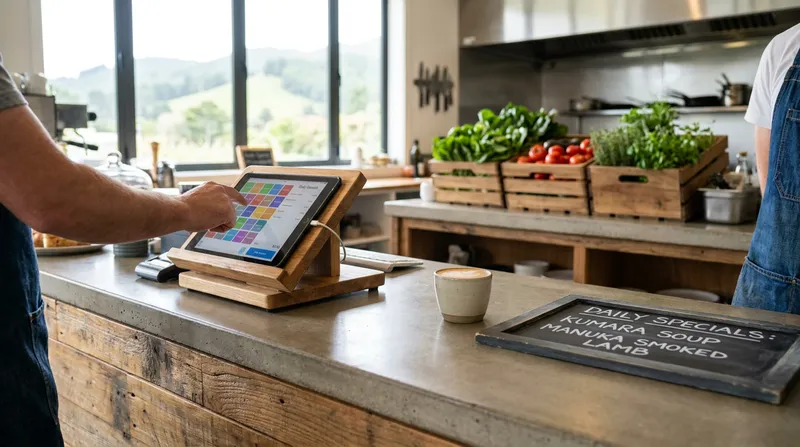
NZ Farm-to-Table POS: Daily Menus & Recipe Costs
Are you losing sleep over the constant stress of manually recalculating recipe costs every time local ingredient prices change? For many New Zealand hospitality owners, this administrative burden leads to silent profit loss, chaotic kitchen preparation, and the ultimate nightmare of selling out of items online that are already gone in the kitchen.
As the farm-to-table movement accelerates, menus are changing faster than ever. What looks like a profitable dish on Monday might become a loss leader by Thursday if your local supplier raises the price of seasonal greens. You need a system that keeps up with your kitchen.
In this guide, we will explore how modern cloud POS systems automate recipe costing, sync your inventory across all channels instantly, and protect your margins while you focus on serving incredible local food.
The Hyper-Local Dining Trend Defining 2026
Consumer preferences in New Zealand are shifting rapidly. Diners no longer just want good food, they want to know exactly where their food comes from. This demand is driving the hyper-local dining trend that is defining 2026, where chefs source ingredients daily from local farmers markets and regional suppliers.
According to the Hotel Yearbook, the hospitality industry is seeing a massive push toward hyper-local, hyper-seasonal offerings where menus celebrate regional flavours and sustainable sourcing.
While this is fantastic for your brand and the local economy, it creates a massive operational challenge. When your ingredients change daily based on what the market offers, your menu must change with them. Static, printed menus and rigid point-of-sale systems simply cannot handle this level of agility.
Actionable Tip: Audit your current menu this week. Identify which staple items can be easily swapped for seasonal local produce without disrupting your kitchen workflow. Check out our Practical Business Guides for NZ Hospitality | Lazygrid for more tips on streamlining your menu planning.
Why Manual Recipe Costing is Destroying Your Margins
If you are still using spreadsheets to manage your seasonal menu pricing, you are likely losing money without even realizing it. The hidden costs of manual calculation are staggering.
Imagine you serve a popular heirloom tomato bruschetta. On Tuesday, a weather event causes local tomato prices to spike by 30%. If your menu price remains static because you do not have time to update your spreadsheet, your profit margin on that dish vanishes instantly.
Research from Hospitality Net shows that effective menu engineering requires calculating the exact cost of each menu item based on real-time ingredient prices to categorise items by profitability and popularity.
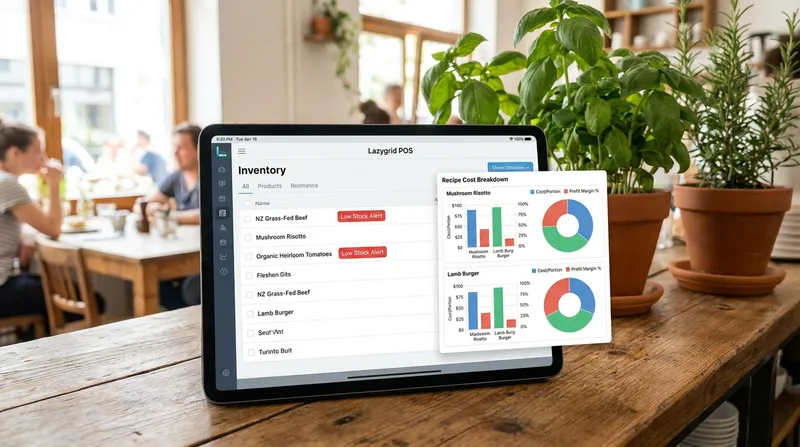
Automated recipe costing eliminates this guesswork. By inputting your recipes into your POS system, the software automatically recalculates the cost of the entire dish the moment you update the price of a single ingredient.
Manual vs Automated Recipe Costing
| Feature | Manual Spreadsheets | Automated Cloud POS |
|---|---|---|
| Time Spent | Hours per week | Instant updates |
| Error Rate | High risk of human error | 100% accurate based on inputs |
| Margin Impact | Delayed reactions cause profit loss | Real-time adjustments protect margins |
| Kitchen Sync | Disconnected from daily prep | Instantly updates the Kitchen Display System (KDS) |
Actionable Tip: Use menu engineering software principles to categorise your daily specials. Group them into "Stars" (high profit, high popularity) and "Dogs" (low profit, low popularity) based on real-time data, and remove the underperformers immediately.
Real-Time COGS Tracking: The Heart of Cafe Inventory
Cost of Goods Sold (COGS) is the most critical metric for any food business. However, traditional systems only calculate COGS at the end of the month after a manual stocktake. By then, the financial damage of a poorly priced menu item is already done.
Real-time COGS tracking allows you to see your exact food costs as transactions happen. But tracking ingredients sold is only half the battle. You also have to account for preparation waste.
A detailed study by the University of Otago Food Waste Innovation found that preparation waste (including unsold food) accounts for 60% of all food waste in NZ cafes, while food spoilage accounts for only 7%. This means your profits are literally ending up in the prep bin before the food ever reaches the customer.
When you upgrade to modern restaurant inventory management software, you can track yield percentages. If a 10kg box of local carrots only yields 8kg of prepped product, your software automatically adjusts the recipe cost to reflect the true usable amount.
Actionable Tip: Set up automated yield management in your POS right now. Weigh your raw ingredients before and after prep for three days to establish an accurate yield percentage. If you are looking to upgrade your hardware to support this, read our guide on Buy vs Lease POS Hardware NZ: Protect Cash Flow 2026 - Lazygrid Blog.
Preventing Stockouts with Omnichannel Syncing and KDS
There is nothing more frustrating for a customer than ordering their favourite meal, paying for it, and then being told five minutes later that the kitchen has run out. When you operate across multiple sales channels, this nightmare multiplies.
Imagine a busy Friday lunch rush. A customer orders your last portion of market fish at the front counter. Simultaneously, another customer orders the exact same dish via your self-service kiosk, and a third orders it through your online delivery portal. If your systems are disconnected, you now have two very angry customers who need refunds.
An omnichannel restaurant POS solves this instantly. When that last portion of fish is sold at the counter, the system automatically updates stock levels across all platforms in real-time. Furthermore, a fully integrated Kitchen Display System (KDS) ensures your chefs are instantly notified of menu changes, preventing them from starting prep on dishes with missing ingredients.
Actionable Tip: Link your digital menu board integration directly to your kitchen inventory. This ensures that items automatically display a "sold out" banner the exact second you run out of ingredients. For more on optimizing customer flow, see How Multilingual Kiosks Boost AOV by 30% in NZ's Tourist Hubs - Lazygrid Blog.
How Smart POS Systems Reduce Restaurant Food Waste
The environmental and financial impact of food waste in the local hospitality sector is staggering. When you run a farm-to-table operation, over-ordering perishable local goods is a costly mistake that directly harms your bottom line.
According to the New Zealand Ministry for the Environment, NZ cafes and restaurants throw away 24,400 tonnes of food annually, 61% of which is avoidable. Furthermore, Hospitality New Zealand notes that local hospitality businesses generate enough food waste to fill roughly 1,000 standard 120-litre kerbside rubbish bins every single day.
To reduce restaurant food waste effectively, you need predictive ordering based on historical sales data. The best hospitality POS systems generate automated purchasing recommendations. By knowing exactly how much of a specific local ingredient you sold last Tuesday, you can order the precise amount for next Tuesday, eliminating spoilage.
Actionable Tip: Schedule 15 minutes every Monday morning to review your POS waste reports. Use this data to adjust your purchasing pars for the upcoming week, specifically targeting the top three items that ended up in the bin.
Beyond the Kitchen: Food Trucks and Artisan Retail
These inventory principles apply just as well to mobile food vendors and farm-to-table retail spaces like artisan delis or local grocers.
If you run a food truck, space is your biggest constraint. A reliable cloud POS allows you to track ingredient depletion from a central commissary kitchen in real-time. You will know exactly when to restock before your next event without having to manually count boxes in the dark.
Similarly, if you sell local retail products alongside your cafe menu, cloud accessibility means you can check stock levels for specialty items right from your smartphone. You can also leverage an integrated Loyalty Programme to identify and reward your regular farm-to-table diners, seamlessly connecting your seasonal inventory with customer retention efforts.
Actionable Tip: Set up low-stock automated alerts in your cloud POS today. Program the system to send you an email the moment your core food ingredient drops below a two-day supply. To learn more about maximizing every customer visit, read Restaurant CRM NZ: Turn Walk-Ins into Repeat Diners - Lazygrid Blog.
Steps to Implement Agile Menu Pricing Today
Transitioning from static menus to a dynamic, farm-to-table pricing model might feel overwhelming, but it does not have to be.
Here is a simple framework to get started:
- Choose Hardware Independence: Do not get trapped by legacy providers. Ensure your system runs on standard iPads so you can upgrade easily. Learn more in POS Lock-In: Why It's Costing NZ Businesses Thousands - Lazygrid Blog.
- Digitise Your Top Sellers First: Start with your top 5 best-selling items rather than your entire menu.
- Link Your Supply Costs: Enter the current market price for the raw ingredients of those 5 items.
- Monitor the Margins: Watch how the software automatically calculates your profit margins over a week.
- Expand the System: Roll out the automated tracking to your seasonal specials and eventually your full menu.
Actionable Tip: Take one hour this afternoon to input just one complex recipe into your POS system. Seeing the exact cost breakdown down to the gram will instantly show you the value of automated tracking.
Ready to Streamline Your NZ Farm-to-Table Kitchen?
Managing a farm-to-table operation in New Zealand requires agility that manual spreadsheets simply cannot provide. By embracing automated recipe costing and real-time COGS tracking, you can protect your profit margins from unpredictable local food prices.
Integrating your inventory across all channels prevents mid-service stockouts, ensuring your customers always have a seamless experience whether they order in person, at a kiosk, or online.
Stop guessing your food costs and start maximizing your profits. Start your free Lazygrid trial today and see your recipe costs in real time.
Frequently Asked Questions
What is automated recipe costing and why do I need it?
Automated recipe costing is software that calculates the exact cost of a dish based on real-time ingredient prices. You need it to ensure your profit margins stay intact even when local produce prices fluctuate wildly from week to week.
How can a cloud POS system prevent menu stockouts?
Cloud POS systems centralize your inventory. This means stock levels sync across your online ordering, self-service kiosks, and front-of-house registers instantly. When an ingredient runs out, the system automatically hides the dependent menu items across all platforms.
Why is real-time COGS tracking important for seasonal menus?
Seasonal menus change frequently, making historical cost data irrelevant. Real-time tracking ensures you price your daily specials correctly based on today's market costs, rather than guessing based on what you paid last month.
Can a food truck use cloud POS for inventory management?
Yes. Cloud-based systems are perfect for food trucks because they allow owners to track stock levels remotely, manage prep at a central kitchen, and process sales on the go using iPads or iPhones without needing a bulky, expensive server.
How does inventory software help reduce restaurant food waste in NZ?
By providing accurate data on what sells and what spoils, inventory software allows owners to optimize their purchasing. It reduces over-preparation and tracks waste logs, helping you identify problem areas and order only what you actually need.