
NZ Surcharge Rules 2026: How to Pass On Paywave Fees Legally
NZ Surcharge Rules 2026: How to Pass On Paywave Fees Legally
Introduction: The 2026 Paywave Surcharge Ban is Approaching
Running a hospitality business in New Zealand means operating on razor-thin margins. Every single percentage point matters to your bottom line. Right now, a major focus for owners of restaurants, cafes, massage clinics, and food trucks is the upcoming regulatory shift regarding credit card surcharge rules nz.
If you are worried about the upcoming surcharge ban, you are not alone. The government is banning in-store surcharges by May 2026, leaving many business owners concerned about losing 1 to 2 percent of their total revenue to paywave fees nz. On top of that, merchants are currently facing the threat of massive Commerce Commission fines if they fail to comply with existing merchant service fee regulations today.
Here is exactly what it means for your business and how to adapt confidently. This guide will walk you through what the new laws mean, how to comply with current rules, and how to legally protect your profit margins without driving your loyal customers away.
What the Retail Payment System Act Means for NZ Hospitality
To understand how to prepare your business, you first need to understand the legislation. The New Zealand government is making significant amendments to the Retail Payment System Act 2022.
According to the Ministry of Business, Innovation and Employment (MBIE), the government is taking action to ban surcharges on all in-store EFTPOS, Visa, and Mastercard debit and credit card payments. This legislative change is designed to stop consumers from feeling penalised at the checkout when they use standard, modern payment methods.
The most important detail for your business is the timeline. The complete ban on these in-store surcharges will take full effect by May 2026. This gives you a clear runway to adjust your business model. You do not have to absorb these costs overnight, but you do need a transition plan.
For more comprehensive strategies on running your venue, check out our Practical Business Guides for NZ Hospitality | Lazygrid.
Actionable Tip: Take 15 minutes today to review your current payment terminal contracts. Note exactly when they expire relative to the May 2026 deadline. This will give you the leverage you need to negotiate better merchant rates or switch providers before the ban forces you to absorb all processing costs.
Current Commerce Commission Surcharging Guidelines (What to Do Right Now)
While the absolute ban does not hit until May 2026, you cannot simply charge whatever you want in the meantime. Until the new laws take effect, surcharging remains legal but is highly regulated by the Commerce Commission.
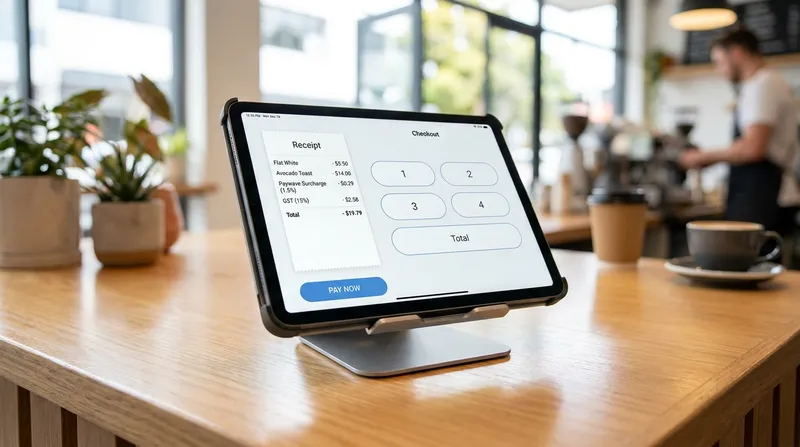
The fundamental rule right now is that your payment surcharge cannot exceed the actual cost of accepting that payment. This cost is known as your Merchant Service Fee (MSF). If your bank charges you 1.5 percent to process a Visa Paywave transaction, your surcharge cannot legally be 2.0 percent.
Recent regulatory changes have already forced banks to lower their costs. As outlined by Consumer Protection New Zealand, domestic personal credit card interchange fees are now capped at 0.30 percent, and in-person contactless debit fees are capped at 0.20 percent. These caps should naturally lower your overall MSF. If you are struggling with setting up specific conditional fees, you might want to learn how to Automate the 15% Public Holiday Surcharge for NZ Cafes - Lazygrid Blog.
Actionable Tip: Log into your merchant portal today and calculate your blended merchant service fee. This is the average percentage you pay across all card types. Once you have this exact number, adjust your POS surcharge settings to match it perfectly. Do not round up.
The Severe Penalties for Non-Compliant Contactless Surcharges
Failing to comply with the current commerce commission surcharging guidelines is not just a minor administrative error. It is a serious breach of the law that carries severe financial consequences.
The government is actively cracking down on businesses that use a contactless surcharge nz as a hidden revenue stream rather than a direct cost recovery mechanism. The penalties for getting this wrong are incredibly steep.
According to legal experts at Buddle Findlay, the maximum penalty for a contravention of a pricing standard under the Act is NZ$500,000 for an individual and a staggering NZ$5,000,000 for organisations. Furthermore, you must make sure your customers know about the fee before they tap their card. If you are dealing with customer frustration over fees, you might also be interested in reading about the NZ Tipping Backlash: How to Disable POS Tip Prompts - Lazygrid Blog.
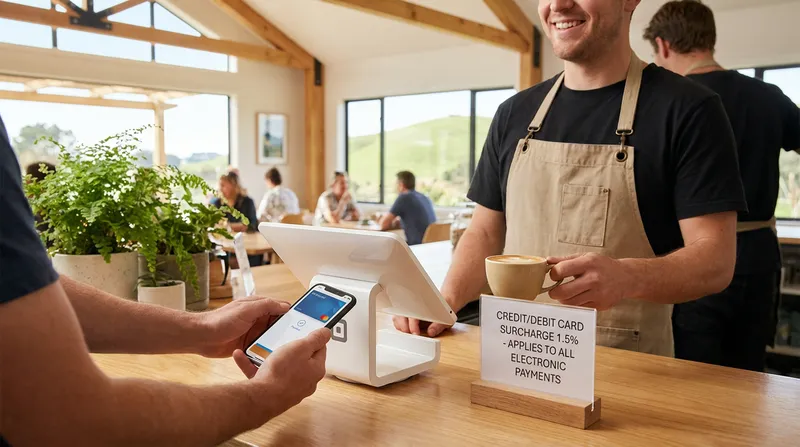
Actionable Tip: Print clear, compliant signage for your front counter immediately. Use a clear, legible font at a size visible to customers approaching the counter, as the Commerce Commission requires the fee to be prominently displayed before payment is presented. Place this sign directly next to your EFTPOS terminal stating exactly what your percentage surcharge is for credit and tap and go fees nz.
How to Legally Pass on Paywave Fees Without Alienating Customers
When May 2026 arrives, you will no longer be able to add a line-item surcharge for in-store payments. This means you must absorb paywave fees nz into your operating costs. However, "absorbing" the cost does not mean you have to take a pay cut. You simply need to pass on paywave fees through smart, strategic pricing.
The secret to doing this without alienating your customers is incremental menu repricing. Do not wait until April 2026 to raise all your prices by 2 percent at once. Instead, raise your prices by 0.5 percent every six months leading up to the deadline. Customers rarely notice a 10-cent increase on a coffee, but they will absolutely complain about a sudden 50-cent jump.
You should also utilise menu engineering. This involves hiding the price increase in your high-margin items. For example, keep your highly competitive items (like a standard flat white) at a stable price, but increase the price of your add-ons, alternative milks, and side dishes by a slightly higher margin to cover the overall processing costs.
Equally important is training your front-of-house staff to handle customer questions about these pricing changes. If a regular notices a slight increase, your team needs a polite, confident response. Train them to explain that the venue is adjusting prices slightly to cover rising operational costs and upcoming payment processing changes, ensuring the business can continue delivering the same high-quality food and service. A well-prepared team prevents awkward counter interactions and maintains customer loyalty. For more ways to keep your customers happy while optimising revenue, read about Restaurant CRM NZ: Turn Walk-Ins into Repeat Diners - Lazygrid Blog.
Actionable Tip: Use your POS reporting dashboard to track whether sales volume holds steady after each price adjustment. Lazygrid's real-time Reporting and Analytics make it easy to spot any drop-off within days, not weeks. Increase the price of your top 5 best-selling items by just 20 cents this week. Monitor your sales data for a month to confirm that volume remains steady, effectively covering a portion of your MSF in advance.
The Online Payment Loophole: QR Codes and Digital Ordering
There is a massive, highly strategic exemption in the upcoming 2026 legislation that every hospitality owner needs to know about. The ban explicitly targets in-store, face-to-face transactions. Online payments are entirely exempt from the surcharge ban.
This means that if a customer pays through a web browser or an app, you can still legally apply an online payment surcharge nz. As noted by the legal team at MinterEllisonRuddWatts, the regulatory framework distinguishes between physical terminal taps and digital ecommerce transactions.
By shifting your dine-in customers to QR code ordering at the table, you transform an in-store transaction into an online transaction. When customers scan the code, browse the digital menu, and pay via their smartphone using Apple Pay or Google Pay, you are legally permitted to pass on the processing fee.
Note: The classification of QR-based dine-in payments as online transactions is subject to regulatory interpretation. We recommend consulting a legal advisor to confirm this applies to your specific setup before implementation.
Beyond compliance, digital ordering has incredible secondary benefits, such as increasing average order values by up to 30 percent and speeding up table turnover times. You can learn more about digital ordering strategies in our guide on Corporate Catering: How NZ Cafes Beat Delivery App Fees - Lazygrid Blog.
Actionable Tip: Set up QR code ordering for your busiest tables or outdoor seating areas this month. Test customer adoption rates and iron out your operational flow long before the 2026 ban forces you to change your entire service model.
Upgrading Your Tech: Hospitality POS Surcharge Automation
Navigating these changing rules with a legacy cash register or a basic, outdated terminal is going to be incredibly stressful. Older systems require manual calculations, which drastically increase the risk of human error and subsequent Commerce Commission fines.
The right POS system removes the manual calculation burden entirely. Modern cloud-based POS systems, like Lazygrid, are designed to automate compliance effortlessly. They can automatically calculate the exact legal surcharge limit nz for physical taps today, and seamlessly transition your business to QR code ordering to utilise the online payment exemption tomorrow.
Furthermore, modern systems integrate your EFTPOS terminals directly with your till, ensuring that the final transaction total includes any fees automatically. According to EFTPOS New Zealand, merchants must include the surcharge in the final transaction total rather than processing it as a separate manual transaction. See how top venues are adapting in The Michelin Effect: How NZ Venues Are Upgrading Tech to Fine-Dining Standards in 2026 - Lazygrid Blog.
Actionable Tip: Audit your current nz hospitality pos systems this week. Check if your software natively supports automated fee calculation based on payment type, and confirm whether it offers integrated, commission-free QR code table ordering.
Conclusion: Prepare Now to Protect Your Margins
The May 2026 ban on in-store credit card and Paywave surcharges marks a significant shift for the New Zealand hospitality industry. However, by taking proactive steps today, you can protect your profit margins without sacrificing customer satisfaction. Start by ensuring your current surcharges strictly comply with Commerce Commission guidelines to avoid hefty fines. Next, begin implementing incremental menu repricing to absorb future costs smoothly. Finally, explore digital solutions like QR code table ordering to take advantage of online payment exemptions.
Want to see how Lazygrid helps NZ hospitality businesses automate surcharge compliance, track sales analytics, and implement QR ordering? Book a free demo today.
Frequently Asked Questions
Is surcharging illegal in New Zealand right now?
No, surcharging is currently legal. However, the fee must not exceed your actual merchant service cost (MSF), and you must clearly communicate the fee to the customer before they present their payment card.
When does the Paywave surcharge ban take effect?
The New Zealand government has mandated that the complete ban on in-store contactless and credit card surcharges will take full effect by May 2026.
Does the 2026 surcharge ban apply to online orders?
No. The upcoming legislation specifically targets physical, in-store transactions. Online payments, which include QR code table ordering and web-based click-and-collect services, are entirely exempt from the ban.
What is the maximum legal surcharge limit in NZ?
There is no fixed, universal percentage limit. Instead, the Commerce Commission dictates that your surcharge must exactly match your blended Merchant Service Fee. For most NZ hospitality businesses, this ranges between 1.2 percent and 2.5 percent depending on their bank and transaction volume.
Can I still charge a public holiday surcharge in 2026?
Yes. A public holiday surcharge (which is typically 15 percent) is designed to cover increased wage costs under NZ employment law, not payment processing fees. This remains completely legal as long as it is clearly advertised to the customer before they order.