
Running Multiple Virtual Brands: NZ Dark Kitchen Tech Guide
Running Multiple Virtual Brands: NZ Dark Kitchen Tech Guide
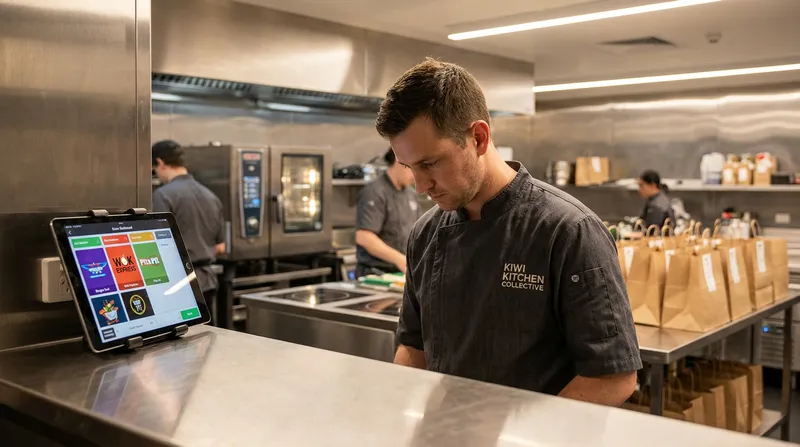
It is a Friday night in Auckland. Your main restaurant is packed, but your kitchen staff are not just cooking for the dining room. They are also managing orders for a virtual burger brand, a delivery-only vegan concept, and your core menu.
Suddenly, four different tablets start pinging simultaneously. A driver arrives for an Uber Eats order that no one has started preparing because the ticket was lost in the chaos. This overwhelming stress and operational chaos is known as 'tablet hell', and it is the exact reason why many ambitious hospitality owners struggle to scale their delivery operations.
Running multiple virtual brands from a single kitchen is one of the most profitable ways to maximise your commercial real estate. However, if your technology is not properly aligned, that profit quickly evaporates into wasted food, incorrect orders, and damaging customer reviews.
In this comprehensive guide, we will explore how to build a unified ghost kitchen POS system NZ operators can rely on. You will learn how to consolidate your inventory, route orders efficiently, and eliminate tablet hell for good.
The Rise of Virtual Brands in New Zealand
The hospitality landscape in New Zealand has shifted dramatically. A virtual brand (or dark kitchen) is a digital-only restaurant that exists entirely on delivery apps like Uber Eats, Menulog, or DoorDash. There is no physical storefront, no dining room, and no waitstaff. You simply cook the food in an existing commercial kitchen and hand it straight to a delivery driver.
This model offers incredible financial opportunities. Instead of paying rent for three different buildings, you can run three distinct menus from the exact same prep bench. According to the Restaurant Association of New Zealand, the hospitality sector continues to see strong consumer demand for convenient takeaway and delivery options, illustrating a massive reliance on food service mobility.
However, traditional point of sale systems were never designed to handle this level of digital complexity. Most legacy systems force you to treat every virtual brand as a completely separate business account. This means you need separate hardware, separate software licenses, and separate inventory tracking. To succeed today, you need dedicated cloud kitchen management software New Zealand operators can use to centralise their entire operation.
The Real Cost of Tablet Hell in Delivery Operations
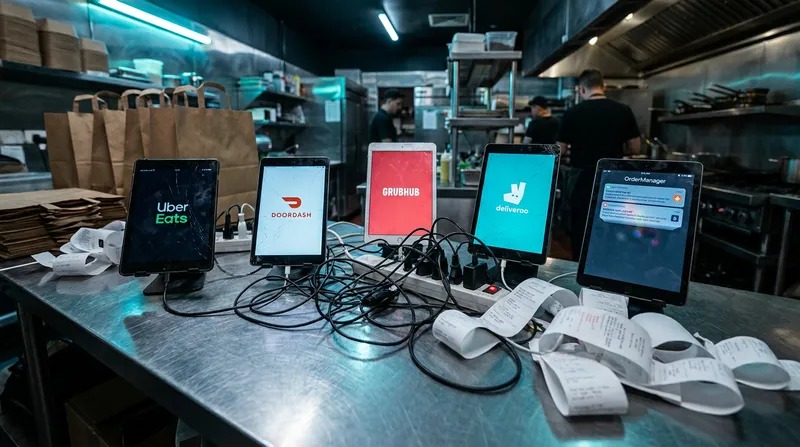
If you have ever run a delivery-only restaurant software setup using standard aggregator tablets, you know what tablet hell looks like. It physically manifests as a tangled mess of charging cables and glowing screens taking up valuable space on your prep counter.
When an order comes in through a third-party app, a staff member usually has to manually punch that order into your main POS system so the kitchen can receive a ticket. This manual double-entry is a massive bottleneck. It leads to human error, missed modifications, and delayed prep times.
As noted by Tacit Corporation, the lack of integration between third-party delivery ordering platforms and a restaurant's point of sale creates 'Tablet Hell', leading directly to manual entry errors and decreased efficiency.
Beyond the operational headache, there is a severe financial strain. High delivery commissions mean your margins are already tight. If tablet hell causes your kitchen to remake even five incorrect orders a night, your profitability for that shift is completely wiped out. Finding a reliable restaurant tablet hell solution is no longer optional. It is mandatory for survival.
How to Start a Ghost Kitchen in Auckland or Wellington
Launching a virtual brand in major New Zealand cities requires a strategic approach to both space and technology. You do not necessarily need a traditional restaurant to get started. Many non-traditional commercial spaces have successfully integrated dark kitchens into their business models.
For example, if you own a massage clinic, a beauty shop, or a retail store with unused commercial back rooms, you can lease that extra square footage to a dark kitchen operator. This creates a lucrative secondary income stream with zero impact on your primary business.
Food trucks can also benefit immensely. A food truck owner can maximise their limited prep space by operating a secondary virtual brand during off-peak hours using a reliable food truck POS New Zealand setup.
Here are the actionable steps to start a ghost kitchen Auckland or Wellington locals will love:
- Analyse Local Demand: Check delivery apps in your specific suburb to see what cuisines are missing. If there are ten burger places but no healthy salad options, you have found your niche.
- Optimise Your Menu for Travel: Only create dishes that will survive a 20-minute car ride. Avoid items that get soggy quickly.
- Calculate Your Margins: Understand the exact cost of delivery aggregators. A report by The Spinoff highlights that major delivery services take around 30 to 35 percent commission from a restaurant's earnings. To combat this, offering commission-free online ordering directly through your own POS system is a highly effective strategy.
- Implement Unified Technology: Set up a single POS system that can handle multiple menus simultaneously.
What About Food Safety Compliance?
Before launching a virtual brand, especially in non-traditional spaces like retail stores, you must ensure full compliance with the NZ Food Act 2014. You will need to register your food business with your local council (such as the Auckland Council or Wellington City Council) and undergo regular verifications. Operating a commercial kitchen requires proper ventilation, grease traps, and strict hygiene protocols, regardless of whether you have a dining room.
Building the Ultimate Dark Kitchen Tech Stack
To run multiple brands efficiently, you need a dark kitchen tech stack that connects your front-end delivery apps directly to your back-of-house operations.
The Restaurant Association of New Zealand notes that the departure of certain delivery platforms places increased pressure on small business owners who must seek alternative systems to maintain profitability without eroding margins. Relying on legacy EFTPOS hardware or disconnected software will only slow you down.
A modern solution, like Lazygrid's cloud-based POS, should include:
- A Cloud-Based POS: This acts as the central brain, processing orders from all brands in one place.
- API Integrations: Software that pulls orders directly from Uber Eats and Menulog into your POS.
- A Kitchen Display System: Digital screens that replace paper tickets.
- Consolidated Inventory Management: Software that tracks ingredients across all your virtual menus.
By using a unified system, you avoid paying for separate POS licenses for each brand. For a deeper look into setting up workflows that handle both in-person and digital orders, read our guide on the Best POS for NZ Restaurants & Bars: Dual Workflows - Lazygrid Blog.
Mastering Multi-Brand KDS Routing
The secret weapon of any successful dark kitchen is a centralised kitchen display system. Multi-brand KDS routing is a software feature that takes incoming orders from different virtual brands and organises them onto a single digital screen in your kitchen.
Here is how to set up your KDS for maximum efficiency:
- Colour-Code by Brand: Assign a specific colour to each virtual brand. For example, make all 'Burger Brand' tickets blue and all 'Vegan Brand' tickets green. When your chefs look at the screen, they instantly know which branded packaging to grab.
- Route to Specific Stations: If you have a fryer station and a salad station, use your KDS to send the fries directly to the fryer screen and the salads to the prep screen, regardless of which virtual brand the customer ordered from.
- Use Bump Capabilities: Allow chefs to 'bump' or clear items off the screen as they are made, tracking exact preparation times.
Moving away from paper tickets eliminates the risk of lost dockets and keeps your kitchen calm. Learn more about upgrading your back-of-house technology on our Kitchen Display System for Restaurants NZ | Lazygrid KDS page.
Seamless Integration and Consolidated Inventory
One of the biggest challenges of running multiple virtual brands is managing your stock and incoming orders. If you have three different brands selling dishes that use chicken breast, you are pulling from the exact same physical fridge. If your software treats these brands as separate businesses, your inventory numbers will be completely wrong by the end of the night.
Consolidated kitchen inventory solves this problem by mapping one physical raw ingredient to multiple virtual menu items. In Lazygrid's cloud kitchen management software New Zealand setup, you can map a 10kg box of potatoes to 'Brand A Fries' and 'Brand B Loaded Wedges'. Whenever an order is placed, the system automatically deducts the correct portion from your master inventory list.
To truly eliminate tablet hell, you also need direct API integrations. When a customer places an order on Uber Eats, the integration pushes that order straight into your virtual restaurant POS and fires the ticket directly to your KDS. No manual entry is required.
This integration allows you to manage your menus from one central dashboard. If you run out of avocado, you can mark it as 'out of stock' on your main POS, and it will instantly update all your delivery apps across all virtual brands. Proper inventory control and automation are core features of any high-performing setup. Discover more essential tools in our article on the Best POS System for NZ Cafes: 7 Non-Negotiable Features - Lazygrid Blog.
Maximising Off-Peak Hours with Delivery-Only Brands
Every hospitality business has slow periods. Whether it is a rainy Tuesday afternoon or a mid-morning slump, you are still paying rent and staff wages during these hours. Virtual brands allow you to turn these off-peak windows into highly profitable delivery shifts.
Interestingly, bad weather is fantastic for delivery businesses. Research shows that delivery demand is 236 percent greater during heavy rain, which are the exact times when on-premise foot traffic is at its lowest.
If you run a bustling cafe that slows down after 2:00 PM, you can launch a virtual comfort food brand that operates exclusively from 2:00 PM to 5:00 PM.
Actionable strategies for off-peak optimisation:
- Cross-Train Your Staff: Ensure your front-of-house staff know how to pack delivery orders so they stay productive when the dining room is empty.
- Use Existing Ingredients: Design your off-peak virtual brand using ingredients you already have prepped from your main menu to minimise food waste.
- Schedule Smartly: Use the reporting features in your POS to track exactly when your delivery orders peak, and schedule your labor accordingly.
For more ideas on optimising your operational hours, read our guide: Coffee Shop POS: Beat the Morning Rush & Boost Sales - Lazygrid Blog.
Conclusion: Taking Control of Your Kitchen
Running multiple virtual brands from a single kitchen does not have to result in operational chaos. By upgrading your dark kitchen tech stack, you can eliminate the stress of tablet hell, streamline your inventory, and serve more customers with fewer errors.
The key is consolidation. A modern ghost kitchen POS system NZ operators trust will pull all your orders, ingredients, and reports into one centralised dashboard. Small independent businesses, food trucks, and even non-traditional spaces can now access the same enterprise-level efficiency as massive global chains.
Lazygrid is built for exactly this kind of operation. With plans like our Standard package at just $59/month, or our Premium plan featuring advanced multi-brand KDS routing and consolidated inventory tools, you can seamlessly manage your entire business. Explore how our software can consolidate your brands into one dashboard by starting a free trial today at Lazygrid.
Frequently Asked Questions
What is the best ghost kitchen POS system in NZ?
The best system is a cloud-based solution that offers multi-brand KDS routing, consolidated inventory management, and direct API integrations with local delivery apps. It should allow you to run multiple brands from a single account without requiring separate, expensive software licenses.
Can a food truck run a virtual restaurant?
Yes. Food trucks can maximise their limited prep space by running a secondary, delivery-only brand during off-peak hours. Using a unified mobile POS system, food truck operators can seamlessly switch between their core menu and a virtual brand to increase daily revenue.
How do I integrate Uber Eats with my POS?
You can integrate Uber Eats by using direct API integration or delivery aggregator software built into your POS. This channels all third-party orders straight into your main system and centralised KDS, completely eliminating the need to manually enter orders from a tablet.
What is multi-brand KDS routing?
Multi-brand KDS routing is a software feature that takes orders from various virtual brands and organises them on a single kitchen display screen. It uses helpful visual cues, like colour-coding by brand, to prevent packaging mix-ups and keep the kitchen running smoothly.
Can non-food businesses like salons host a ghost kitchen?
Absolutely, provided they meet all local food safety regulations. Businesses with excess commercial real estate, such as massage shops, beauty salons, or retail stores, can lease their unused back rooms to dark kitchen operators. This creates a reliable secondary income stream and maximises the value of the leased property.