
Self-Ordering Kiosk ROI: Guide for NZ Restaurants
New Zealand hospitality and service business owners are currently caught in a brutal squeeze. On one side, you have rising operational costs and severe staff shortages. On the other side, customers are tightening their wallets. If you run a takeaway restaurant, cafe, food truck, or even a massage and beauty shop, you are likely understandably cautious about whether investing in new technology will actually pay off.
However, the reality is quite the opposite. The traditional model of having a staff member stand at a till for eight hours a day is becoming financially unsustainable. You need hard, localized numbers and a clear return on investment (ROI) formula, not just vague promises of efficiency.
This comprehensive guide will show you exactly how a restaurant self service kiosk in New Zealand can transform your business. We will break down the true self service kiosk cost in NZ, provide a concrete ROI calculation formula, and reveal how automated upselling kiosks can increase your average order value (AOV). Whether you need a food truck ordering kiosk or a self service payment kiosk for your beauty salon, this is your blueprint for survival and growth.
What is a Self-Ordering Kiosk?
A self-ordering kiosk is a customer-facing digital station that allows your guests to browse your menu or service list, customize their selections, and complete their payment without needing assistance from your staff.
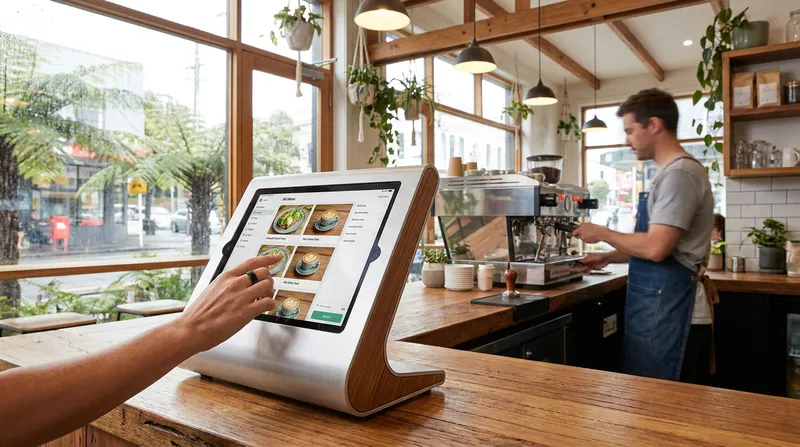
In the past, these systems were massive, clunky machines reserved for global fast-food chains. Today, modern hospitality tech in NZ has evolved significantly. Systems like Lazygrid use sleek, affordable iPads paired with secure iPad stands and integrated EFTPOS terminals. This makes digital menu ordering in NZ highly accessible to single-location cafes, mobile food trucks, and small service businesses.
The core capabilities of a modern takeaway restaurant kiosk in NZ include:
- Full digital menu displays with high-quality images.
- Customization options for dietary requirements or service preferences.
- Automated upselling prompts that suggest add-ons or upgrades.
- Multiple payment methods, including contactless tap-and-go and Apple Pay.
- Direct integration with your kitchen display systems or service booking software.
By shifting the order entry process directly to the customer, you eliminate miscommunications, reduce counter congestion, and free up your team to focus on what actually matters. If you want to see how this fits into a broader technology stack, check out our guide on Hospitality POS NZ: Cut Costs with an All-in-One Platform.
The "NZ Minimum Wage Squeeze": Reducing Hospitality Labor Costs
Let us address the most pressing issue for local operators. The cost of labor in New Zealand is rising rapidly, and finding reliable staff is harder than ever. Business owners are constantly battling to keep their wages-to-revenue ratio at a profitable level.
According to data from Stats NZ, the accommodation and food services sector has seen massive increases in total gross earnings, reflecting the compounding cost of labor for business owners. Furthermore, recent insights from Employment Hero show that while overall wage growth can sometimes fluctuate, the baseline hourly rates remain a significant hurdle for small and medium enterprises trying to maintain their profit margins.
When you install a self-ordering kiosk, you have two choices: reallocate your staff to roles that generate more value, or reduce your total scheduled hours. If you move a staff member to the prep station, you instantly speed up your service times. If you cut a three-hour shift from the roster, you instantly reduce your overhead.
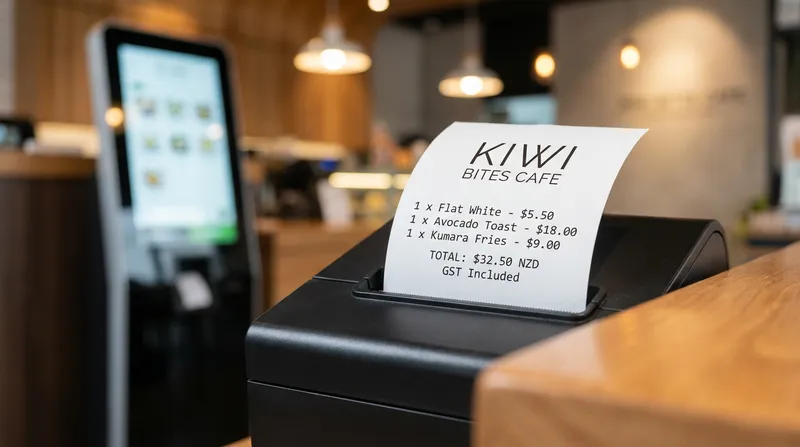
Think of a kiosk as your most reliable employee. It never calls in sick, it never arrives late, and it costs a fraction of the price of a human cashier. By implementing a contactless ordering system, you can comfortably handle your peak lunch rush with two staff members instead of three.
How to Increase Average Order Value (AOV) with Automated Upselling
Saving money on labor is great, but making more money on every single order is even better. This is where the automated upselling kiosk truly shines.
Human staff often forget to upsell during a busy rush. Even when they do remember, they might feel pushy or uncomfortable asking a customer if they want to add extra bacon, upgrade to a large coffee, or purchase a premium massage oil. Customers, in turn, can feel rushed or judged when ordering at a traditional counter.
A digital screen removes all of that friction. When a customer uses a digital menu ordering system, they can browse at their own pace. The psychology of self-service dictates that people are far more likely to indulge when they do not have to say their order out loud to a stranger. Customers can also easily scan their digital loyalty cards at the kiosk, encouraging repeat visits and higher spend per transaction.
The kiosk never forgets to ask, "Would you like fries with that?" or "Would you like to upgrade your 30-minute massage to a 60-minute session?"
The data backs this up entirely. According to industry statistics compiled by Restroworks, self-service kiosks in quick-service restaurants consistently drive a 10% to 30% increase in average order value, while also reducing total order time by nearly 40%. For more insights on revenue generation, read How Self-Ordering Systems Boost NZ Restaurant Revenue 30%.
The True Cost of Order Errors
Another factor that boosts your profit margin is the elimination of order errors. When a staff member mishears an order over a loud coffee grinder, you have to throw that product away and remake it. This wastes ingredients, frustrates the customer, and slows down the queue. Because the customer inputs their own order on a kiosk, order accuracy improves significantly, directly reducing your food waste and improving your inventory management.
The 90-Day Payback Plan: Calculating the True ROI for Your Business
Many competitors will tell you that kiosks are a great investment, but they fail to show you the actual math. Let us break down a realistic 90-day payback plan for a standard New Zealand cafe or takeaway restaurant.
Step 1: Calculate Your Upfront and Ongoing Costs Instead of spending $5,000 on proprietary hardware, you can use a cloud-based system like Lazygrid. While our Lite plan is just $24/month for solo operators, we will use the $59/month Standard plan for this calculation as it fits most growing venues.
- Hardware: Two iPads, two secure stands, and a receipt printer might cost you around $1,500 upfront. (You can view our POS Hardware NZ for exact specifications).
- Software: The Lazygrid Standard plan is $59 per month.
- Total Year 1 Cost: Approximately $2,200.
Step 2: Calculate Your Labor Savings Let us assume your kiosk allows you to eliminate 3 hours of scheduled minimum wage labor per day during your peak periods.
- 3 hours x $23.95 per hour (the NZ adult minimum wage from 1 April 2026) = $71.85 saved per day.
- Over a 30-day month, that is $2,156 in direct labor savings.
Step 3: Calculate Your AOV Increase Assume your cafe processes 100 orders per day with an average order value of $15.
- If the kiosk handles just 40% of those orders (40 orders), and increases the AOV by 20% ($3 extra per order).
- 40 orders x $3 = $120 extra revenue per day.
- Over a 30-day month, that is $3,600 in additional revenue.
Step 4: The Final ROI In a single month, your kiosk has generated $2,156 in labor savings and $3,600 in new revenue. That is a total monthly financial benefit of $5,756.
Your initial investment was only $2,200. This means the self service kiosk cost in NZ pays for itself in less than three weeks. Even if you are highly conservative and cut those estimates in half, you will still achieve a full return on investment well within 90 days.
Legacy POS vs Cloud-Based Kiosks
To understand why this ROI is so achievable, it helps to compare modern cloud systems with traditional setups:
| Feature | Lazygrid Cloud POS | Legacy POS Systems |
|---|---|---|
| Upfront Hardware Cost | From $999 (iPad based) | $3,000 to $5,000+ |
| Monthly Software Fee | $24 to $149 | $100+ (often with hidden fees) |
| Footprint | Compact, wireless options | Bulky, requires extensive wiring |
| Updates | Automatic, cloud-based | Manual, often requires a technician |
Beyond Restaurants: Kiosks for Food Trucks, Cafes, and Service Shops
A major misconception is that self-service technology is only for burger joints. The modern ordering system fits perfectly into a variety of hybrid business models.
Food Trucks: Space is your most valuable commodity. A food truck ordering kiosk can be mounted on the outside of your vehicle. Customers can place their orders and tap their cards while you focus entirely on cooking. Modern iPad systems also offer offline modes, meaning you can continue trading even if the local cell tower drops out during a busy summer festival.
Massage and Beauty Shops: Service businesses suffer from constant front-desk bottlenecks. If you are in the middle of providing a massage, you cannot run to the front to check in a new client. By setting up a self service payment kiosk, clients can check themselves in, rebook future sessions, and purchase retail products (like lotions or face creams) between appointments without interrupting your service flow.
Cafes and Coffee Shops: A dedicated self-ordering kiosk allows your regulars to skip the main line, punch in their usual order, and wait at the pickup counter. This dramatically reduces queue times and improves the overall customer experience. For more tips on managing the morning rush, explore our guide on the Best Cafe POS NZ: Beat the Morning Rush.
Integrating Kiosks with Your POS and EFTPOS NZ
A kiosk is useless if it does not communicate perfectly with the rest of your business. Seamless POS integration for self service is absolutely non-negotiable.
When a customer places an order on a Lazygrid kiosk, that data flows instantly into your central Point of Sale system. If the customer orders food, the ticket is routed directly to your Kitchen Display Systems, complete with color-coded urgency and allergy warnings.
Crucially for New Zealand businesses, your kiosk must integrate with local payment providers. Lazygrid supports EFTPOS NZ certified terminals, ensuring your transactions are fast, secure, and compliant with local banking standards. You can also accept Apple Pay, Google Pay, and all major credit cards. Plus, with Lazygrid, you get the peace of mind of having a local, Wellington-based support team ready to help if you ever need assistance.
How Much Does a Self-Service Kiosk Cost in NZ?
With a modern cloud-based system, you use off-the-shelf Apple hardware, avoiding massive upfront capital expenditures.
Hardware Costs: You can use iPads you already own, provided they run iPadOS 15 or later. If you need to purchase new equipment, starter hardware packages are highly affordable. You can get an iPad, a wireless EPSON or Xprinter thermal printer, and a secure cash drawer starting from around $999 (GST exclusive).
Software Plans: Lazygrid offers flexible, transparent pricing designed for small businesses.
- Lite Plan ($24/month): Ideal for solo operators and small food trucks who want to test the waters with a single main account.
- Standard Plan ($59/month): Our most popular tier. This includes advanced printing for kitchen routing, online ordering, and a booking system, making it perfect for growing cafes and takeaway restaurants.
- Premium Plan ($149/month): Built for high-volume operations, this tier unlocks advanced loyalty programmes, Reserve with Google integration, and comprehensive multi-location management.
Conclusion
The hospitality and service industries in New Zealand are tough, but you do not have to let rising wages and staff shortages dictate your profit margins. Implementing a self-ordering kiosk is a highly accessible, incredibly profitable tool for cafes, food trucks, and service shops across the country.
By automating the order entry process, you empower your customers to spend more, you eliminate costly ordering errors, and you free up your team to provide exceptional service. The ROI on a modern iPad-based kiosk is rapid and undeniable.
If you are ready to modernize your operations, cut your labor costs, and boost your revenue, it is time to explore what a cloud-based system can do for you. Book a free demo and see how easy it is to get started by visiting Lazygrid.digital today.
Frequently Asked Questions
How much does a self service kiosk cost in NZ?
The cost varies, but modern cloud-based setups are highly affordable. Instead of spending $5,000 on legacy proprietary hardware, you can use an iPad-based system. Hardware packages start around $999 (GST exclusive) for an iPad, a secure stand, and a printer. Software subscriptions like Lazygrid range from $24 to $59 per month, allowing you to avoid massive upfront capital expenditures.
How quickly will a restaurant self service kiosk pay for itself?
For most New Zealand hospitality businesses, a kiosk achieves a full return on investment (ROI) within 30 to 90 days. This rapid payback is driven by a combination of reduced labor costs during peak hours and an automated upselling system that consistently increases your average order value (AOV) by 10% to 30%.
Can a digital menu ordering system integrate with my existing NZ EFTPOS terminal?
Yes, absolutely. Modern kiosk software like Lazygrid integrates seamlessly with EFTPOS NZ certified terminals. This means the exact payment amount is sent directly from the kiosk to your terminal, eliminating manual entry errors, speeding up the checkout process, and ensuring compliance with local banking standards.
Are takeaway restaurant kiosks suitable for food trucks and small cafes?
Yes, they are perfect for small spaces. Because they run on compact iPads, they take up very little counter space. Food trucks can mount them externally to serve more customers, and small cafes can use them to bust queues during the morning coffee rush without sacrificing their limited floor plan or hiring extra counter staff.
Do customers actually prefer using a contactless ordering system?
Yes, consumer behavior has shifted dramatically. Studies consistently show that over 60% of customers prefer self-service options when available. It allows them to browse the menu at their own pace, customize their orders without feeling judged or rushed, and avoid standing in long, slow-moving queues.
Can massage and beauty shops use a self service payment kiosk?
Yes, kiosks are highly adaptable for the wellness industry. A kiosk in a salon or massage shop allows clients to check in for appointments, rebook future sessions, and purchase retail products independently. This frees up your staff to focus entirely on providing treatments rather than managing the front desk.