
DoorDash Drive NZ: White-Label Delivery Without 30% Fees
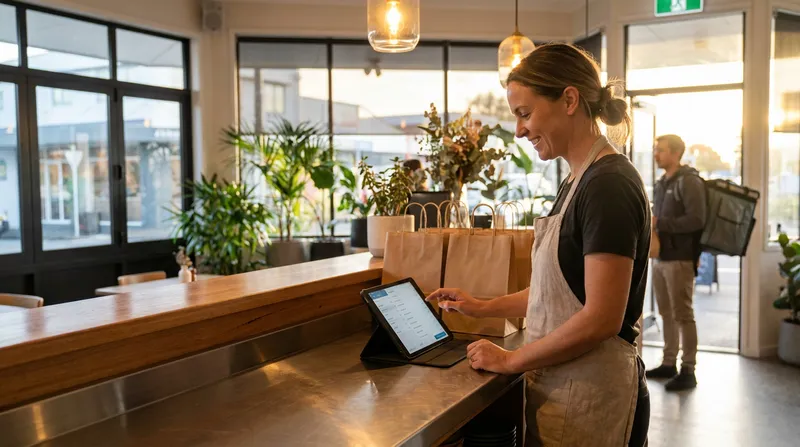
If you run a restaurant, cafe, takeaway shop, or food truck in New Zealand, you already know the frustration of watching Friday night orders roll in on Uber Eats and DoorDash while almost none of the profit stays in your bank account. Third-party delivery marketplaces take 30% to 33% (plus GST) off the top and lock away your customer contact details so you can never market to your own regulars directly.
Yet when Kiwi owners try to set up direct delivery without marketplace apps, they usually hit one of two walls. Some local ordering platforms still list DoorDash white-label delivery as "coming soon" rather than live today, leaving you to arrange your own delivery in the meantime. Others do unlock DoorDash courier dispatch in New Zealand, but charge NZ$219 or more every single month just to access it.
The good news is that DoorDash Drive NZ is available to New Zealand merchants, and you do not need a NZ$200+ monthly software bill or a fleet of payroll drivers to use it. In this guide, you will learn how white-label courier fulfillment works in New Zealand, see the real NZD basket math compared to 30% marketplace commissions, and follow a practical plan to move your regulars onto a direct browser-based menu linked straight to your POS.
Why 30% delivery app commissions break NZ hospitality margins
Off-premise dining is no longer a side hustle for Kiwi hospitality. According to the Restaurant Association of New Zealand, annual national hospitality sales reached $15.99 billion for the year ended June 2025, with the takeaway food sector leading the entire industry at 3.2% growth ($137.6 million in added sales) even as ingredient prices climbed 4.8%.
The problem is that rising takeaway demand does not translate into profit when third-party apps control the checkout. An investigation by Consumer NZ highlighted Restaurant Association chief executive Marisa Bidois's warning that typical New Zealand restaurant profit margins sit at just 4% to 7%. Even after Uber Eats cut its local commission cap from 35% to 30% in 2020, Restaurant Association chief executive Marisa Bidois told the Herald (as Newstalk ZB reported) that the commissions were crippling for many hospitality businesses.
Worse still, the headline commission is not the only hit to your bottom line. Because marketplace apps also withhold customer email addresses and phone numbers, you have no way to follow up with people who enjoyed your food. Instead of building a direct relationship with local regulars, you end up paying a 30% commission over and over again just to serve neighbours who already know and love your menu.
Quick audit to run today: Export your last 30 days of Uber Eats and DoorDash payout statements. Add your ingredient cost and kitchen labour cost to the total marketplace commissions and promotional co-funding fees. If your net profit per order is razor-thin (or goes negative once packaging is included), you have an immediate financial case to shift repeat volume to direct ordering.
What is DoorDash Drive in New Zealand and how does white-label delivery work?
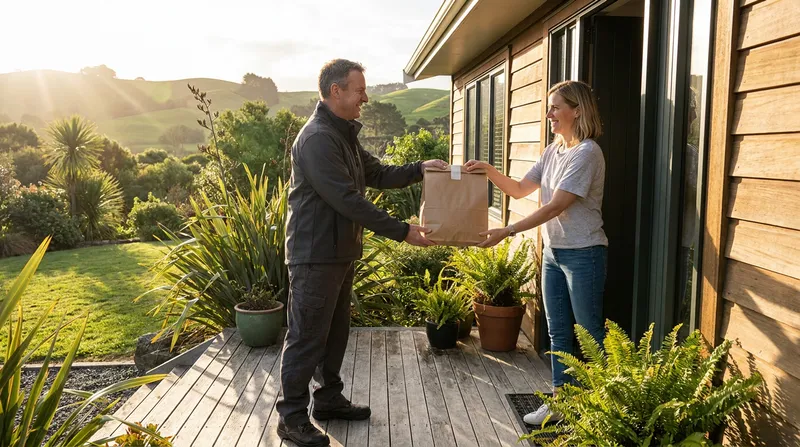
Many Kiwi venue owners assume white-label Dasher delivery is unavailable here because some ordering platforms (such as MyPreOrder) list DoorDash Drive as "coming soon" rather than available today. That limitation belongs to those software vendors, not to DoorDash.
DoorDash offers Drive On-Demand to New Zealand merchants, and according to Inside Retail New Zealand, DoorDash's network covered 24 towns and cities and over 77% of New Zealand's population as of February 2025. Beyond major metros like Auckland, Wellington, Christchurch, Hamilton, Tauranga, Hastings, and Dunedin, DoorDash's local footprint includes regional hubs such as Whakatane, Te Puke, Tokoroa, Hawera, Feilding, Levin, Masterton, Ashburton, Oamaru, and Wanaka.
To understand how white label food delivery NZ works, it helps to separate DoorDash's two completely different products:
- DoorDash Marketplace: Your venue appears inside the DoorDash consumer app alongside local competitors. DoorDash drives the customer traffic, owns the customer profile, and charges 30% to 33% commission (plus GST) on every order.
- DoorDash Drive On-Demand: Your venue never appears on a third-party marketplace app for these orders. As outlined by DoorDash for Merchants, DoorDash acts purely as an invisible courier network that picks up orders placed directly through your own website or ordering link, charging a flat fee per delivery with zero percentage commission and no DoorDash subscription fee.
Because the customer checks out on your branded browser menu, you keep full control of your menu presentation, pricing, and customer database. DoorDash simply handles the wheels.
First check to run today: Check whether your suburb sits inside DoorDash's active New Zealand courier footprint by entering your street address on DoorDash's NZ consumer site to see if local stores deliver to your block. Once confirmed, note that DoorDash sets the Drive delivery radius automatically for your area, so check which suburbs you can reach.
Step-by-step: from browser checkout to doorstep tracking
One reason small businesses hesitate to leave third-party apps is the fear that managing couriers manually will create chaos during a busy shift. When your direct ordering page is built directly into your POS, the workflow stays clean and simple for your counter team:
- Customer orders in their browser: A diner taps your "Order Online" link from Google Maps, Instagram, your website, or a QR code flyer. Your menu opens straight in Safari or Chrome with zero app downloads or account headaches, and payment processes securely online via Stripe.
- Order fires straight to your POS and kitchen: Instead of staff squinting at a separate delivery tablet and manually re-typing items into the till, the paid order lands inside your POS automatically and prints straight to your kitchen docket printer.
- DoorDash Delivery for your direct orders: Delivery orders placed on your browser menu are fulfilled by DoorDash Delivery couriers, so you don't need your own drivers.
- Live SMS tracking for the customer: As detailed by DoorDash for Merchants, the diner receives automated text messages with a live tracking link showing when their order is picked up and when the courier is arriving, cutting out "where is my food?" phone calls to your counter.
Kitchen check to run this week: Time your actual kitchen ticket turnaround on a busy Friday night so you know how long orders realistically take.
The real NZD math: marketplace commissions vs own drivers vs DoorDash Drive
Percentage commissions look painless on a $20 lunch, but they punish you hardest on your most profitable orders: family dinners, office lunches, and group takeaways. Flat-fee white-label dispatch flips that maths completely in your favour.
DoorDash for Merchants lists Drive On-Demand pricing at $6.99 to $10.99 per delivery order, depending on distance and zone. To see how that compares against percentage commissions, consider three typical New Zealand delivery baskets using an illustrative mid-range Drive courier fee of NZ$9.00 alongside typical 30% DoorDash Marketplace fees and DoorDash's Self-Delivery backup Dasher option (15% + NZ$9.99):
| Order Size (NZD) | DoorDash Marketplace (30% commission) | DoorDash Self-Delivery w/ Backup Dasher (15% + $9.99) | DoorDash Drive (Illustrative NZ$9.00 Flat Fee, Merchant Absorbs Full Fee) | DoorDash Drive (Illustrative NZ$9.00 Fee, Customer Pays $6.99 at Checkout) |
|---|---|---|---|---|
| $35 Cafe Lunch | You pay $10.50 (30.0%) | You pay $15.24 (43.5%) | You pay $9.00 (25.7%) | Net delivery cost to you: $2.01 (5.7%) |
| $55 Friday Takeaway | You pay $16.50 (30.0%) | You pay $18.24 (33.2%) | You pay $9.00 (16.4%) | Net delivery cost to you: $2.01 (3.7%) |
| $85 Family Dinner | You pay $25.50 (30.0%) | You pay $22.74 (26.8%) | You pay $9.00 (10.6%) | Net delivery cost to you: $2.01 (2.4%) |
Note: NZ$9.00 is an illustrative assumption within DoorDash's published NZ$6.99 to NZ$10.99 Drive On-Demand range; exact courier fees vary by delivery distance and local zone. Direct online orders also incur standard online card processing plus a small platform fee (a fraction of what delivery apps take, which you can pass on to customers). Figures exclude GST for clean comparison.
Look closely at that $85 family dinner row. On a third-party marketplace app, you hand over $25.50 (or $28.05 on a 33% DashPass order) plus GST on the commission. Using white-label DoorDash Drive at an illustrative $9.00 courier fee and passing a fair $6.99 delivery fee to the customer leaves you paying $2.01 out of pocket, keeping over $23 more margin on a single order before standard card processing and platform fees.
Direct online card acceptance in New Zealand is also getting steadily leaner. Under the Retail Payment System Act 2022, the Commerce Commission New Zealand confirmed revised interchange fee caps on Visa and Mastercard personal debit and credit cards (effective 1 December 2025 for domestic cards and 1 May 2026 for foreign cards), which the Commission expects to cut interchange fees by about a further $100 million a year, with commercial credit card caps following in April 2027. If you want to benchmark how online and in-store payment rates stack up locally, read our Square POS NZ vs Local EFTPOS (2026) real cost breakdown.
When budgeting your margins, remember that 15% GST also applies to direct food and delivery fees in New Zealand (we break down how GST and courier tax invoices work in the FAQ section below).
Pricing move to consider: Consider passing part of the courier cost on to customers as a delivery fee rather than absorbing all of it. Sharing the delivery fee keeps your out-of-pocket cost low while still offering diners a fairer deal than marked-up marketplace apps.
Why hiring your own delivery drivers rarely stacks up for small NZ venues
When Kiwi owners get fed up with 30% apps, the first instinct is often to hire a part-time student to run deliveries. Before you post a job ad, run the real 2026 payroll numbers.
According to Employment New Zealand, New Zealand's adult minimum wage rose to NZ$23.95 per hour from 1 April 2026. Once you add 3.5% employer KiwiSaver (the minimum since 1 April 2026, per Inland Revenue New Zealand), 8% holiday pay, ACC levies, and vehicle mileage or commercial business-use car insurance, a driver costs noticeably more than the NZ$23.95 minimum wage.
That fixed payroll cost hurts most during uneven hospitality shifts:
- On a quiet Tuesday night with just two delivery orders across a four-hour shift, you are paying nearly NZ$96 in base minimum wages alone (almost NZ$48 per delivery) before KiwiSaver, holiday pay, ACC, and vehicle costs.
- On a rainy Friday night when six orders land within ten minutes, one driver cannot reach every doorstep fast enough, leading to cold food and angry phone calls.
- If your driver calls in sick at 4:30 pm, your entire delivery channel shuts down overnight.
On-demand white-label Dashers solve both sides of that staffing headache: you pay zero wages during quiet shifts and can dispatch multiple couriers simultaneously during peak dinner rushes.
Staffing check before you hire: Divide your average weekly delivery orders by your total weekly delivery opening hours. Unless your venue has enough steady, hour-after-hour delivery volume to cover a full shift's wages and vehicle running costs, keep your staffing lean and use on-demand DoorDash Drive couriers instead of payroll drivers.
Comparing white-label delivery and direct online ordering systems in NZ
You can request Dashers yourself through DoorDash's Merchant Portal, but using an ordering system with DoorDash delivery built in saves you re-keying every order. However, software pricing across New Zealand varies wildly, and steep monthly subscriptions or extra add-on fees can erode your margins almost as fast as marketplace commissions. Here is how the major options available to Kiwi operators compare in 2026:
| Platform / Option | Monthly Starting Price (NZD, excl. GST) | DoorDash Drive Available in NZ? | How Direct Ordering Works | Key Watch-Out for NZ Venues |
|---|---|---|---|---|
| MyPreOrder NZ | Free Starter plan; paid plans NZ$99 to NZ$249/month | Not yet (listed as "coming soon") | Standalone ordering site & app | Delivery via DoorDash Drive not yet available |
| Supaorder | From NZ$219/month per site | Yes | Separate online ordering platform | High fixed monthly fee before a single order is placed |
| Enterprise / Legacy Stacks (e.g., MOBI or POS + Paid Add-ons) | Quote-only or NZ$78+/month + add-on fees | Varies by third-party middleware | Often requires separate POS sync tools | Compulsory diner surcharges, extra percentage cuts, or 12-month lock-in contracts |
| Lazygrid POS | From NZ$24/month (Lite plan) | Yes (DoorDash Delivery included) | Browser-based menu synced straight to POS | Carries a small platform fee (a fraction of what delivery apps take, passable to customers) |
Notice how quickly fixed software overhead adds up. Paying NZ$219/month for a standalone ordering tool on top of your existing till system costs NZ$2,628 per year before you even factor in POS subscriptions or manual menu updates across two separate platforms. If you are reviewing locked-in legacy providers, our guide to the best Epos Now alternatives in NZ for 2026 explains how flexible cloud POS systems cut out multi-year hardware contracts.
With Lazygrid POS, browser-based online ordering for pickup and DoorDash Delivery is included on every plan, starting right from the NZ$24/month (excl. GST) Lite plan. Because your online menu syncs directly with your POS catalogue on your iPad or iPhone, marking an item sold out at the counter removes it online instantly. You pay only a small platform fee (a fraction of what delivery apps take, which you can pass on to customers at checkout), while keeping your brand, margins, and customer data inside one system.
Software audit to run this week: Write down every software fee you currently pay across your till, online ordering portal, and delivery middleware, then multiply by 12. If you are paying more than NZ$100/month just to take direct web orders without integrated POS syncing and DoorDash courier dispatch, shortlist an all-in-one POS alternative.
Beyond restaurants: how cafes, food trucks, and beauty or wellness shops use white-label couriers
White-label courier delivery is not reserved for pizza shops and burger bars. Across New Zealand, cafes, mobile food operators, and service businesses are using the exact same browser menu and DoorDash Delivery setup to unlock new revenue without hiring delivery staff.
Cafes handling office lunches and cabinet catering
Morning and midday corporate orders are high-margin opportunities, yet pulling a barista off the espresso machine to walk boxes down the street wrecks counter speed. Put your sandwich platters, pastry boxes, and coffee bundles on your browser ordering link so local offices can schedule midday drops via Dashers.
If you also serve regular business clients on account, see our NZ POS guide to cafe office tabs and bar house accounts.
Food trucks taking pre-orders from regular pitches
Mobile food vendors operating at consistent weekday hubs or council-approved sites can share a browser QR menu on Instagram stories so local workers pre-order ahead of the lunch rush (for pickup or local courier drop where covered by DoorDash). All mobile food operators must keep their registration and verification up to date under the Food Act 2014 as required by the Ministry for Primary Industries (New Zealand Food Safety).
Because cloud POS ordering requires an active internet connection (there is no offline ordering or payment mode), food trucks at regular signal-covered pitches should run a dedicated 4G/5G wireless broadband router. For poor-signal events, Starlink Business (from NZ$92/month) provides a reliable connection, leaving phone hotspots strictly for temporary emergencies.
Beauty shops and massage clinics selling retail locally
Salons and wellness studios often stock high-margin retail lines (cleansers, massage oils, serums, candles, and pamper gift boxes) that clients run out of between appointments. Instead of losing that repeat retail spend to big online pharmacies, list your top retail items on a browser-based menu linked to your POS (with inventory tracking on Lazygrid's Standard plan at NZ$59/month excl. GST) and dispatch local same-day delivery via DoorDash.
If you are weighing up salon software that combines retail sales with appointment scheduling, check our MyMG Booking review for NZ salons and venues.
Quick win to launch this week: Pick your top 10 highest-margin, travel-friendly items (such as cafe lunch boxes, food truck combo packs, or salon skincare refill kits), publish them in a dedicated "Local Delivery" category on your direct menu, and pin the link to the top of your Instagram and Facebook pages.
How to move repeat customers off Uber Eats and DoorDash onto your direct menu
Turning on direct ordering will not automatically empty your marketplace tablets overnight. You do not need to delete Uber Eats or DoorDash Marketplace either. The smartest Kiwi operators treat third-party apps strictly as paid customer-acquisition billboards: let the marketplace introduce a brand-new local diner to your food once, then convert every repeat order onto your own direct browser menu.
Follow this four-part conversion playbook over the next 30 days:
- Drop a QR bag-stuffer into every marketplace order: Print simple A6 cards with a scannable QR code pointing straight to your direct browser menu. Give diners a clear reason to switch, such as "Order direct next time for our regular in-store prices, delivered straight to your door." Staple one card to the outside of every Uber Eats and DoorDash bag.
- Keep your direct prices visibly lower: Many venues mark up their marketplace menus to survive commission fees. Make sure your direct browser menu reflects your regular in-store prices so customers immediately see how much they save on a family order by ordering direct.
- Fix your Google Business Profile ordering link: Thousands of hungry locals search your venue name on Google Maps before tapping an app. Make your direct browser menu the primary "Order Online" link on your listing so diners do not accidentally click a third-party aggregator ad. Our NZ Google Business Profile optimisation guide walks through claiming and setting those links properly.
- Use the customer list you finally own: Every time a customer orders on your direct browser menu, their name, email, and order history save straight into your POS customer records. Send a short, helpful message on quiet Tuesday or Wednesday afternoons featuring a mid-week bundle. For more practical retention ideas that cost almost nothing, explore our guide on 15 low-cost restaurant marketing strategies for NZ.
First marketing step to take: Order a batch of A6 QR code cards from a local Kiwi printer so you can see how many marketplace diners switch to direct ordering (if you want promo-code tracking in Lazygrid, talk to the Lazygrid team).
Next steps: launching white-label delivery without overpaying
Moving repeat takeaway and retail orders away from 30% marketplace apps does not require hiring drivers or paying NZ$219/month for standalone delivery software. Here is your three-step launch plan for this week:
- Confirm your DoorDash NZ delivery zone and check which suburbs DoorDash can deliver to from your venue.
- Connect a POS with built-in browser ordering and DoorDash Delivery, so paid web orders print straight to your kitchen and go out with Dashers without extra tablets.
- Put your direct menu link everywhere by updating your Google Business Profile and stapling QR bag-stuffer flyers onto every marketplace order for the next 30 days.
Want to test how browser-based ordering and DoorDash Delivery work alongside your daily counter service? You can start a free 7-day Lazygrid trial (no credit card required, with free remote setup and your first menu build included) and see how much margin stays in your business on your very next Friday rush.
Frequently Asked Questions
Who handles customer support or refunds if a DoorDash Drive courier spills or delays an order?
Because white-label orders happen directly through your own brand, the customer contacts your venue first rather than an overseas call centre. You stay in control of the guest recovery: you can offer a fast remake or process a refund from your POS to keep that customer loyal. If the issue was caused by the courier (such as dropped packaging, wrong-address drop-off, or non-delivery), you submit a delivery dispute with order proof to DoorDash Drive support for reimbursement.
Do my customers need to download the DoorDash app to order or track their delivery?
No. Customers never need to install an app or create a DoorDash account. They browse your menu, customise their items, and pay right inside their normal mobile web browser. Once the Dasher is assigned, DoorDash sends an SMS directly to the customer's mobile number with a web link showing real-time map tracking and arrival updates.
How far will a DoorDash Drive courier deliver in New Zealand, and are there parcel size limits?
DoorDash sets the Drive On-Demand delivery radius automatically, and it varies by market and by DoorDash's operational requirements. For parcel size, orders must fit comfortably inside a standard insulated courier bag or car boot and be safely carried by one driver. Sealed food bags, cafe catering boxes, and salon retail gift bags work seamlessly, whereas heavy multi-crate freight is better suited to traditional couriers.
Can New Zealand venues deliver alcohol or age-restricted items via DoorDash Drive?
Alcohol delivery in New Zealand is regulated under the Sale and Supply of Alcohol Act 2012, and remote sales require an off-licence and specific legal notices. Check your licence conditions with your local council and confirm with DoorDash whether alcohol delivery is supported for your account before offering it.
How does NZ GST work on direct delivery fees and DoorDash Drive charges?
According to Inland Revenue New Zealand (IRD), when a GST-registered New Zealand business supplies food and direct delivery outside an online marketplace, 15% GST applies to both the food and the delivery fee charged to your customer. On the expense side, keep the tax invoices for your DoorDash Drive courier charges and other business expenses so you can claim back the GST input tax credit in your regular GST return.
We use GloriaFood for our NZ takeaway website: what should we do before its April 2027 shutdown?
With GloriaFood scheduled to reach end of life on 30 April 2027, Kiwi takeaway shops and food trucks relying on it should plan their migration well ahead of the rush. Export your menu descriptions, prices, and customer contact records now, move onto a POS-integrated browser ordering system that includes DoorDash Delivery, and update your website's "Order Now" button and Google Business Profile link so your regulars can find your new ordering link easily.