
How to Get a Food Truck Licence in NZ (2026 Guide)
Are you dreaming of taking your culinary creations on the road? Getting a food truck licence in NZ is the first major hurdle for many aspiring mobile vendors. However, there is a frustrating, multi-layered bureaucracy in New Zealand that catches many new owners completely off guard. You must register your food safety plan with the Ministry for Primary Industries (MPI) or your home council, but you must also apply for separate, costly mobile trading permits for every single local council district you wish to operate in.
Whether you are launching a brand new food truck business setup in New Zealand, or you are an existing restaurant or cafe owner looking to expand with a mobile pop-up stall, understanding these mobile food vendor regulations is absolutely crucial.
In this comprehensive guide, we will break down the exact steps to secure your food truck registration in New Zealand, explain the critical difference between a Food Control Plan and a National Programme, and show you how to choose the best offline POS system for remote markets.
The Core Pain Point: Understanding the Dual-Layer Bureaucracy
The biggest mistake new mobile traders make is assuming that one single licence covers everything. In New Zealand, operating a food truck requires two completely different types of approval.
First, you need food safety registration. This proves that your food is safe to eat and that your kitchen practices meet national hygiene standards. Second, you need a mobile trading permit. This is essentially a parking and land-use permission slip that allows you to legally sell goods on public property.
The frustration arises because your food safety registration is valid nationwide, but your mobile trading permit is strictly limited to the specific local council that issued it. If you live in Auckland but want to drive down to a festival in Hamilton, your Auckland food safety registration is perfectly valid, but your Auckland trading permit is useless. You must apply for a separate trading permit from the Hamilton council before you arrive.
Understanding this dual-layer system early on will save you thousands of dollars in fines and weeks of administrative headaches.
Step 1: Create a Food Truck Business Plan
Before you buy a vehicle or finalize your menu, you need a solid business plan. The mobile food industry in New Zealand is highly competitive. To stand out, you need a clear concept, a defined target audience, and a thorough understanding of your startup costs.
According to the Restaurant Association of New Zealand, the hospitality sector is worth billions of dollars, but long-term success requires careful financial planning and a reduction of bureaucratic red tape.
When writing your plan, consider your daily operations. Will you serve farm-to-table meals? If so, you will need to track recipe costs meticulously. For insights on managing dynamic ingredients, check out our guide on NZ Farm-to-Table POS: Daily Menus & Recipe Costs. You must also budget for your initial council registration fees, commercial kitchen rental, vehicle insurance, and marketing.
Step 2: Get Your Food Truck Licence in NZ Under MPI Rules
The foundation of your food truck registration in New Zealand is food safety. Under the Food Act 2014, all mobile food vendors must operate under a registered safety plan. You will fall into one of two main categories.
| Feature | Food Control Plan (FCP) | National Programme |
|---|---|---|
| Risk Level | High (Raw meat, from-scratch meals) | Low-Medium (Pre-packaged, hot drinks, reheating) |
| Record-Keeping | High intensity (daily temperature logs) | Moderate intensity |
| Audit Frequency | High (regular council audits) | Lower frequency |
| Example Foods | Burgers, raw seafood, complex curries | Coffee, baked goods, packaged snacks |
Food Control Plan NZ
A Food Control Plan (FCP) is required for higher-risk food activities. If you are preparing and cooking raw meat, poultry, seafood, or creating complex meals from scratch inside your truck, you will almost certainly need an FCP. This plan requires you to keep detailed written records of your cooking temperatures, cleaning schedules, and fridge temperatures. You will be subject to regular audits by a council environmental health officer.
National Programme Food Truck NZ
A National Programme is designed for lower-risk activities. If you are only selling pre-packaged food, reheating commercially prepared baked goods, or serving hot drinks like coffee and tea, you will likely operate under a National Programme. The record-keeping requirements are less intense, and your audits are less frequent.
To find out exactly which plan applies to your specific menu, use the My Food Rules tool provided by the Ministry for Primary Industries (MPI). This official questionnaire takes about 15 minutes to complete and will tell you exactly what level of registration you need.
Do I Need a Commercial Kitchen?
Yes, in most cases you will need a commercial kitchen. Preparing high-risk food inside a cramped truck is often heavily restricted. Many councils require you to prepare your raw ingredients in a registered commercial kitchen before loading them into your mobile unit. You must include the address of this prep kitchen in your food safety application.
Step 3: Securing Mobile Trading Permits Across Councils
Once your food safety plan is approved, you must tackle the local council rules. To sell food on the street or in public parks, you need a mobile trading permit. Every local council has its own unique rules, fees, and application processes.
Mobile Trading Permit Auckland
The Auckland Council requires vendors to hold a specific mobile trading licence to operate on public land. They offer different types of licences depending on whether you want a fixed site or a roaming permit. A roaming licence allows you to trade at up to five different locations, but you cannot trade at multiple locations simultaneously without holding separate permits. Auckland also strictly prohibits mobile traders from parking within a certain distance of existing brick-and-mortar cafes to protect local businesses.
Wellington Mobile Trading Licence
The Wellington City Council has strict guidelines for public space trading. You must apply for a specific site approval, and your vehicle must pass a rigorous health inspection to ensure it is suitably constructed for safe food preparation. Popular waterfront spots are highly contested, so applying well in advance is essential for the summer season. Permit fees vary widely based on the location and duration, so always check their official website for the most current pricing.
Temporary Event Permits
If you do not want to commit to an annual roaming licence (which can cost upwards of $2,000 in major cities), you can apply for temporary event permits. These are ideal for one-off festivals or summer concerts and typically cost around $150 per event.
Selling Food at Markets NZ Council Rules
If the thought of applying for multiple street permits sounds exhausting, there is a helpful loophole. Selling food at markets in NZ often bypasses the need for an individual public land permit. When you trade at a privately organized event (such as a weekend farmers market, a music festival, or a private wedding), the event organizer usually holds a blanket resource consent. You still need your MPI food safety registration, but you do not need a separate street trading permit from the council for that specific day.
Actionable Tip: Always register your food safety plan with your "home council" (the district where your prep kitchen or vehicle is permanently based). Then, apply for mobile trading permits only in the surrounding councils where you actually plan to park on public streets.
Estimated Licensing Timeline
Expect the entire process to take between 4 to 12 weeks. Food safety registration usually takes 20 working days, while specific council trading permits can take an additional 2 to 4 weeks depending on the season and local council backlog.
Step 4: Vehicle Selection, Layout, and Setup
Buying a food truck is the largest capital investment you will make. When selecting a vehicle, you must ensure it complies with the Australia New Zealand Food Standards Code.
Your truck must have:
- Easily cleanable surfaces (stainless steel is the industry standard).
- A dedicated hand-washing sink with hot and cold running water.
- A separate sink for washing dishes and utensils.
- Adequate ventilation and extraction fans.
- Sufficient refrigeration to keep high-risk foods below 5 degrees Celsius.
- Proper waste-water holding tanks.
Do not purchase a second-hand food truck without having a council health inspector review the layout first. Many new owners buy cheap, imported trailers only to discover that the sink sizes or ventilation systems do not meet New Zealand legal requirements.
Step 5: Choose the Best POS System for Your Food Truck
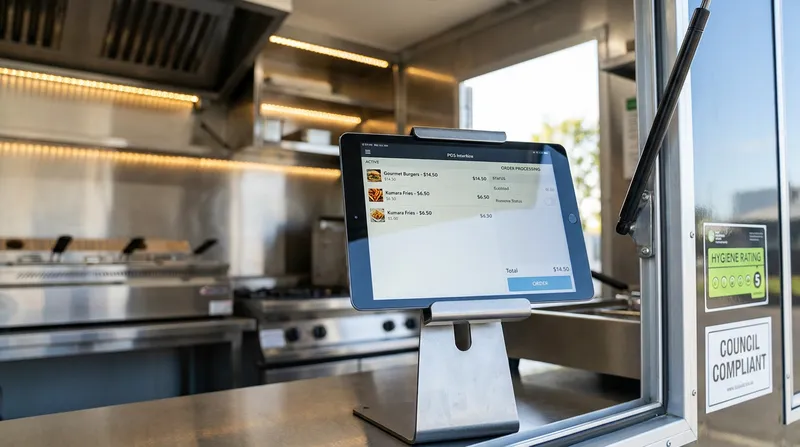
Once your food stall permit in NZ is approved, you need a reliable way to take payments. Food trucks face unique technology challenges compared to traditional restaurants. You are constantly moving, counter space is incredibly limited, and internet connections at remote festivals are notoriously unreliable.
Offline POS System & EFTPOS Integration
Nothing kills your revenue faster than an EFTPOS terminal that drops out during a massive lunch rush. Lazygrid POS offers a robust offline mode, allowing you to continue taking orders and processing cash sales even when the local cell tower is completely overloaded. Once your internet connection is restored, the system automatically syncs your data securely to the cloud.
Your POS must also integrate seamlessly with local payment providers to prevent manual entry errors. Lazygrid connects directly with EFTPOS NZ certified terminals. To ensure your numbers always match up at the end of the day, read our guide on POS Reconciliation NZ: Stop Till Errors with 2-Way EFTPOS. Furthermore, if you plan to pass on Paywave fees to your customers, you must comply with local Commerce Commission regulations. Learn more in our article on NZ Surcharge Rules 2026: How to Pass On Paywave Fees Legally.
Compact iPad Hardware & Pricing
Traditional, bulky cash registers do not work in a mobile setup. You need a cloud-based point-of-sale system that runs on an iPad or iPhone. Lazygrid allows you to use the Apple devices you already own, saving you thousands of dollars in upfront proprietary hardware costs.
Furthermore, our 'Lite' pricing plan at just $24 per month is specifically designed as the best option for solo operators and food trucks. If you are debating how to finance your new technology, our breakdown on Buy vs Lease POS Hardware NZ is a must-read.
Online Pre-Ordering, Kiosks & Loyalty
Want to reduce the massive queues outside your truck? Implement an online ordering system. Customers can scan a QR code taped to the side of your truck, place their order from their smartphone, and receive a text message when their food is ready for pickup. This frees up your staff to focus entirely on cooking rather than managing a chaotic line of waiting customers.
If you operate at recurring markets, Lazygrid's loyalty programme lets customers earn and redeem points whether they visit your truck or your main location. This is a powerful tool to turn one-time festival attendees into loyal, repeat customers.
Step 6: Expanding from a Brick-and-Mortar to a Mobile Setup
If you already own a restaurant or cafe, launching a mobile unit is a brilliant marketing strategy to expand your brand footprint. A food truck allows you to cater lucrative weddings, corporate events, and summer festivals without interrupting your main kitchen operations.
By using a unified system like Lazygrid POS, managing a new mobile location alongside your primary venue is incredibly simple. The multi-location management feature allows you to track sales from your brick-and-mortar store and your mobile pop-up on the exact same dashboard. You can transfer stock between locations, maintain consistent pricing, and manage staff seamlessly across both sites.
Conclusion
Learning how to start a food truck business in NZ requires patience, a tolerance for paperwork, and an incredible menu. By understanding the critical difference between your nationwide MPI food safety registration and your localized council mobile trading permits, you can easily avoid the most common regulatory traps that bankrupt new owners.
Remember to design your mobile operations around ultimate reliability. Secure a commercial kitchen for your daily prep work, carefully map out your target council districts, and invest in an offline-capable POS system that will never let you down during your busiest lunch hours. Be cautious of legacy POS providers that trap you in expensive contracts, which we cover in detail in our post about POS Lock-In: Why It's Costing NZ Businesses Thousands.
Ready to upgrade your mobile business technology? Start your free Lazygrid trial today and see how it fits your food truck setup.
Frequently Asked Questions
How much does a food truck licence cost in NZ?
The cost varies wildly depending on your local council. Food safety registration typically costs between $200 and $500 annually. However, mobile trading permits can cost anywhere from $150 for a temporary event permit to over $2000 for an annual premium location licence in major cities like Auckland or Wellington.
Do I need a Food Control Plan or a National Programme for my food truck?
It depends entirely on your menu. If you cook raw meat or prepare high-risk meals from scratch, you need a Food Control Plan. If you only sell pre-packaged items or hot drinks, you will likely fall under a National Programme. Always use the Ministry for Primary Industries My Food Rules tool to confirm.
Can I park my food truck anywhere in Auckland to sell food?
No. Auckland Council strictly regulates where mobile traders can park. You cannot block footpaths, you cannot park directly outside a competing restaurant, and you must hold a specific roaming or fixed-site permit for the exact public land you occupy.
What is the best offline POS system for food trucks in New Zealand?
Lazygrid POS is highly recommended for mobile vendors. It operates on compact iPad hardware, features a robust offline mode for remote areas with poor internet, and integrates directly with local EFTPOS NZ terminals without charging exorbitant third-party commissions.
Do I need a commercial kitchen to prep food for my NZ food truck?
In most cases, yes. Preparing high-risk food inside a cramped truck is often heavily restricted by local councils. You are typically required to prepare your raw ingredients in a registered commercial kitchen before loading them into your mobile unit for final cooking and service.