
NZ Food Control Plan Verification: Complete Audit Checklist
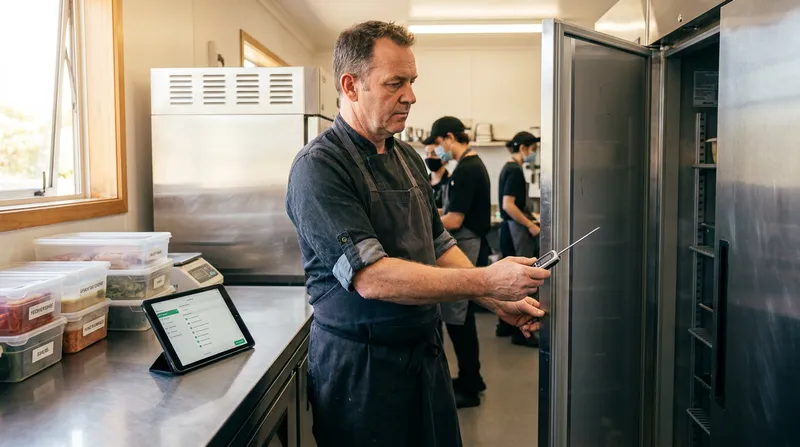
You run a spotless kitchen. Your benches gleam, your chillers hum at four degrees, and your team washes their hands constantly. Yet when your local council Environmental Health Officer (EHO) arrives for your NZ Food Control Plan verification, a wave of panic hits.
Many verification problems come down to incomplete records and staff knowledge gaps, not just cleanliness. When the verifier opens your folder, they might find three days of missing chiller logs, a recorded high temperature with zero notes explaining how you fixed it, or a junior barista who freezes when asked how to calibrate a probe thermometer.
Whether you run a bustling restaurant, a neighbourhood cafe, a mobile food truck, or a massage and beauty clinic serving refreshments to clients, passing your verification requires knowing exactly how the verifier grades your business. This complete audit checklist breaks down the official Ministry for Primary Industries (MPI) framework, gives you a mock interview cheat sheet for your staff, and shows you how to turn compliance into a fast, daily habit.
What is a Food Control Plan (FCP) under the Food Act 2014?
In New Zealand, the statutory Food Act 2014 replaced the outdated, one-size-fits-all Food Act 1981 with a risk-based sliding scale. Instead of regulating your business based solely on what your building looks like, the law regulates you based on the food safety risk of what you make and sell.

For most cafes, restaurants, caterers, and food trucks that prepare or cook higher-risk meals, the standard pathway is the MPI Simply Safe & Suitable Template Food Control Plan (tFCP). Because the rules in this template are pre-approved by MPI, you do not need to pay an independent evaluator to validate your plan from scratch. You simply tailor the relevant sections to your kitchen, register with your local council, and prove during verification that you follow what you ticked.
Important Regulatory Update: On 7 August 2026, MPI released new cards for the Simply Safe & Suitable Template Food Control Plan. The update now allows food service and retail operators to make and sell pre-cooked chilled meals and frozen meals directly to consumers under the standard template without needing an expensive Custom Food Control Plan.
How the Colour-Coded Simply Safe & Suitable Cards Work
When your verifier walks in, they will refer to your plan using MPI's official colour-coded card structure. According to MPI's Simply Safe & Suitable Template Food Control Plan, your plan is organised around your daily workflow:
- Dark Blue Cards (Setting up): Business details, layout plan, water supply, and management responsibilities.
- Blue Cards (Starting): Staff training logs, sickness policies, personal hygiene, cleaning schedules, and pest control.
- Green Cards (Preparing): Sourcing food, receiving deliveries, separating raw and ready-to-eat items, and allergen management.
- Magenta Cards (Making + Cooking): Proving temperatures for cooking poultry, cooling hot food safely, reheating, and sushi rice acidification.
- Orange Cards (Serving + Selling): Hot holding cabinets, cold displays, self-service buffets, packaging, and food recalls.
- Purple Cards (Closing): Chiller and freezer maintenance, waste removal, and end-of-day wrap-up.
- Red Card (When something goes wrong): Your master troubleshooting and corrective action guide.
Action Step: Check the bottom corner of your Simply Safe & Suitable folder today. If you are using an older version and you sell pre-packaged grab-and-go meals, download the latest cards (released August 2026) from MPI so your scope of operations matches your menu.
National Programme vs Food Control Plan: Rules for Cafes, Food Trucks, and Beauty/Massage Salons
Not every New Zealand business serving food or drinks needs a full Template Food Control Plan. Lower-risk businesses operate under MPI National Programmes (Levels 1, 2, or 3), while certain service businesses are completely exempt.
If you are unsure where your business sits on the sliding scale, you can run your operations through MPI's My Food Rules Tool. Here is how the rules apply to our specific business sectors:
1. Restaurants and Full-Service Cafes
- Your Tier: Template Food Control Plan (Simply Safe & Suitable).
- Why: You cook, cool, reheat, and prepare high-risk foods (meat, poultry, dairy, seafood, and cooked rice or pasta) for immediate consumption.
2. Mobile Food Trucks and Coffee Carts
- Your Tier: Template FCP (if cooking burgers, tacos, or hot meals) or National Programme Level 1/3 (if only making espresso coffee and selling pre-packaged, shelf-stable snacks or commercial ice blocks).
- The Multi-Council Trap: If your food truck only trades within one city (e.g., Wellington City), you register with that local council. However, if you drive your food truck to festivals and markets across multiple council boundaries, MPI's National Programme and FCP registration rules state that you must register as a multi-area business (or with your home base council while notifying host councils of your registration certificate). Along with sorting out your mobile compliance, make sure your truck is equipped for remote trading by reading our NZ Food Truck POS Hardware Guide: EFTPOS & Offline Rigs.
3. Massage Clinics, Beauty Salons, and Wellness Spas
Many massage therapists, day spas, and beauty salon owners worry about whether serving herbal tea, infused water, or a biscuit after a treatment triggers a council food audit.
- When You Are Exempt: Under the Food Act 2014's exemptions (check with MPI's My Food Rules tool or your council), if you provide complimentary refreshments (like herbal tea, coffee, water, or a pre-packaged biscuit) that are purely incidental to your primary service (a massage or facial) and you do not charge separately for the food, you are exempt from needing a registered FCP or National Programme, though your snacks must still be safe and hygienic.
- When You Must Register: If your wellness spa or beauty clinic starts retailing manufacturer-packaged chilled wellness tonics, raw slices, or health foods, you may fall under National Programme 1 or 2. If you open an in-house wellness cafe preparing fresh smoothies, acai bowls, or salads for sale, you will require a Template Food Control Plan.
How Often Will Your Business Be Verified (And What Does Failure Cost)?
New business owners are often caught off guard by how quickly their first audit arrives. According to Wellington City Council's verification guidelines, a brand-new food business must undergo its initial verification within 6 weeks of registration approval.
During this visit, the verifier will observe your kitchen and check your records. From there, your performance dictates both your public food grade and how often you have to pay for future audits:
- Acceptable Outcome (Performing Well): If you pass your initial verification and your subsequent 12-month verification with an 'Acceptable' outcome, you are rewarded by moving to an 18-month verification cycle.
- Unacceptable Outcome (Non-Compliance): If the verifier finds critical food safety risks or missing records, you receive an 'Unacceptable' outcome. Your next verification frequency drops to 3, 6, or 9 months until you prove sustained compliance.
The Hidden Financial Cost of Disorganised Records
Failing an audit or forcing a verifier to wait while you hunt for lost temperature sheets hits your bank account immediately. According to Auckland Council's food registration and verification fee schedule, a Template Food Control Plan verification starts at $816 (National Programme verifications start at $408-$612), plus the annual MPI Food Business Levy.
That base fee only covers a set allocation of verifier time. If your paperwork is messy, or if the EHO has to return for follow-up site visits to sign off on Corrective Action Requests (CARs), Auckland Council charges extra time at $204 per hour.
The 5 Official Criteria Verifiers Use to Grade Your Business
Global POS blogs often publish generic cleaning lists that ignore how New Zealand verifiers actually score you. As detailed in Auckland Council's Eatsafe grading framework, verifiers assess your business across five specific criteria to determine your food grade:
- A Grade (91% to 100%): Excellent.
- B Grade (61% to 90%): Good.
- C Grade (50% to 60%): Satisfactory.
- D Grade: An issue likely to make food unsafe has been found and corrective actions are required.
- E Grade: A critical food safety issue requiring temporary closure.
Use this 5-pillar self-audit checklist 14 days before your scheduled verification to give yourself the best shot at an 'A' grade.
Pillar 1: Confidence in Management
Verifiers want proof that the day-to-day manager actively enforces the plan, rather than shoving it in a drawer until audit week.
- Your tailored Simply Safe & Suitable plan is onsite (in print or digital format) and updated to reflect your current menu.
- Every section you do not use is clearly crossed out or removed so the verifier does not audit you on processes you don't perform.
- Every time a fridge temperature spiked or a piece of equipment broke, you recorded a Corrective Action on the Red Card log explaining what you did with the food and how you prevented a repeat.
- You have completed an internal self-check and traced a mock supplier recall within the last 12 months.
Pillar 2: Food Safety Behaviour
This covers how your staff behave when handling food and whether they can answer questions without the owner prompting them.
- Every staff member (including part-time weekend dishwashers and front-of-house servers) has a signed training record in the Blue Cards matching the tasks they perform.
- Dedicated handwashing basins have warm running water, liquid soap, and single-use paper towels (never tea towels) at all times.
- Staff know the exact exclusion rule for vomiting or diarrhoea: they must stay away from work until they have been symptom-free for 48 hours.
- Cuts and grazes on hands are covered with bright, waterproof dressings and single-use gloves.
Pillar 3: Process Control
Process control is where the EHO checks your critical numbers, cooking records, and allergen safety.
- Your probe thermometer has been calibrated in iced water (0°C +/- 1°C) and boiling water (100°C +/- 1°C) every 12 months, with the date and reading written down.
- Daily chiller temperatures are recorded for every unit containing high-risk food.
- Delivery check logs show you check the temperature of chilled deliveries (5°C or colder) from new suppliers.
- Ready-to-eat foods stored in the chiller for more than 24 hours are clearly date-labelled with a 'use-by' or 'made-on' sticker.
- Staff can immediately access accurate allergen matrices for every item on the menu.
Pillar 4: Environmental Control
This assesses your physical premises, pest exclusion, and cleaning standards.
- Hard-to-reach grease traps, chiller door seals (gaskets), ice machine interiors, and can opener blades are completely free of mould or food build-up.
- Your sanitiser spray bottles are labelled with the chemical name, are food-safe, and staff know the required contact time (e.g., 30 seconds vs 5 minutes) and dilution ratio.
- Raw meats are stored on the bottom shelves of the walk-in chiller below ready-to-eat foods and fresh produce.
- Pest control bait stations are mapped, checked regularly, and insect screens or external doors have no gaps larger than a pencil width.
Pillar 5: Compliance History
Your track record from previous council inspections.
- Any Corrective Action Requests (CARs) or recommendations noted in your previous verification report have been permanently resolved, with photo and log evidence ready to show the officer.
Critical NZ Temperature Control Rules (Print This for Your Kitchen Wall)
If a staff member writes down a chiller temperature of 8.5°C on Tuesday morning and leaves the 'Corrective Action' column blank, you will lose marks during your verification. Make sure your team memorises these exact Simply Safe & Suitable temperature limits:
| Process Step | Official NZ Requirement | What to Do When Something Goes Wrong (Red Card) |
|---|---|---|
| Chilled Storage | Keep food between 0°C and 5°C. (Wait 10 minutes and re-test if the door was just opened during prep). | If food has been above 5°C for less than 4 hours, move it to a working chiller or use it immediately. If more than 4 hours (or time unknown), throw it out. |
| Frozen Storage | Keep food frozen hard (typically -18°C or colder). | If food is still partially frozen (ice crystals present) or at 5°C or below, you can move it to a chiller and use it within 24 hours. Do not refreeze thawed high-risk food. |
| Cooking Poultry & Mince | Cook to at least 75°C for 30 seconds (or 70°C for 2 minutes, or 65°C for 10 minutes) in the thickest part. | Continue cooking until the core temperature and time combination is met, and log the final reading. |
| Cooling Hot Food | Cool from 60°C to 21°C within 2 hours, then from 21°C to 5°C within a further 4 hours (6 hours total). | Divide into shallow pans, stir in an ice bath, or use a blast chiller. If it fails to reach 5°C within 6 hours, discard the batch. |
| Reheating | Reheat rapidly to 75°C or hotter inside 2 hours (only reheat once). | Keep heating until it reaches 75°C. Never use a bain-marie or hot-holding cabinet to heat cold food from scratch. |
| Hot Holding | Keep hot food at 60°C or hotter in pie warmers or bain-maries. | If food drops below 60°C, either reheat it to 75°C immediately (once only) or throw it out if it has been below 60°C for more than 2 hours. |
The 'Mock Audit' Cheat Sheet: 5 Questions Verifiers Ask Junior Staff
Environmental Health Officers rarely direct all their questions at the owner. Instead, while walking through the kitchen or coffee station, they will casually ask a junior chef or barista a question to test Food Safety Behaviour. Run a five-minute huddle before your audit and make sure every team member can answer these five questions:
- "Can you show me how you sanitise this prep bench?"
- Correct Answer: First, scrape away food debris and wash the surface with warm soapy water (detergent) to remove grease. Second, spray the food-safe sanitiser on the clean bench and leave it for the required contact time written on the bottle before wiping with a clean paper towel or air drying.
- "How do you use this probe thermometer between checking raw chicken and cooked chicken?"
- Correct Answer: Wipe away any food residue and sanitise the metal probe with an alcohol wipe or food-safe sanitiser before and after every use so we never cross-contaminate cooked food.
- "What do you do if a customer says they have a severe peanut or gluten allergy?"
- Correct Answer: Check the current allergen chart (or ask the head chef to check packaging labels), inform the kitchen clearly on the order ticket, wash hands, and use separate clean utensils, chopping boards, and pans to prevent cross-contact.
- "What happens if you wake up with vomiting or diarrhoea before your morning shift?"
- Correct Answer: Phone the manager immediately, do not come into work, and do not return to food handling until at least 48 hours after the last symptom has stopped.
- "Where are the food safety records kept if the manager isn't here?"
- Correct Answer: Every staff member must be able to point directly to the Simply Safe & Suitable binder or open the digital records on the counter iPad.
Paper vs Digital Food Control Plans: Eliminating 'Diary Catch-Up' Panic
One of the most common myths in New Zealand hospitality is that you must keep a physical, printed paper binder on a shelf to pass a council inspection. In fact, both the MPI National Programme guidance and MPI's Simply Safe & Suitable Template Food Control Plan explicitly confirm that you do not need to print the plan or records if you use an electronic version, provided staff can access it at all times and your records are kept safe for at least 4 years.
When you rely on paper clipboards in a busy kitchen, sheets get splashed with oil, pens go missing, and chefs fall into the trap of filling out an entire week's worth of temperature numbers on Sunday night. Experienced verifiers spot 'bulk-filled' diaries in seconds (identical pen ink, identical handwriting slant, and identical 4.0°C numbers every day).
Connecting Compliance to Your Daily POS Workflows
If you already run your counter on an iPad using One Connected POS System for Your Business | Lazygrid POS NZ, you already have the hardware needed to keep your kitchen organised and audit-ready without extra clutter:
- Eliminate Allergen Miscommunication: Green Card allergen errors happen when servers scribble unreadable notes on paper pads. With Lazygrid's Kitchen Display System (KDS) and Direct to Kitchen Routing: Kiosks, KDS & Printers in NZ, allergen warnings and order modifications are highlighted clearly on the kitchen display, and orders can be routed to the right kitchen printer (see our comparison of Epson vs Xprinter: Best NZ POS Receipt Printers (2026)).
- Empower Customers to Flag Allergies Directly: Whether customers order at a counter Self-Service Kiosk (which includes built-in allergen information displays), scan table QR codes using our QR Table Ordering for NZ Cafes: Complete POS Setup Guide, or pre-order takeaway via one of the Best Online Ordering Systems for NZ Restaurants (2026), customer-entered notes and allergy flags flow straight to the kitchen, reducing the miscommunication that comes with handwritten tickets.
- Tighter Stock and Waste Tracking: Spoiled ingredients hurt both your verification score and your bottom line. Lazygrid's real-time Inventory Management tracks stock levels, low-stock alerts and waste, helping you spot over-ordering and spoilage (ingredient-level recipe tracking is available on the Premium plan). Learn more in our guide on Theoretical vs Actual Food Cost: Closing the Variance Gap.
- Staff Accountability: Using Lazygrid's Staff Management sub-accounts and built-in time clock, you know exactly which team members are on shift to complete opening and closing checks, while keeping front-of-house service moving fast (see our NZ Hospo Guide: Boost Table Turnover Without Rushing Guests).
- Seamless Appointments for Service Venues: For massage clinics, beauty salons, and restaurants, Lazygrid's Booking/Reservation System (with Reserve with Google integration on the Premium plan) lets you store special client notes and preferences alongside their profile so your team knows exactly what to prepare before the guest walks through the door.
If you are currently weighing up your technology stack, compare how a local New Zealand system supports your daily workflow in our guide to the Best Lightspeed POS Alternatives in NZ: Top Systems for Hospitality & Service Businesses, or browse more operational guides on the Lazygrid Blog.
Frequently Asked Questions (NZ Food Control Plan Verification)
What is the difference between a Template Food Control Plan and a National Programme in NZ?
A Template Food Control Plan (tFCP) is for higher-risk food businesses like restaurants, cafes, and caterers that cook, cool, and prepare high-risk foods. National Programmes (Levels 1, 2, and 3) are for lower-risk food businesses, such as those selling only shelf-stable pre-packaged food, espresso coffee, or scooping commercial ice cream, and require less intensive daily record-keeping.
Do food trucks and beauty or massage salons need a Food Control Plan in New Zealand?
Food trucks that cook or prepare high-risk foods (like burgers, tacos, or hot meals) require a Template Food Control Plan, while coffee carts serving only espresso and pre-packaged shelf-stable snacks usually fall under a National Programme. If a food truck operates across multiple city or district council boundaries, it must register as a multi-area business. Beauty salons, massage clinics, and wellness spas that serve complimentary herbal tea, coffee, or biscuits purely incidental to a paid treatment are exempt under the Food Act 2014's exemptions (check with MPI's My Food Rules tool or your council), provided they do not charge separately for the food or retail chilled food products.
How soon after registering a new food business in NZ will my first verification happen?
Under the Food Act 2014, a newly registered food business must have its initial verification within 6 weeks of registration approval. Make sure you begin recording daily chiller temperatures, cleaning logs, and staff training records from your very first day of trading.
What happens if I fail my council Food Control Plan verification?
If critical non-compliances are found, you will receive an 'Unacceptable' verification outcome and be issued Corrective Action Requests (CARs) with strict deadlines to fix the issues. Your verification interval will be shortened to 3, 6, or 9 months, you may receive a 'D' or 'E' food grade in councils that use Eatsafe grading, and you will be billed hourly verifier rates (such as $204/hour in Auckland) for follow-up inspections.
What is the difference between a technical non-compliance and a critical non-compliance during an audit?
A technical non-compliance is a minor gap in documentation or housekeeping that does not pose an immediate threat to consumer health, such as forgetting to cross out an unused card in your Simply Safe & Suitable binder. A critical non-compliance poses a serious, direct risk to food safety, such as storing high-risk food above 5°C for more than 4 hours, having no warm water or soap at the handwashing basin, or failing to separate raw chicken from ready-to-eat food. A critical non-compliance typically triggers an 'Unacceptable' outcome, a downgraded council food grade, and mandatory follow-up audits.
How long do I have to fix a Corrective Action Request (CAR) after a council inspection?
Your verifier will set a deadline for each Corrective Action Request based on its severity; serious food safety issues must be fixed immediately. Failing to close a CAR before the agreed deadline can result in extra hourly verifier charges and enforcement action.
What are the exact temperature rules for chillers, freezers, cooking, and cooling in NZ?
Under MPI's Simply Safe & Suitable rules, chilled high-risk food must be stored between 0°C and 5°C, and frozen food must be kept frozen hard (around -18°C). Poultry, minced meat, and sausages must be cooked to an internal core temperature of 75°C for at least 30 seconds (or 70°C for 2 minutes, or 65°C for 10 minutes). Cooked hot food must be cooled from 60°C to 21°C within 2 hours, and from 21°C down to 5°C within a further 4 hours. Hot-held food in cabinets or bain-maries must stay at 60°C or above.
How do I calibrate a kitchen probe thermometer for an MPI verification?
You must check your probe thermometer every 12 months using both the ice-point and boiling-point methods and write the results in your plan. For the cold check, fill a glass with crushed ice and a little cold water, stir, wait 2 minutes, and insert the probe without touching the sides; it must read between -1°C and +1°C. For the hot check, place the probe into briskly boiling water; it must read between 99°C and 101°C. If the probe is outside those limits and cannot be adjusted, replace it immediately.
How long do I need to keep Food Control Plan temperature and cleaning records?
Under MPI regulations, you must retain all Food Control Plan and National Programme records (including daily temperature logs, delivery checks, probe calibrations, and corrective action notes) for at least 4 years, and they must be readily accessible during any verification.
Can I use a digital Food Control Plan instead of the printed MPI Simply Safe and Suitable folder?
Yes. MPI legally permits food businesses to use electronic PDF plans or digital compliance apps on an iPad or tablet instead of a paper binder, provided all staff on shift know how to access the plan and records can be shown to the verifier immediately.
What changed in the August 2026 MPI Simply Safe & Suitable update?
In August 2026, the Ministry for Primary Industries released new cards for the Simply Safe & Suitable Template Food Control Plan. The update expanded the template's scope so that registered cafes, restaurants, and food retailers can now cook, chill, package, and sell pre-cooked chilled meals and frozen meals directly to consumers without needing to apply for an expensive Custom Food Control Plan.
Conclusion: Make Audit Readiness an Everyday Habit
Passing your Food Control Plan verification in NZ with an 'A' grade does not require a chaotic, midnight cleaning marathon the night before your Environmental Health Officer arrives. When you align your daily kitchen habits with MPI's five verification criteria, write down every corrective action when a temperature fluctuates, and train your junior staff on the five core spot-check questions, verification day becomes a stress-free formality.
Ready to replace counter clutter and manual admin with a faster, smarter setup? Explore Lazygrid POS NZ to see how our iPad POS, Kitchen Display System, real-time inventory tracking, and integrated booking tools help New Zealand cafes, restaurants, food trucks, and service businesses run smoothly every single shift.